

Thanks to the James Webb Space Telescope’s (JWST) high sensitivity in the infrared range, astronomers are able to lift the veil over the most distant regions of the cosmos and look back to the first billion years after the Big Bang. During large-scale deep-space surveys, the observatory’s instruments detected remarkable structures that scientists have called “Little Red Dots,” or LRDs. Since 2024, researchers have found more than 300 such objects. They look exactly as their name suggests: tiny, faint objects with a distinctly pronounced red hue in the telescope’s images.
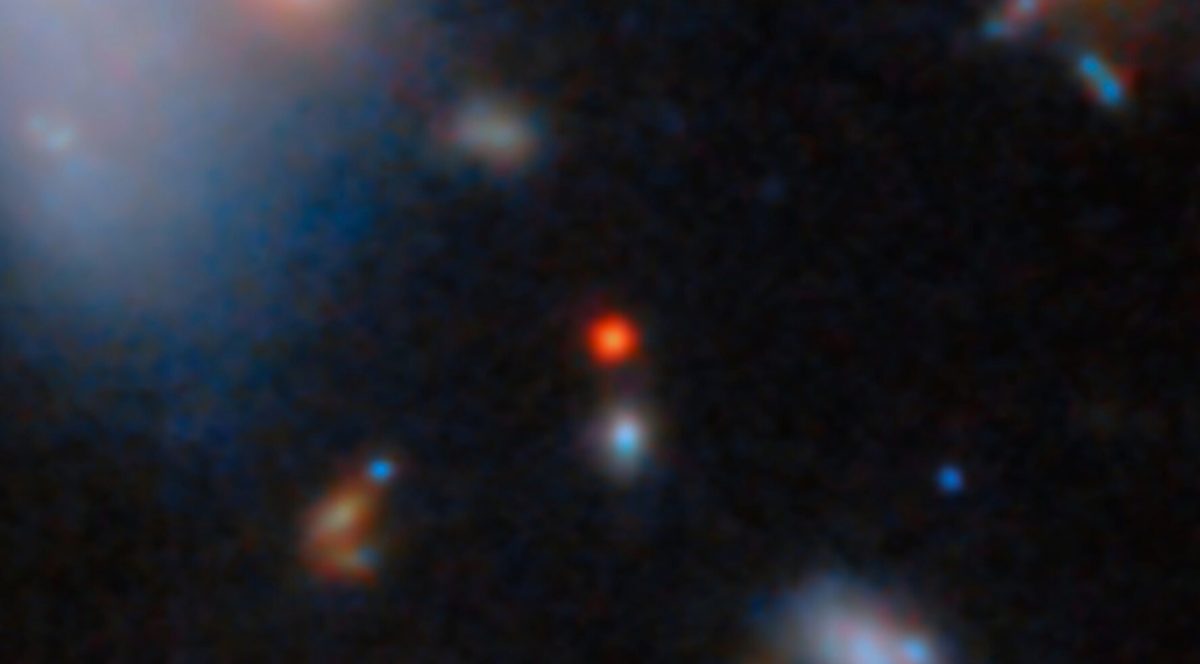
Analysis of the light from LRDs indicates that they existed during the cosmic period from 0.6 to 1.6 billion years after the birth of the Universe—the initial era of formation of the first galactic systems. However, their true nature remains one of the most intriguing mysteries of modern astrophysics, which researchers around the world are working to solve.
Hypotheses of Origin
Scientists are considering several hypotheses that could explain the nature of the Little Red Dots. According to the leading theory, LRDs are embryonic galactic structures with extraordinarily bright cores. Their characteristics resemble those of active galactic nuclei, or AGNs, whose enormous energy is generated by supermassive black holes. However, this theory raises a difficult question for astronomers: if LRDs truly contained supermassive black holes at such an early stage in the history of the Universe, this would contradict classical ideas about the rate of their growth, because the formation of such objects requires a long time.
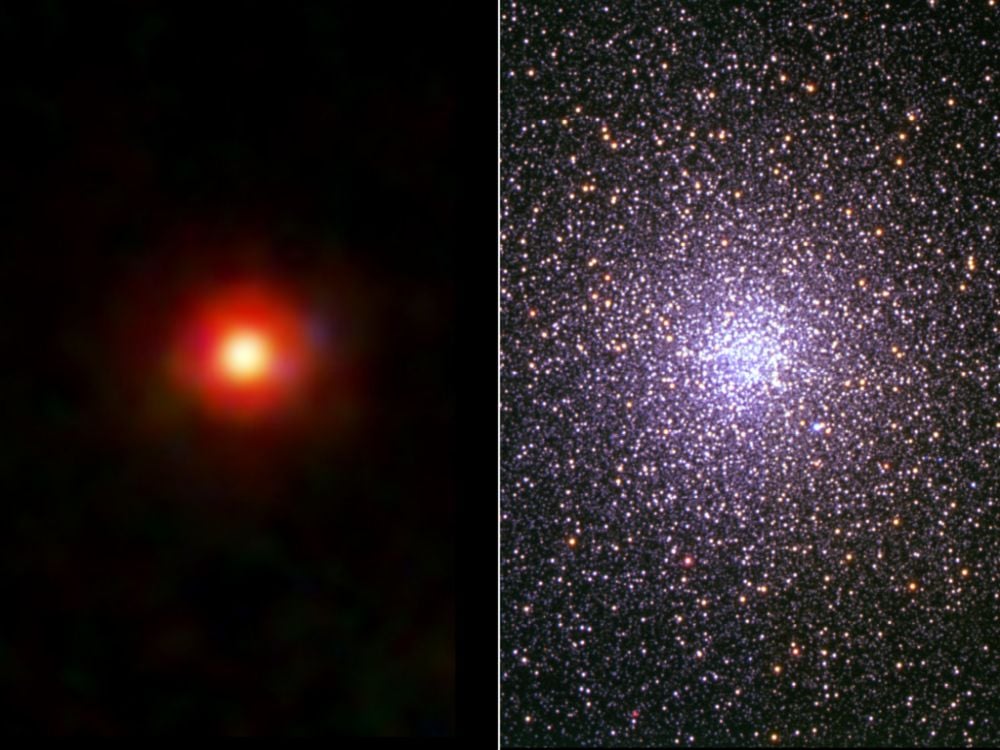
An alternative hypothesis suggests that the “dots” may not be galaxies, but individual supermassive primordial stars whose mass exceeds that of the Sun by hundreds of thousands or even a million times. Scientists suggest that JWST may have detected these cosmic giants during the final stages of their lives before supernova explosions. As a result of such explosions, the first heavy chemical elements would have been scattered into space, while the explosions themselves would have produced primordial stellar-mass black holes. Later, because of the high density of the surrounding environment, these black holes could have merged with one another, forming even more massive objects.
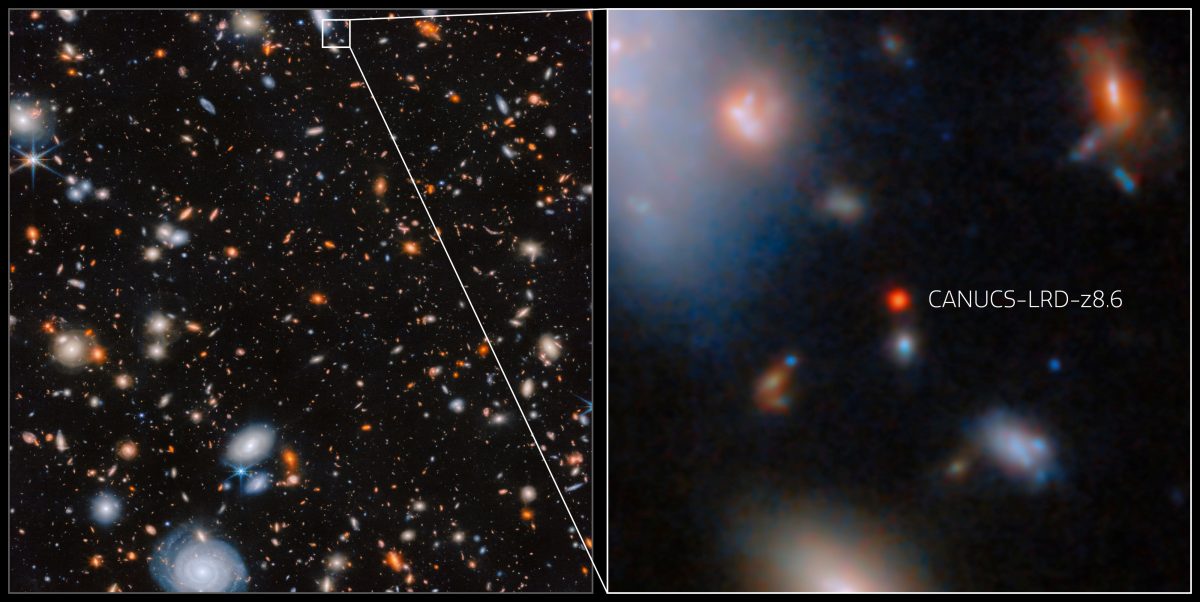
Other theories consider the possibility that LRDs are ancient, dense globular clusters containing supermassive stars, or black holes wrapped in thick cocoons of ionized gas and dust.
A “Seed” of a Cosmic Monster Caught in the Act
A key breakthrough in understanding the evolution of these sources was made by an international team of astronomers led by Dutch researcher Karina Caputi. Using JWST instruments, the scientists managed to detect a unique object that is probably an LRD at the very beginning of its formation. The object was named Pseudo-LRD-NOM. It is a compact starburst galaxy located at an astonishing distance of approximately 12 billion light-years and is at an early stage of development—no more than 10 million years old.
Such a distant and faint object could be observed thanks to the effect of gravitational lensing: the massive Abell 370 galaxy cluster, located between us and the galaxy, acted as a giant cosmic lens and amplified its light.
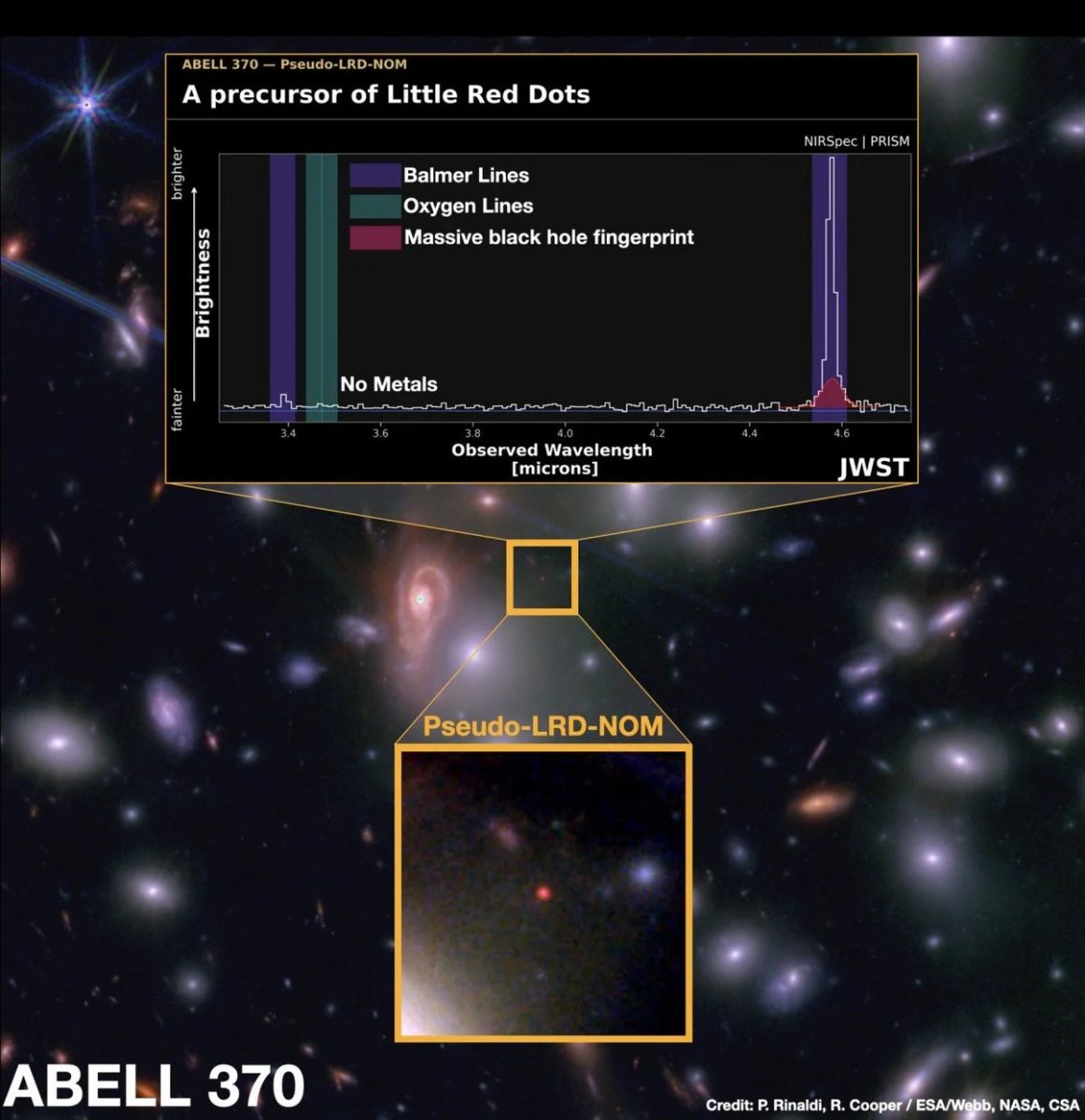
The analysis showed that Pseudo-LRD-NOM is almost metal-poor, meaning that it consists mainly of primordial hydrogen and helium. However, the object demonstrates an exceptionally high rate of new-star formation. JWST data indicate that an active black hole is already operating at the center of the galaxy and may have formed even before the onset of widespread star formation. The intense process of stellar birth directs new amounts of gas toward the center, feeding and accelerating the growth of the black hole.
Scientific Implications of the Discovery
For the research team, Pseudo-LRD-NOM became a remarkable discovery. Unlike most other distant galaxies, its spectrum contains almost no spectral lines of metals. This is an extremely rare phenomenon for actively star-forming objects, because massive stars enrich their surrounding environment with heavier elements very quickly.
The discovery of this “seed” is a fundamental step toward uncovering the mystery of the origin of the Little Red Dots. It provides direct evidence of an active black hole inside a dense, dusty galaxy undergoing active formation.
Determining the nature of LRDs gives scientists an opportunity to understand how modern galaxies such as our Milky Way were built. These objects serve as the primordial building blocks of the Universe, preserving a chemical “memory” of the earliest generations of stars. By observing their evolution and the birth and death of the first stellar giants, astronomers are able to trace the chemical evolution of the cosmos. In addition, further spectroscopic observations with JWST will help determine exactly how the first black holes formed and what role they played in the development of the Universe.
Nevertheless, the Little Red Dots of the early Universe still remain a mystery to scientists.
According to universetoday.com