

Two years after Europe sent a spacecraft to investigate the aftermath of humanity’s first deliberate collision in space, the Hera mission is approaching its final destination. The European Space Agency (ESA) has released the first close-up image of the Didymos asteroid system, taken from a distance of approximately 60 km.
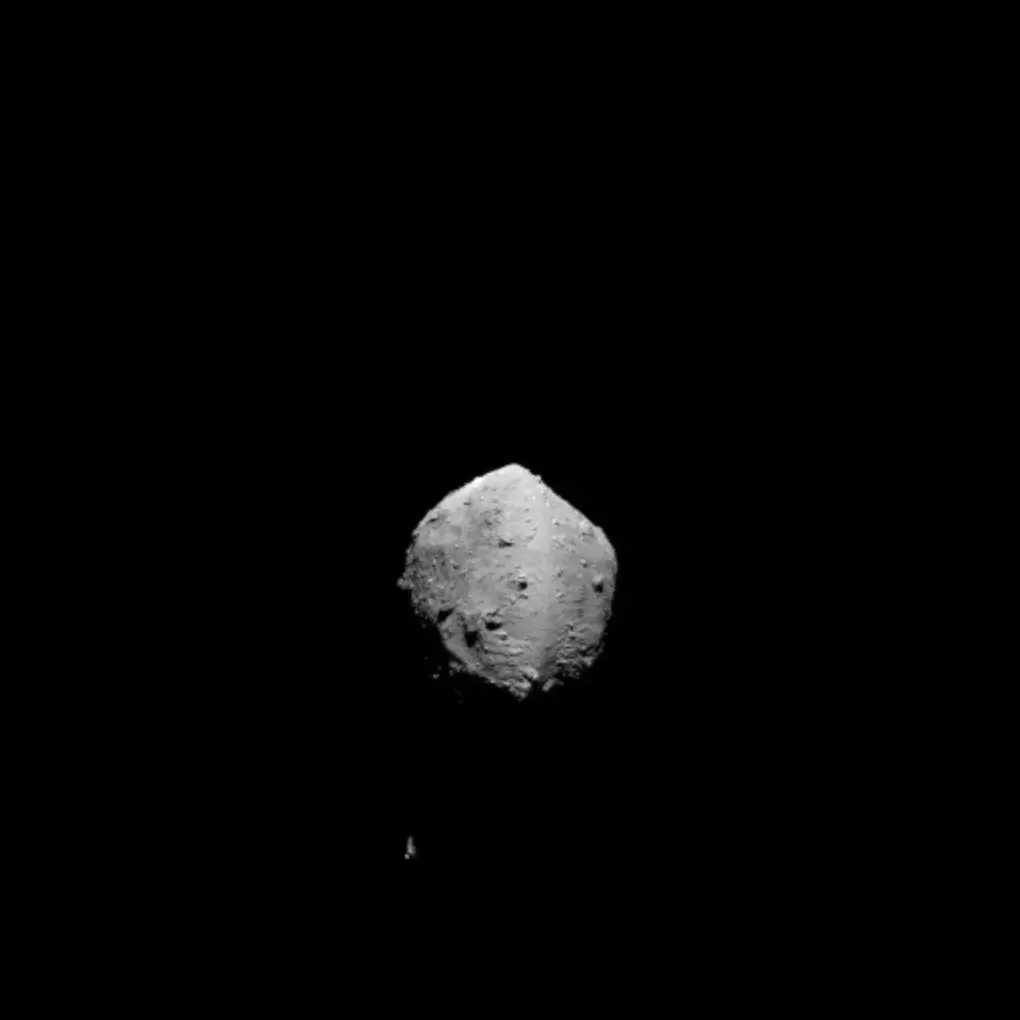
The black-and-white photograph shows the far side of Didymos, which NASA’s DART probe never had a chance to see before crashing at full speed into its smaller moon, Dimorphos. According to the science team, the asteroid looks entirely different from this angle, and some of its terrain may have formed as a result of the powerful impact.
As Hera principal investigator Patrick Michel noted, the team’s first reaction was an exclamation of excitement: “It feels as though we are looking at an entirely new world.”
The Aftermath of a Space Crash
In September 2022, NASA carried out the large-scale DART (Double Asteroid Redirection Test) experiment, directing a 570-kilogram spacecraft at Dimorphos, a 170-metre-wide moon orbiting the 800-metre-wide asteroid Didymos.
Ground-based observations confirmed the mission’s success: Dimorphos’s orbital period decreased from 11 hours and 55 minutes to 11 hours and 23 minutes. However, scientists needed a close-up inspection to assess the consequences in detail and determine whether this technique could serve as a reliable method of protecting Earth from asteroid threats.
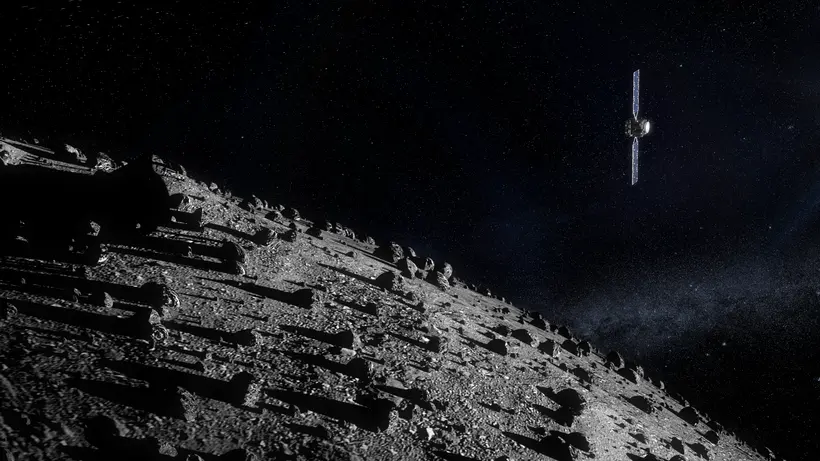
Launched on October 7, 2024, Hera became a natural follow-up to the American mission. After a two-year journey through the Solar System, the spacecraft is preparing to begin full operations.
New Details and Signs of Destruction
The new image shows Didymos’s central equatorial ridge, which had been observed previously. However, the rest of the surface has proved considerably more varied. Scientists have identified numerous boulders, craters and patterns resembling troughs or grooves.
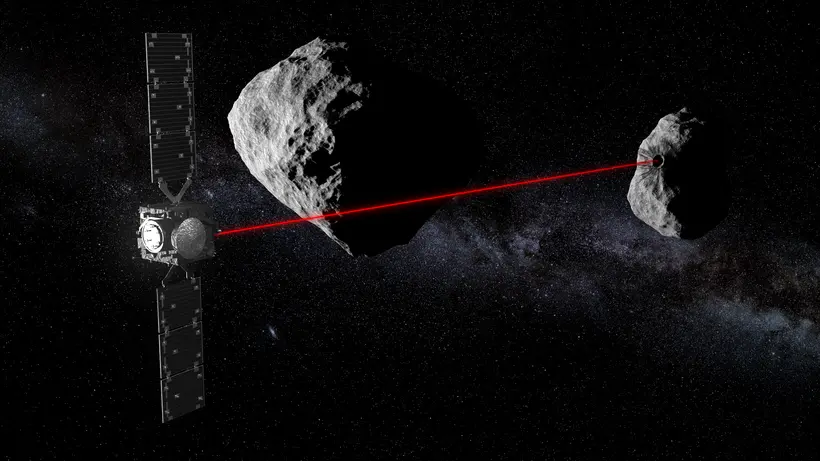
The researchers suggest that these surface features formed when shattered debris from Dimorphos travelled across the 1 km of space separating the two bodies and fell onto Didymos’s surface. Dimorphos itself also appears in the frame, but currently looks like a tiny sliver near the bottom of the image.
Hera will study both objects at close range for at least six months. As mission scientist Michael Küppers emphasised, the team faces painstaking work to systematically map all the changes it identifies.
We previously reported on what you need to know about the Hera mission.
Based on information from ESA.
