

The youngest known white dwarf paired with a millisecond pulsar is probably still surrounded by a cloud of residual material, and such clouds could cause young pulsars to be misclassified. The system was found in the globular cluster NGC 362. Mass transfer from the white dwarf to the pulsar ended relatively recently, and the dwarf itself has not yet begun to cool. Evidence for the cloud comes from its ultraviolet brightness, which is lower than models predict.
The Youngest Known Companion
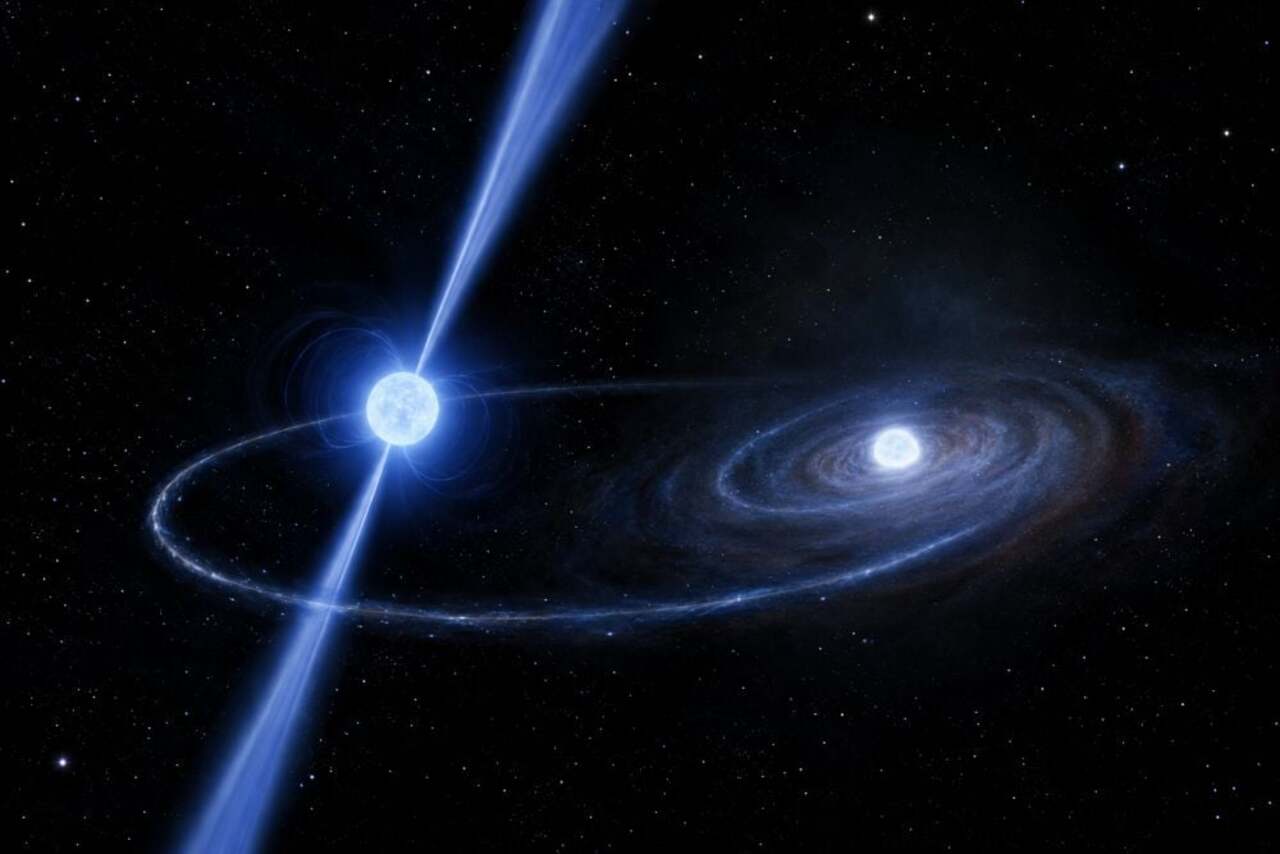
Millisecond pulsars are spun up in binary systems. Gas from the companion star falls tangentially onto the neutron star, increasing its rotation rate, while the companion is eventually stripped down to its exposed core—a helium white dwarf.
A team led by University of Bologna doctoral student Greta Ettorre identified such a white dwarf beside the pulsar NGC 362D in Hubble Space Telescope images and published its findings in the peer-reviewed journal Astronomy & Astrophysics. Its colour and brightness match a model of a helium white dwarf with a mass of 0.18 solar masses, in which hydrogen is still burning at the base of the envelope. Its surface is still heating up and has a temperature of approximately 13,000 kelvin. It will begin cooling in about 180 million years.
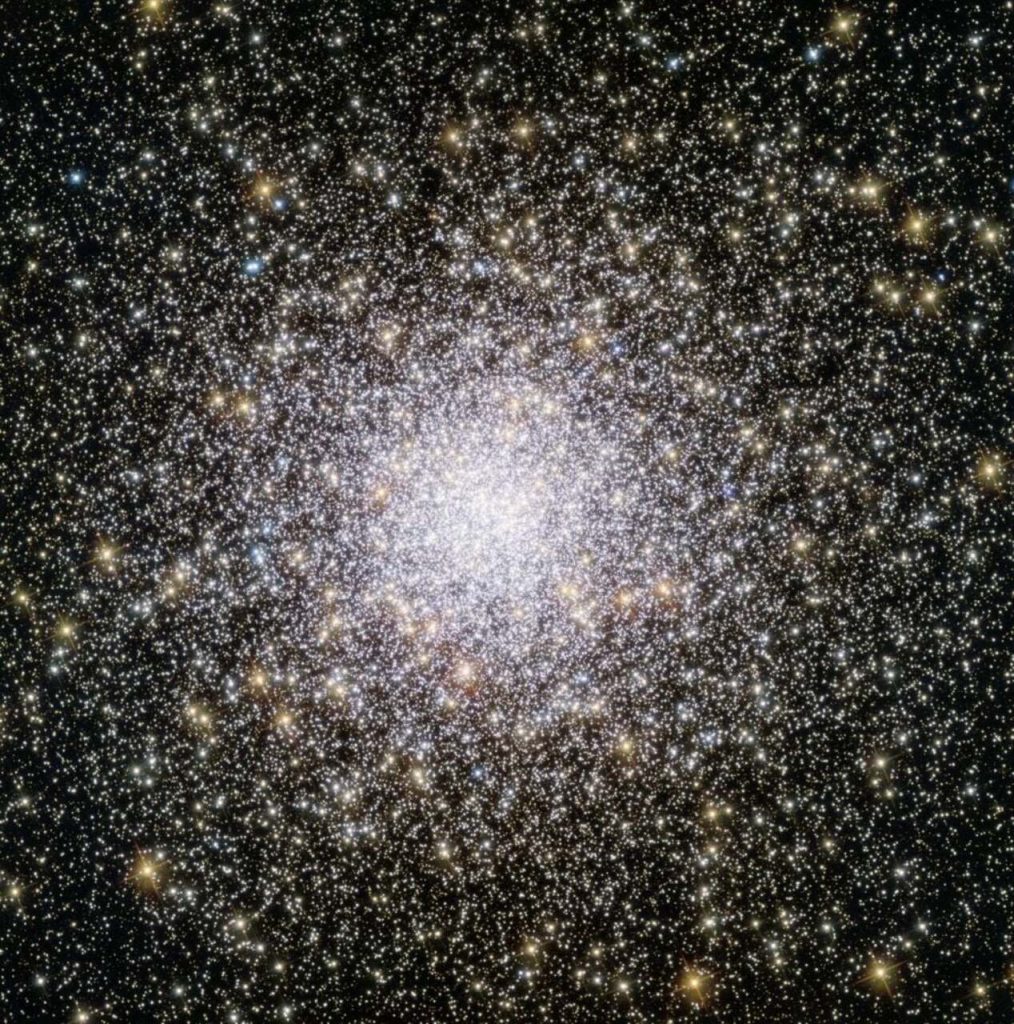
According to the models, mass transfer in this system ended between 600 and 700 million years ago, and no younger companion to a millisecond pulsar has yet been found. That is less than three of the Sun’s orbits around the centre of the Galaxy, whereas most stars in globular clusters are more than ten billion years old. The circular orbit supports this age estimate, since neighbouring stars in the cluster have not yet had time to perturb it.
According to the authors, the stage immediately after a pulsar is spun up has rarely been observed. As Universe Today reports, Emanuele Dalessandro of the Italian National Institute for Astrophysics describes the system as a unique opportunity to study this stage.
The animation shows how gas from a companion star spins up an old pulsar to millisecond rotation periods. Source: NASA
A Deficit of Ultraviolet Radiation
The shorter the wavelength, the more the white dwarf’s colour deviates from the model. In the near-ultraviolet, it is approximately half as bright as expected. Fifteen ordinary white dwarfs in the cluster show no such discrepancy, indicating that image processing is not responsible.
The most likely explanation is that the white dwarf is surrounded by a cloud of material. Small dust grains absorb and scatter short-wavelength radiation more strongly than red light, so the greatest losses occur in the ultraviolet. The origin of this cloud remains unknown.
The Risk of Misclassification
The pulsar PSR J1816+4510 in our Galaxy has similar characteristics. Because of its radio eclipses, it was initially classified as a redback—a binary in which the pulsar’s wind strips material from a low-mass star, and that material periodically blocks the radio signal. Spectra later revealed a young white dwarf in the system.
The authors believe that residual material can produce redback-like signatures, potentially leading to the misclassification of young pulsars with white dwarf companions. NGC 362D shows no eclipses, probably because the material is distributed in clumps or is too diffuse.
Spectra of the relatively bright companion could help test the cloud hypothesis. Narrow metal lines would indicate residual material, while variations in radial velocity would refine the masses of both bodies.
