

Neutrinos may reveal information about the places where they were born. Those places may be stars preparing to explode as supernovae. Moreover, by analyzing these ghostly particles, which have no electric charge and almost no mass, scientists may be able to determine whether the star that produced them will become a black hole or a neutron star.
The Role of Neutrinos in Stellar Evolution
When a massive star finally exhausts its fuel reserves and the nuclear reactions that cause it to expand cease, its core collapses under its own weight. The extremely high temperature and pressure created by this collapse compress protons and electrons, forming neutrons. This, in turn, causes the release of an enormous number of ghostly particles known as neutrinos. And, as Space.com reports, they may reveal a great deal about the object that produced them.
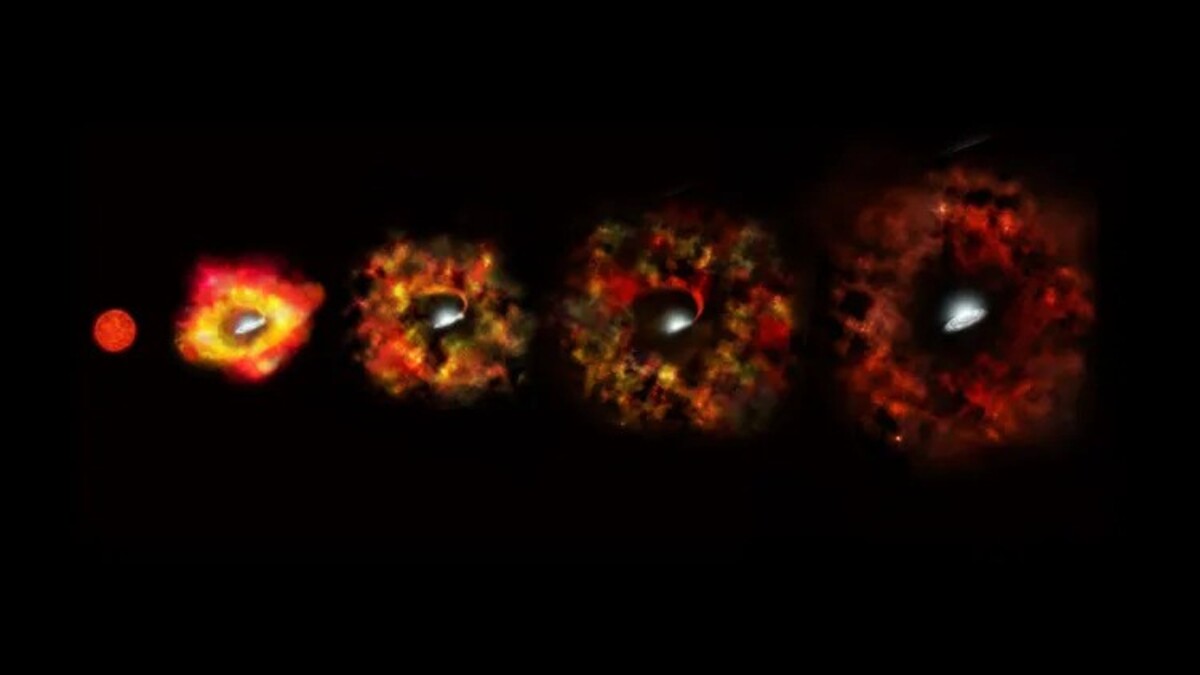
Normally, neutrinos interact only very weakly with any form of matter. However, when the core of a massive star collapses, it emits an astonishing number of neutrinos — enough for a significant fraction of them to collide with the layers just outside the core and heat them. In some cases, this neutrino heating can cause the rest of the star’s mass to explode as a supernova, leaving behind an extremely dense concentration of neutrons known as a neutron star. In other cases, neutrino heating fails to trigger an explosion, and the star collapses into a black hole.
“Neutrinos are not a secondary detail in supernovae,” said study co-author Mariam Gogilashvili, an astrophysicist at the Niels Bohr Institute at the University of Copenhagen in Denmark. “They carry away about 99% of the energy released during core collapse, and even a small change in their behavior can determine the fate of the entire star.”
The Three “Flavors” of Neutrinos
Much remains unknown about which massive stars explode and give rise to neutron stars, and which collapse to form black holes. Understanding these details could help scientists better explain a wide range of cosmic processes, including how dying stars enriched the Universe with the matter that now makes up everything from planets to people.
To gain insight into these mysteries, scientists investigated the role that the unusual nature of neutrinos may play. There are three “flavors” of neutrinos — electron, muon, and tau neutrinos — named after the type of particle produced when each interacts with matter. In 1998, physicists discovered that neutrinos can “oscillate,” meaning they can transform from one flavor into another — a discovery recognized with the 2015 Nobel Prize in Physics. There are also three corresponding flavors of antineutrinos, which can likewise change flavor.
Both muon and tau neutrinos, as well as their antineutrinos, interact with ordinary matter much less frequently than electron neutrinos and antineutrinos. This suggests that neutrino flavor transformation could potentially affect how effectively neutrinos heat matter inside a dying star and trigger an explosion.
How Do Neutrinos Change “Flavor” Inside a Stellar Core?
Scientists previously believed that flavor transformation would play only a minor role in the collapse of dying stars. Over the past decade, however, physicists have discovered that because dying stars generate such enormous numbers of neutrinos, the particles can become so concentrated that they begin interacting with one another. This causes neutrino flavor transformations inside the collapsing stellar core.
In the new study, scientists modeled the collapse of 195 stars with masses ranging from nine to 120 times that of the Sun. They analyzed different assumptions about where exactly neutrino flavor transformations occur inside collapsing stellar cores.
The researchers found that neutrino flavor changes can significantly reduce the likelihood that dying massive stars will explode as supernovae. They also found that the resulting neutron stars may have lower masses than previously predicted by theoretical models.
“Ghost Particles” May Help Solve Astrophysical Mysteries
These new findings could help solve several long-standing mysteries. For example, astronomers have observed fewer supernovae than theoretical calculations predict, and neutrino flavor transformation may help explain this discrepancy, Gogilashvili noted. Flavor changes may also help explain why the largest red supergiants disappear without producing supernova explosions — perhaps they simply collapse directly into black holes.
In addition, the scientists calculated that neutrino flavor transformation may lead to the formation of lower-mass neutron stars.
In the future, researchers plan to incorporate more realistic models of neutrino behavior into three-dimensional computer simulations of massive stars, allowing neutrino flavor transformations to begin and evolve over time as the stars approach collapse.
