

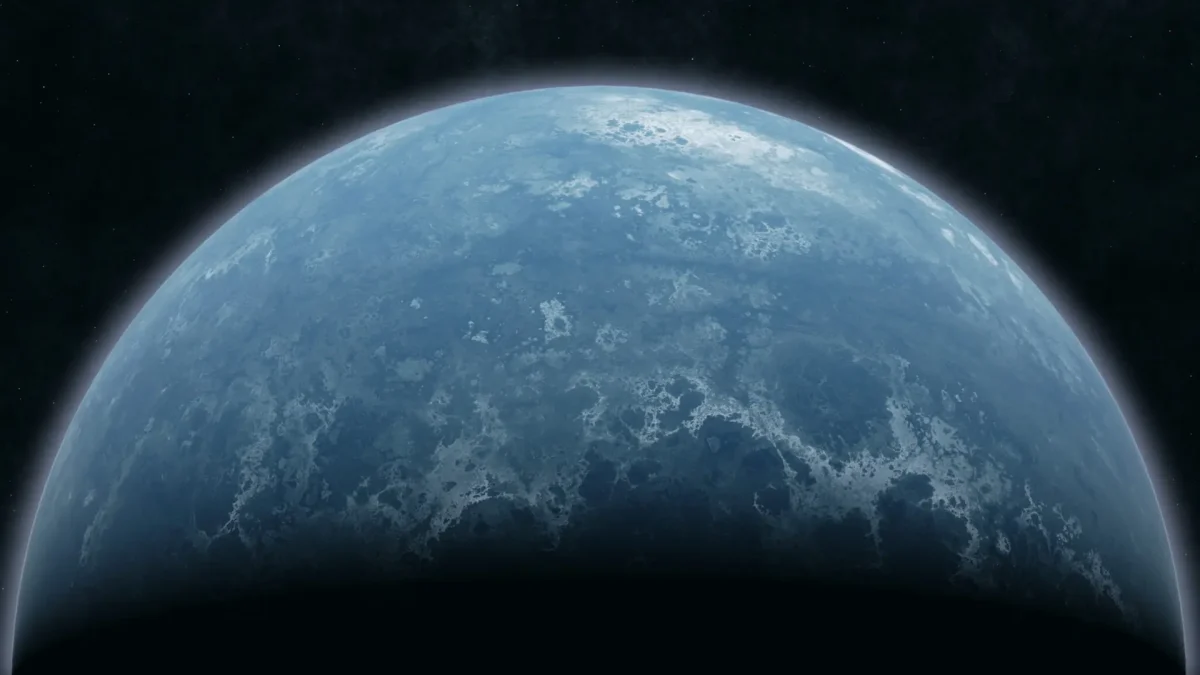
Astronomers have created a computer model of Earth that deliberately excludes any influence from living organisms. The virtual planet’s atmosphere contains no oxygen or methane, which are sustained by the biosphere on the real Earth. The model suggests that oceans and a temperate climate can persist for billions of years without life, so their presence alone does not prove that a distant planet is inhabited.
Comparison with the Real Earth
The model traces the planet’s evolution from 50 million to 5 billion years after its formation. The properties of the virtual Earth at an age of 4.5 billion years were compared with 19 measured characteristics of preindustrial Earth, ranging from atmospheric carbon dioxide levels to magnetic field strength. This reference state was chosen because human activity has already altered the modern climate.
Seventeen values fell within the margins of uncertainty, while ocean acidity and dissolved CO₂ levels fell slightly outside them. The results were published in the peer-reviewed journal The Planetary Science Journal.
A Natural Climate Regulator
The model is based on VPLanet, software developed in the laboratory of University of Washington astronomer Rory Barnes, according to Interesting Engineering. Surface and atmospheric components were added as part of Samantha Gilbert-Janizek’s doctoral research.
The carbonate–silicate cycle regulates the model’s climate. Volcanoes release carbon dioxide, while rainwater containing dissolved CO₂ slowly breaks down rocks. During weathering, the gas becomes bound in carbonates, which settle on the ocean floor and descend into the mantle along with tectonic plates. As temperatures rise, weathering accelerates. More CO₂ is removed from the atmosphere, weakening the greenhouse effect. In colder conditions, weathering slows, allowing volcanic gas to accumulate and warm the surface again.

Over 4.5 billion years, the Sun became approximately 30% brighter, yet the average surface temperature remained between 12 and 24 degrees Celsius. The authors conclude that life itself may not be necessary for long-term habitability. This finding argues against the strong version of the Gaia hypothesis, introduced by James Lovelock and Lynn Margulis in the 1970s, which holds that living organisms maintain Earth’s favorable climate.
A Young Earth Without Life
Initially, the atmospheric partial pressure of carbon dioxide reached about one bar—approximately 3,500 times the preindustrial value of 28 pascals. The ocean was most acidic during the first billion years, when its pH fell to around 6.6. This means it was approximately 30 times more acidic than the modern ocean, whose pH is about 8.1.

Without life, Earth would likely have had a colder past than geological evidence indicates for the real planet. The young Sun shone less brightly, and the model contains no methane from microorganisms, which may have compensated for the lack of warmth on the real Earth.
A Spectrum Without Oxygen
Using NASA’s future Habitable Worlds Observatory, astronomers will search for Earth-like planets and assess their atmospheres through reflected light. The authors calculated reflected-light spectra for both the real Earth and its biosphere-free model. The former shows absorption bands from oxygen, ozone, and methane, while the latter contains only those of water vapor and carbon dioxide.
Atmospheric composition, rather than water and climate alone, will therefore help distinguish an inhabited planet from a merely habitable one. The simultaneous presence of oxygen and methane remains a more compelling sign, because these gases react with one another and would disappear without constant replenishment.
The authors identify calculations for planets orbiting stars on the Habitable Worlds Observatory’s target list as their next step. First, they will need to improve how clouds are represented. Clouds are currently modeled in a simplified way, so the correct temperature was achieved with only 8% cloud cover, compared with approximately 67% on the real Earth.
