

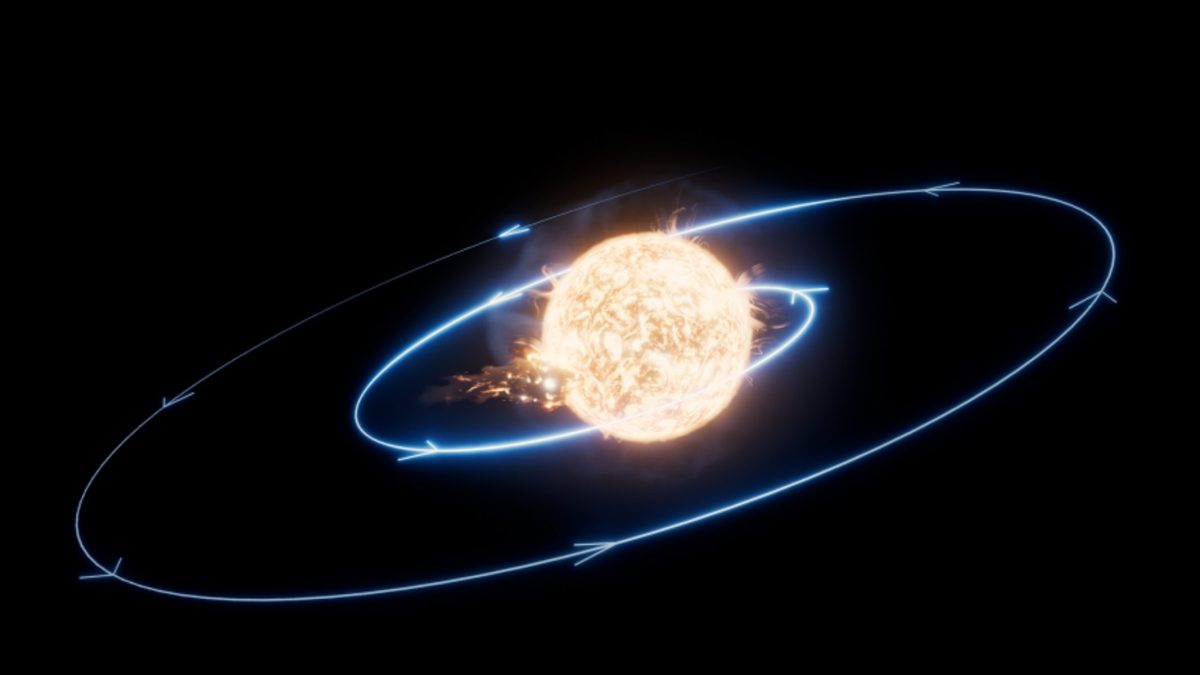
The young Sun likely swallowed a planet several times more massive than Earth. Such an event should have left a chemical trace deep inside our star, and it may still be detectable today. One hypothesis explains two long-standing discrepancies between solar models and observations at once.
What Did Not Match in the Models
The Sun’s internal structure is studied through oscillations of its surface. Sound waves travel through the star’s interior and return, and their behavior allows scientists to reconstruct the temperature, density, and speed of sound at different depths. The precision of such measurements is extremely high.
Standard stellar evolution models have still not been able to reproduce these data completely. The largest discrepancy concerned the speed of sound just below the convective zone — the outer layer where matter is actively mixed — as well as the depth of this layer. Lithium remained another puzzle, because there is far less of it on the solar surface than calculations predict.
The Hypothesis of a Falling Planet
Professor Mutlu Yıldız of Ege University in Turkey proposed that both anomalies may have a common origin in the Sun’s early chemical history. Young stars are surrounded by protoplanetary disks, whose gas has a different composition from the material of already formed planets. Therefore, the fall of a fully formed body onto a star changes its chemistry differently from the simple accretion of gas from the disk.
The author carried out the calculations using the MESA stellar evolution code. He tested various accretion scenarios and compared the results with data on surface oscillations and the chemical composition of the outer layers, while also examining alternative explanations involving the equation of state, matter opacity, and different descriptions of mixing. As reported by the Royal Astronomical Society, the observations are best described by a scenario in which a super-Earth with a mass of 5 to 10 Earth masses fell into the young Sun. The findings were published in the peer-reviewed journal Monthly Notices of the Royal Astronomical Society.
The model reveals another detail. A body of such mass would pass through the star’s outer layers while losing very little material, allowing its matter to sink deep into the interior. As a result, the chemical imprint could remain detectable even billions of years after the event itself.
Why the Solar System Looks Exceptional
There are no super-Earths — planets several times more massive than Earth — in our Solar System. At the same time, a 2016 study by Rebecca Martin and Mario Livio noted that more than half of nearby Sun-like stars have at least one such planet. The entire region inside Mercury’s orbit is also empty.
The same researchers proposed a possible mechanism. Super-Earths may have formed in the inner regions of the disk and depleted the solid material there, after which their orbits gradually migrated inward toward the Sun.
It is not the star’s gravitational attraction itself that shrinks the orbit, but the gas surrounding the planet. The body exchanges angular momentum with the gas, loses part of it, and slowly moves inward. That study only demonstrated that such a pathway was possible; it did not claim that the planets actually fell into the Sun.
How This Can Be Tested
For now, it is impossible to prove that such engulfment actually occurred. Mutlu Yıldız emphasizes that confidence would require an independent detection of the predicted structural and chemical signature. Searching for this signature will be the next step.
The hypothesis can only be tested on the Sun, because it is the only star whose interior can be probed in such detail. For other stars, scientists are limited to surface chemistry, which preserves evidence of such events much less effectively.
