

In a recent study of infrared light collected by the James Webb Space Telescope, a group of astronomers detected ice around the young star Beta Pictoris for the first time. It turned out to be mostly non-crystalline and mixed with carbon dioxide. This indicates frequent collisions.
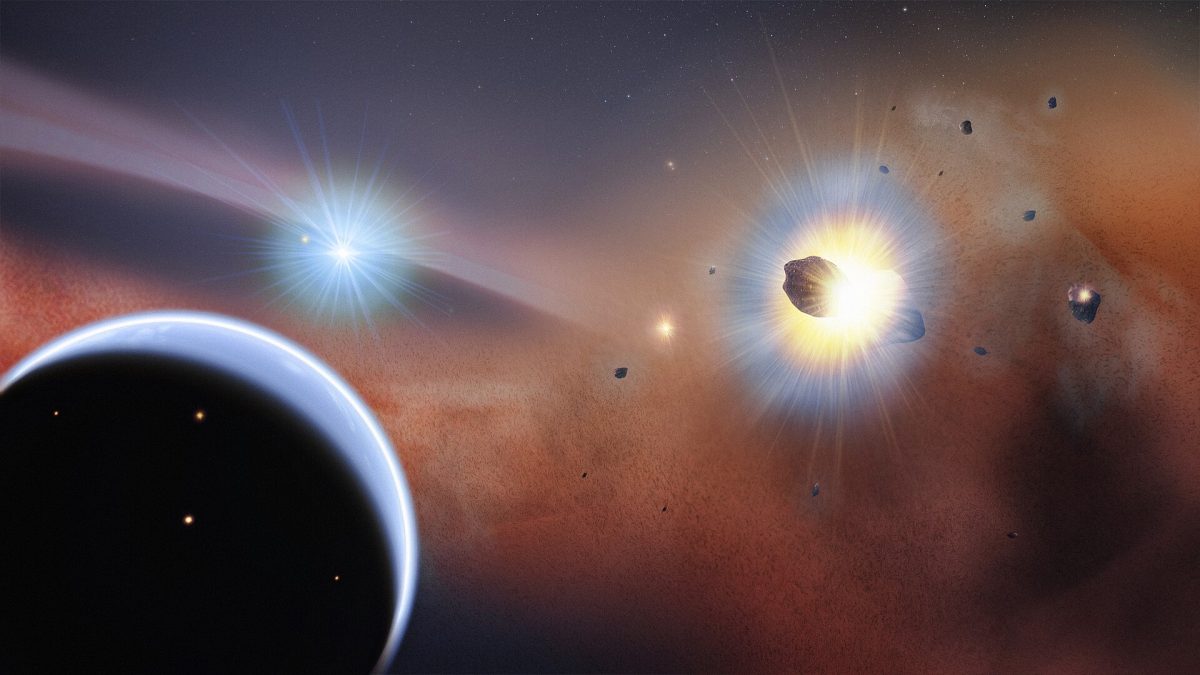
Carbon monoxide in a dusty disk
Beta Pictoris is a star approximately 20 million years old, located about 64 light-years from us. It is surrounded by a dusty disk containing planets and smaller bodies. Although 20 million years may not seem particularly young, our Solar System has existed for about 4.6 billion years. Therefore, the Beta Pictoris system is still stabilizing and forming smaller bodies within its dusty disk. As reported by Phys.org, astronomers have discovered three larger planets in the system, one of which was found earlier this year.
Previous observations of Beta Pictoris revealed gaseous carbon monoxide, even though sunlight should destroy it within approximately 50–300 years, which is a short period on a cosmic scale. Researchers say that the presence of this substance may indicate that it was recently released through collisions between solid icy bodies, possibly comets or volatile-rich planetesimals. However, no previous studies had found evidence of ice. This was understandable in the case of pure ice. Models showed that pure ice grains would quickly disappear under such conditions in the disk, but ice mixed with other materials could survive for longer.
Infrared observations reveal ice
In the new study, astronomers used the James Webb Space Telescope’s Near-Infrared Spectrograph (NIRSpec) to map the disk and analyze the reflected starlight from opposite sides. The new analysis directly revealed, for the first time, signs of water ice and solid carbon dioxide in the Beta Pictoris debris disk. The water ice turned out to be mostly amorphous, meaning that its molecules do not have an ordered crystalline structure. The team calculated that less than 7% of the ice’s volume could consist of crystalline water ice.
The spectra also showed that carbon dioxide was contained within the water ice, at a ratio of approximately one carbon dioxide molecule for every 10 water molecules. Although the researchers acknowledge that other mixtures are possible, the carbon dioxide-to-water ratio matches other spectral observations of the system. Therefore, scientists suggest that a CO₂-H₂O mixture is probably the dominant configuration of CO₂ ice, with the CO₂ ice embedded in an H₂O-rich environment within the Beta Pictoris disk.
Frequent collisions in the dusty disk and amorphous ice
The new observations of ice around Beta Pictoris show that it resembles the ice found in comets in our Solar System and in young protoplanetary disks. This indicates that the processes involved in the formation of cosmic bodies are similar everywhere.
The authors of the study write: “Both crystalline and amorphous H₂O ice have been observed in the Solar System. If H₂O ice condensed in an amorphous form during the early stages of star formation, then, in order to remain amorphous, it must have stayed below ~100 K or undergone processes that destroy the crystalline lattice, such as photolysis by high-energy photons, radiolysis by galactic cosmic rays, or sputtering by energetic stellar wind ions. In the outer regions of the disk, primordial amorphous H₂O ice may be widespread due to these effects.”
This means that the ice may have originated in cold interstellar material or during the earliest stages of the star’s formation. Some of it was then likely incorporated into icy planetesimals, which protected it from crystallization. The team also notes that the ice signatures turned out to be fairly uniform throughout the disk, which most likely means that they result from frequent collisions between these icy bodies across the disk, rather than from a single recent explosion.
The authors of the study argue that impact velocities during the early stage of the debris disk would have been insufficient to crystallize water ice. Therefore, ongoing collisions between icy bodies are likely occurring at low impact velocities, keeping the water ice in an amorphous state. The anomalous carbon monoxide detected in an earlier study may also be explained by this process. Frequent collisions likely supply fresh carbon monoxide, as it is continuously destroyed by the star’s radiation.
The study may also help scientists understand the icy components of our own Solar System. In future research, comparing debris disks in systems of different ages could reveal how ice changes as planetary systems mature.
