

Scientists have studied the star-forming region G40.282−0.219, which contains several distinct dense clumps. In one of them, they discovered as many as three protostars. All three have different masses and are at different stages of formation.
Studying star-forming regions
As reported by Phys.org, astronomers using the ALMA radio telescope array in Chile discovered three dense cores at different stages of evolution within the massive star-forming region G40.282−0.219. The findings shed light on the physical and chemical differences between cores within a single large dense cluster.
In recent years, observations using the Atacama Large Millimeter/submillimeter Array (ALMA) have shown that massive dense clumps often consist of numerous smaller dense cores. These dense cores are located close to one another but differ in mass, evolutionary stage, and physical and chemical properties.
Previously, low-resolution observations could only capture the general properties of massive dense clumps, without distinguishing individual dense cores or determining their physical and chemical properties and evolutionary stages.
Using ALMA data, the researchers identified three dense cores in the massive star-forming region G40.282−0.219 and analyzed their physical and chemical properties, as well as their relative evolutionary stages, from different perspectives.
Three dense stellar cores in an evolutionary sequence
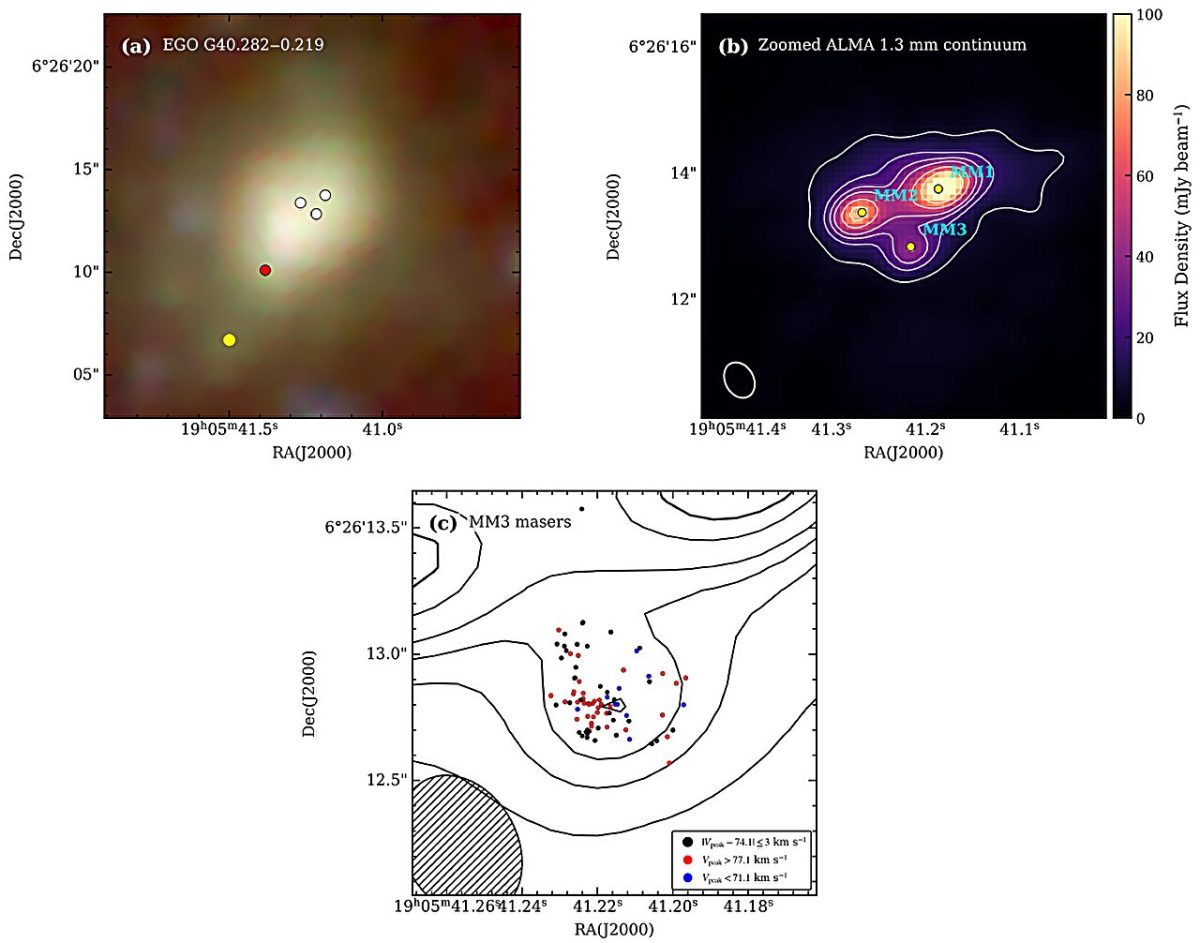
G40.282−0.219 is located approximately 3.4 kiloparsecs from Earth, and previous low-resolution observations showed that it is a massive young stellar object. Using ALMA data obtained at a wavelength of 1.3 mm, the team resolved it into three dense cores located within a single parent cloud: MM1, MM2, and MM3.
The study showed that MM1 has the greatest mass — approximately 24.6 solar masses — but the smallest number of detected molecular spectral lines. No associated outflows or masers were detected.
MM2 has a mass of approximately 8.4 solar masses and produces a powerful outflow, with its silicon monoxide (SiO) jet reaching a velocity of about 25 km/s.
MM3 has the lowest mass, approximately 5.2 solar masses, but at the same time has the highest dust temperature and the most diverse molecular composition. It also contains a 6.7 GHz Class II methanol maser. Therefore, an evolutionary sequence exists in G40.282−0.219, extending from the youngest core, MM1, to the most evolved one, MM3.
According to the researchers, the results show that only a comprehensive approach that takes several factors into account — such as mass, density, temperature, and other physical properties; the presence or absence of outflows and jets; the richness of molecular spectral lines; and the types of masers detected — makes it possible to determine more accurately the evolutionary stages of dense cores in regions where massive stars form.
