

Powerful orbital observatories such as the James Webb Space Telescope (JWST) allow astronomers to peer deep into the past and see galaxies that formed at the dawn of time. However, to fill in the gaps in the history of the early Universe, scientists need not only telescopes but also highly sophisticated computer models. An international team of researchers has presented just such a project — an unprecedentedly detailed simulation called Lumina, the results of which were published in the journal Monthly Notices of the Royal Astronomical Society.
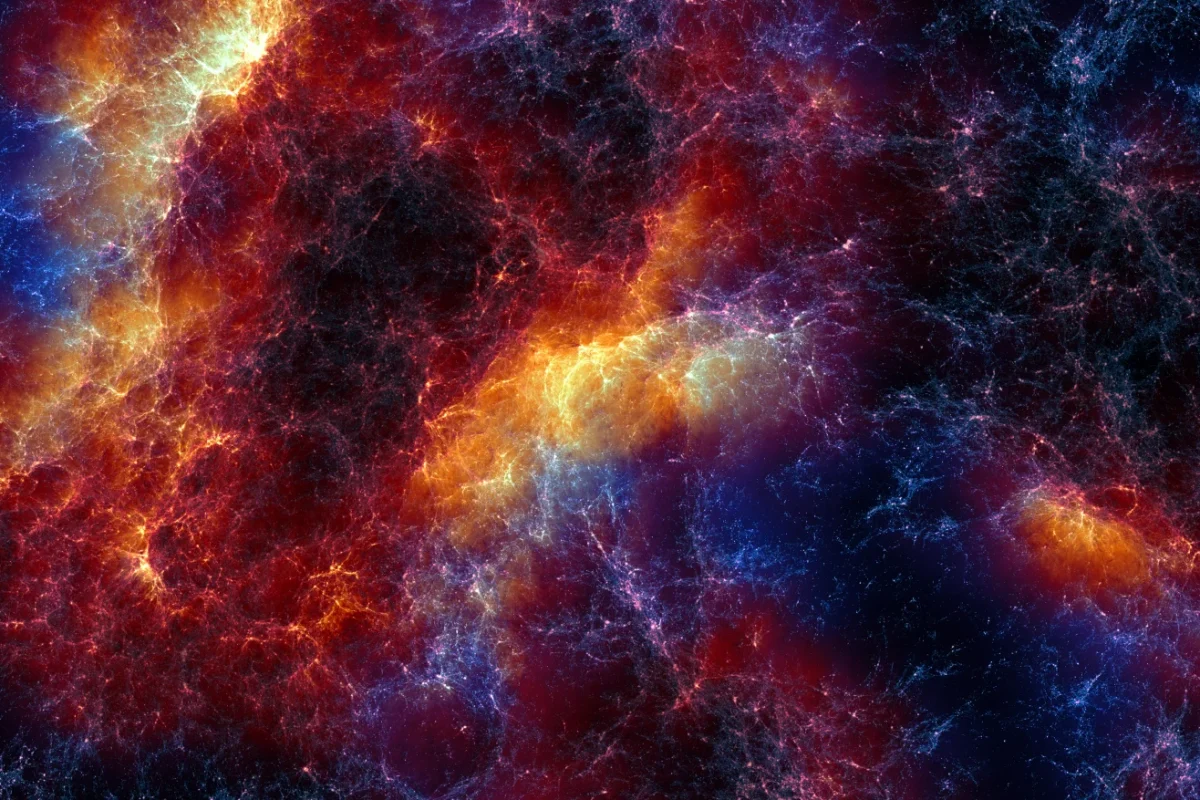
The main feature of Lumina is its enormous volume, which is more than 100 times larger than that of all previous comparable models. The virtual cube of space extends approximately 1.5 billion light-years in each direction. For comparison, the diameter of our Milky Way is about 100,000 light-years.
According to the research leader, Oliver Tsir of the Harvard & Smithsonian Center for Astrophysics, the model makes it possible to observe both the global “cosmic web” of galaxy clusters and the structures of individual stellar systems at the same time.
Three years of computing
Creating such a detailed digital twin of the Universe required enormous computational resources. Work on the model lasted almost three years using the Frontier supercomputer at Oak Ridge National Laboratory in the United States, where more than 15,000 graphics processing units (GPUs) were employed.
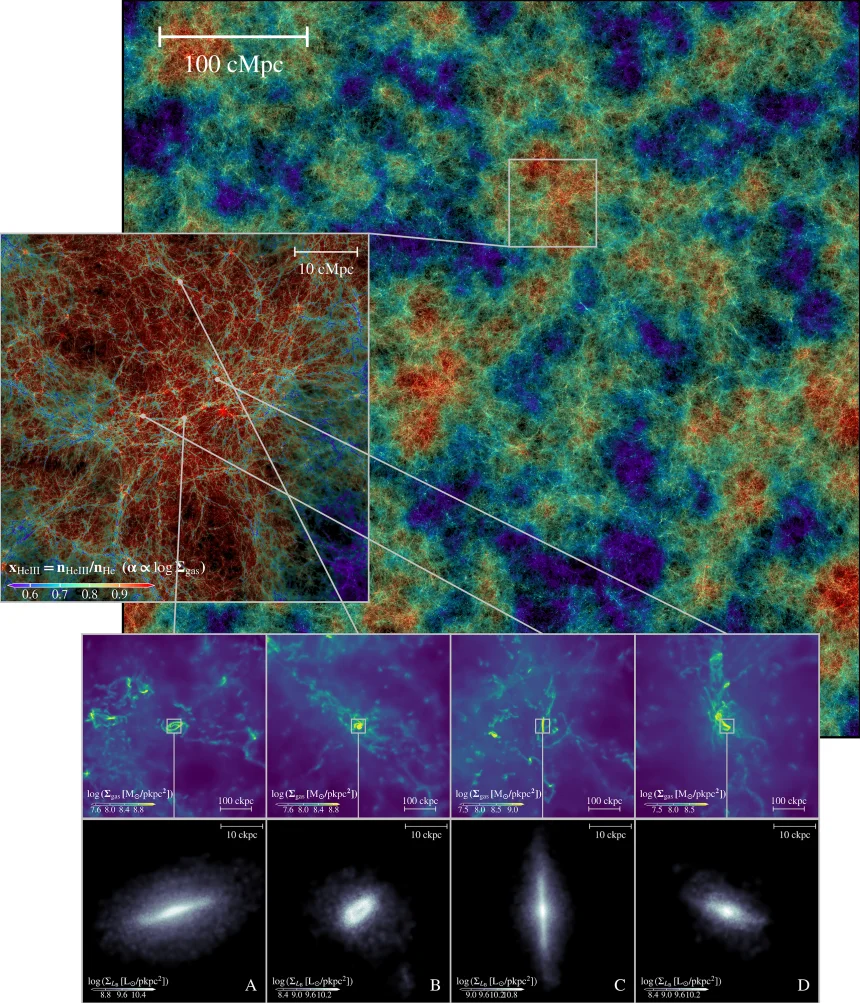
Although the simulation itself has not yet been made publicly available, the published visualizations are impressive because of their contrast in scale: the camera can zoom in on an individual galaxy and then, in an instant, pull back to show just how tiny it is in the ocean of space. As Oliver Tsir notes, despite its enormous size, the Lumina model covers only a small fraction of the actual Universe.
The epoch of reionization
The project focuses on the first 2 billion years after the Big Bang, when the epoch of reionization took place. During this transformative period, ultraviolet radiation from the first stars and black holes knocked electrons out of hydrogen atoms — the most abundant element in the Universe. This made the Universe transparent to light and fundamentally changed the process of galaxy formation. Lumina became the first model to track the transformation of two key elements of the early Universe — hydrogen and helium — within a single simulation.
Astronomer Julian Muñoz of the University of Texas at Austin calls the work an impressive technical breakthrough. Since the early Universe evolved unevenly, only a model of this scale makes it possible to trace how different regions changed at different rates. In addition, the simulation helps scientists study cosmic patterns millions of light-years across that are invisible to telescopes and arose from differences in the motion of dark and ordinary matter under the influence of radiation.
The practical value of Lumina lies in testing fundamental theories. By comparing the model’s data with JWST observations, physicists will be able to search for rare galaxies and test their ideas about the structure of the Universe. Moreover, discrepancies between the virtual and real Universe interest scientists even more than similarities, because these may point to gaps in our knowledge and suggest a path toward discovering new physics.
Earlier, we reported on what existed before the Big Bang.
Based on CNN
