

When observing the initial images from the James Webb Space Telescope, it appears as though an aperture has been opened into the very infancy of the universe. These images reveal clusters of galaxies that have never been captured by any previous instrument, dust pillars where stellar formation occurs, and faint streaks of light originating from objects billions of light-years distant. Beneath these images lies a remarkable fact: the telescope truly presents the past — not metaphorically, but in a literal sense. To comprehend how this is feasible, it is essential to first understand the composition of the instrument itself and the rationale behind its distinctive design.
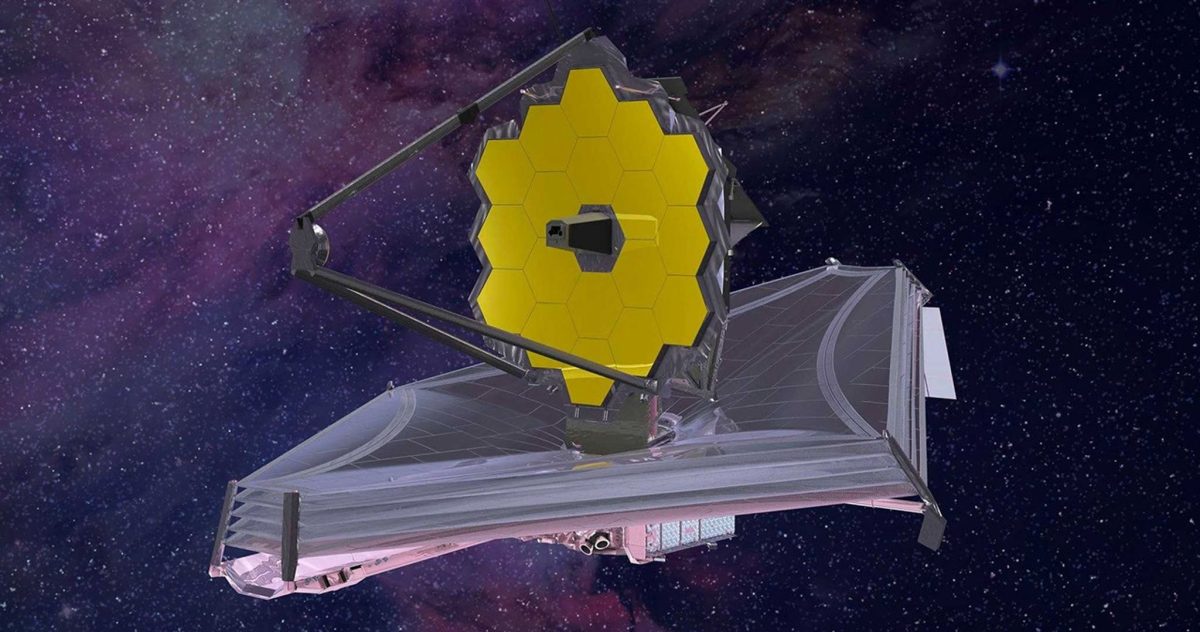
A mirror with dimensions comparable to the roof of a house
The core component of any telescope is its primary mirror. Its size correlates directly with the amount of light it can collect and its capacity to detect objects that are both faint and distant. In the case of the James Webb Space Telescope, this mirror measures 6.5 meters in diameter and is composed of 18 hexagonal segments, each coated with a thin layer of gold. Gold was selected not for aesthetic appeal but because it exhibits exceptional reflectivity in the infrared light spectrum — the operational wavelength range of the observatory. The total mass of gold used on the mirror is approximately fifty grams; by weight, this is comparable to a golf ball, and by volume, it would fit within a sphere roughly the size of a small bead.
The issue at hand is that a solid mirror of such dimensions cannot be accommodated within any rocket, as the fairing responsible for transporting the spacecraft into space is exceedingly narrow. The engineers devised an innovative solution — by folding the mirror akin to a sheet of paper, employing origami techniques. The three side segments on each side are folded backward, enabling the spacecraft to be launched in a compact form and subsequently unfolded once in space. Each segment measures 1.32 meters in diameter, weighs approximately 20 kilograms, and is equipped with actuators that meticulously adjust their positions, ensuring that all eighteen individual mirrors coalesce into a singular, continuous concave surface.
Beryllium is selected here intentionally. This metal possesses a lightweight nature, demonstrates minimal deformation in response to temperature variations, and maintains its form even at cryogenic temperatures, conditions under which conventional glass would fracture. It is due to these stability characteristics that it was specifically chosen for the mirror.
Why is the device concealed behind a shield of such vast proportions as a tennis court?
The most prominent characteristic of Webb is the massive, shimmering shield situated beneath the mirror, which resembles five unfurled sails. This component is the sunshield, and without it, the entire structure would be rendered insignificant.
The principle is that the telescope detects infrared light, which is fundamentally heat. Any warm object emits light within this spectrum, including the telescope itself. If Webb’s instruments were to heat up, their own heat would obscure the faint signals from distant galaxies, analogous to how bright light in a room can overpower the glow of a candle. Therefore, it is essential to maintain the spacecraft in extremely cold conditions. A shield, approximately the size of a tennis court (21 × 14 meters), continuously protects the mirror and scientific instruments from the Sun, Earth, and Moon. This shield is composed of five layers of thin film, with heat being dissipated as it transfers from one layer to the next. On the sunward side, the shield heats to over 80 °C, while on the opposite side, the temperature drops to approximately –233 °C; under such frigid conditions, the mirror and near-infrared instruments operate efficiently without mutual interference. Additionally, one instrument designed to detect mid-infrared light requires even lower temperatures and is thus cooled further by a dedicated cryogenic refrigerator.
This is the origin of the device’s distinctive silhouette. Each characteristic is meticulously designed to achieve a singular objective: to contain the cold and to inhibit heat from hindering observations.
The location at which the telescope is concealed within the Earth’s shadow
Webb does not orbit the Earth in the same manner as the Hubble Space Telescope. Instead, it has journeyed 1.5 million kilometers away from our planet to a designated position known as the Lagrange point L2, a specific location in the solar system where gravitational forces are in equilibrium. This allows the spacecraft to orbit the Sun at the same velocity as Earth, maintaining alignment with it.
The selection of this location is primarily influenced by thermal considerations. At L2, the Sun, Earth, and Moon are approximately aligned on the same side of the telescope. This configuration allows a single shield to effectively block all principal sources of heat and illumination simultaneously, while the opposite side of the spacecraft remains permanently oriented towards the cold, dark realm of space. Concurrently, this orbit provides the telescope with an unobstructed view of the celestial sphere. The only notable drawback is that repair personnel cannot access the spacecraft at such a distance, necessitating that all systems operate flawlessly on the initial attempt.
Light that has traversed billions of years
The primary consideration is why this telescope perceives the past. The explanation resides in the finite velocity of light. Although light propagates at an extremely rapid pace — approximately 300,000 kilometers per second — it is not instantaneous. Consequently, any image observed with the naked eye or through optical instruments is invariably a representation from a previous moment.
This phenomenon occurs on Earth as well; it often goes unnoticed. We observe the Sun as it was eight minutes prior, owing to the travel time of its light to our planet. When considering distant galaxies, these delays extend into billions of years. The light captured by the Webb Space Telescope today embarked on its journey long before the existence of Earth or the Sun. Through the examination of deep space, the telescope effectively looks back in time: the greater the distance of an object, the older the light we observe from it is.
This is the fundamental reason for the construction of the observatory, which aims to examine the most remote galaxies. These celestial bodies are situated at such extraordinary distances that their light has been propagating towards us for over 30 billion years, providing us with a glimpse of the universe as it appeared merely a few hundred million years following the Big Bang, during the epoch when the earliest stars began to form.
Why does light from the past appear red?
This passage elucidates the underlying rationale for the James Webb Space Telescope’s particular focus on infrared light. The universe persistently expands, leading to a gradual elongation of the space between galaxies. As this space expands, the light waves traversing it also stretch. The longer a light beam propagates, the more its wavelength extends, resulting in a shift toward the red end of the spectrum. This phenomenon is referred to by astronomers as the redshift.
The illumination originating from the earliest stars was initially ordinary visible light. However, after billions of years of cosmic travel, its wavelengths have stretched significantly, shifting from the visible spectrum to the infrared region, which is imperceptible to the human eye. A standard optical telescope would not be capable of detecting such light. The James Webb Space Telescope was expressly designed for this purpose: its instruments are capable of detecting light within a wavelength range of approximately 0.6 to 28 micrometers, deep within the infrared spectrum, beyond the perceptual capacity of the human eye. [^8] Consequently, it functions as a form of time machine — though rather than traveling through time, it patiently awaits the arrival of the Universe’s most ancient light to be captured by its mirror.
The function of the telescope with respect to the light it captures
Collecting light constitutes only half of the challenge. Subsequently, it must be converted into knowledge. Concealed behind Webb’s primary mirror are four scientific instruments — NIRCam, NIRSpec, MIRI, and FGS/NIRISS — each of which analyzes the captured light in its unique manner. Some of these instruments generate images that depict the shapes of galaxies, the outlines of nebulae, and clusters of stars. Others serve as spectrographs: they decompose the beam into its components, analogous to how a raindrop disperses sunlight into a rainbow. From this spectrum, astronomers can ascertain the chemical composition of an object, its velocity, and its distance.
This capability is especially advantageous in the examination of exoplanets orbiting other stars. When such a planet transits in front of its host star, a portion of the star’s light passes through the planet’s atmosphere. Various gases absorb specific wavelengths, resulting in distinctive absorption features within the spectrum. By analyzing these spectral gaps, researchers can ascertain the atmospheric composition of a planet located tens or even hundreds of light-years away. Thus, a single telescope possesses the capacity to observe both the distant past of faraway galaxies and the atmospheres of planets that may have once harbored traces of life.
In a span of only a few years since its commissioning, the James Webb Space Telescope has significantly contributed to the advancement of astronomical knowledge — ranging from the discovery of unexpectedly mature galaxies in the early universe to detailed analyses of exoplanetary atmospheres. Each transmission of new images to Earth offers a glimpse not of the present universe, but of its past state, as from long ago — a snapshot that, after billions of years of travel, has only now arrived at our observational instruments.
