

Analysis of data from the Event Horizon Telescope (EHT) network of radio telescopes, which previously took more than a month, now takes minutes, according to NVIDIA. The company has released an open-source tool that combines signals from telescopes using graphics processing units (GPUs). Images of black holes are later reconstructed from the data obtained in this way.

Terabytes in minutes
According to NVIDIA’s technical blog, the cuPhoton.xBeam module processed 10 terabytes of Event Horizon Telescope (EHT) recordings in 70 seconds on a Vera Rubin NVL72 system equipped with 64 GPUs. The same data set took almost nine hours to process using conventional x86 CPUs, approximately 460 times longer.
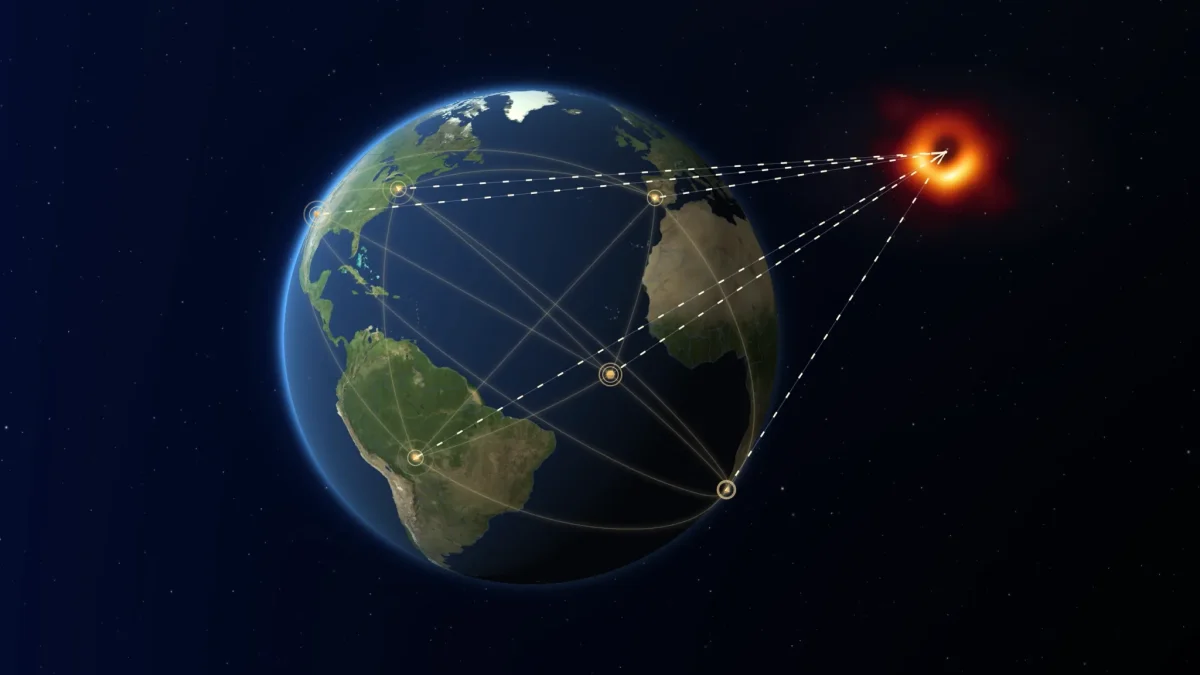
The EHT telescopes are located on different continents and work together as a single antenna the size of the Earth. Radio waves from the vicinity of a black hole reach each station with different time delays, so the recordings must first be synchronized. The signal is then divided into frequency channels, and the data from each pair of telescopes are multiplied together. This entire process is called correlation, and images are subsequently reconstructed from the resulting information about the source’s brightness distribution.
Months of waiting
During the April 2017 observing campaign, approximately 3.5 petabytes of raw data were recorded using eight telescopes. The hard drives containing the recordings were physically transported to the MIT Haystack Observatory and the Max Planck Institute for Radio Astronomy in Bonn. There, the data were correlated using the DiFX software, which was designed for conventional CPUs. In a separate blog post about CUDA-X libraries, the company provides another comparison, stating that an analysis that previously took more than a month can now be completed in eight minutes.

The first image of the black hole’s shadow in the galaxy M87 was released in April 2019, two years after those observations. The image of Sagittarius A* based on data from the same 2017 campaign appeared only in May 2022. Correlation accounted for only part of this delay, as calibration, image reconstruction, and verification followed.
Open-source code on NVIDIA chips
The cuPhoton package is available on GitHub under the Apache 2.0 license, meaning it is free and open to modification. It is written in CUDA, so it runs only on NVIDIA GPUs, ranging from server racks to the DGX Spark desktop computer.
The announcement was made on November 16, 2026, at the SC26 supercomputing conference. As reported by Interesting Engineering, on the same day the company presented libraries for plasma physics and molecular simulation, as well as Nemotron for Science, an open model for scientific AI agents.
Limitations of the tool
Despite being announced alongside AI agents, xBeam does not use machine learning; it relies on conventional computing. Therefore, the debate over whether artificial intelligence can be trusted in astronomy does not directly apply to this tool.
NVIDIA is developing the tool in collaboration with the Harvard & Smithsonian Center for Astrophysics and the Haystack Observatory. The company believes that reconstructing an image of the black hole in M87 in real time is becoming achievable. However, calibration and image reconstruction remain separate stages outside xBeam.
NVIDIA has not named a specific observing campaign in which xBeam will be used. It will be most useful for the ngEHT project, or Next Generation Event Horizon Telescope, which plans to add more stations and image changes around black holes. The number of telescope pairs that need to be correlated grows approximately in proportion to the square of the number of stations. The eight telescopes used in the 2017 campaign formed 28 pairs, while the 13 stations cited by NVIDIA in its description of the EHT form 78 pairs.
The same cuPhoton package also contains the xLens module for plasma physics, which is used by Pacific Fusion, a company working on controlled nuclear fusion, to analyze data during simulations. Meanwhile, the Nemotron model has found applications in chemistry. After further training the model on the results of its own experiments, Lila Sciences laboratory demonstrated 61% accuracy in selecting recipes for synthesizing quantum dots — nanocrystals used in displays and solar panels — while GPT-6 Astra achieved 54% on the same task.
