

Galaxies in a distant, dense group contain several times less cold molecular gas than their typical counterparts. This is the very gas from which stars form. The space between the group’s galaxies is filled with a huge cloud of gas, much of which has been stripped from them, but most of it is too hot to become material for new stars. It appears that astronomers have caught in action the mechanism through which a dense environment deprives galaxies of their raw material.
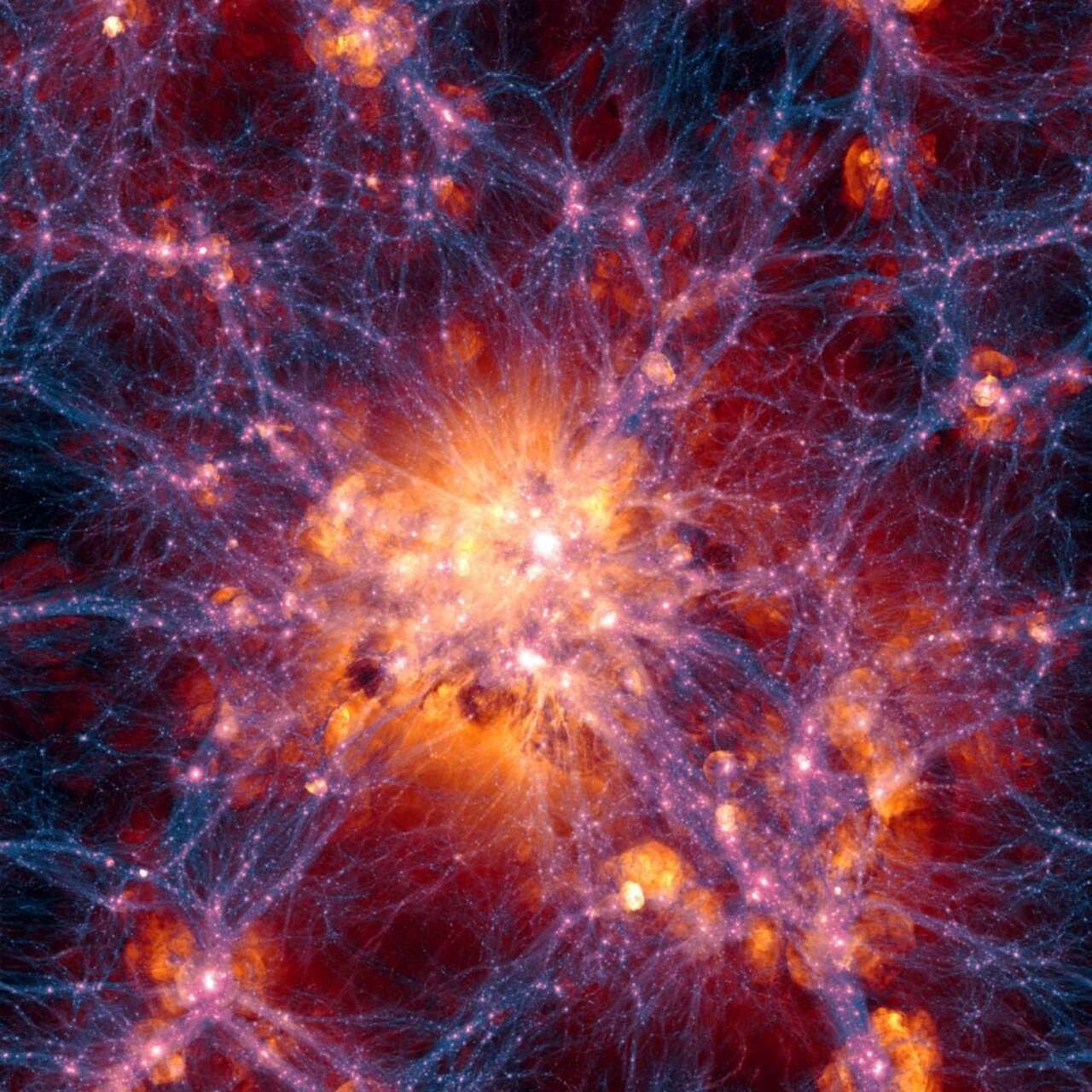
Where does the cold gas disappear?
The most active period of star formation in the Universe occurred about 10 billion years ago, and its rate has since dropped by approximately 97%. So the question of where the cold gas has gone has long puzzled astronomers.
As Universe Today reports, there are several possible explanations. Gas can be blown away by stellar winds and jets from active galactic nuclei — regions around supermassive black holes where matter falls in and releases enormous amounts of energy. It can also be stretched by tidal forces during close encounters or heated and stripped away by hot, diffuse gas that fills the space between galaxies.
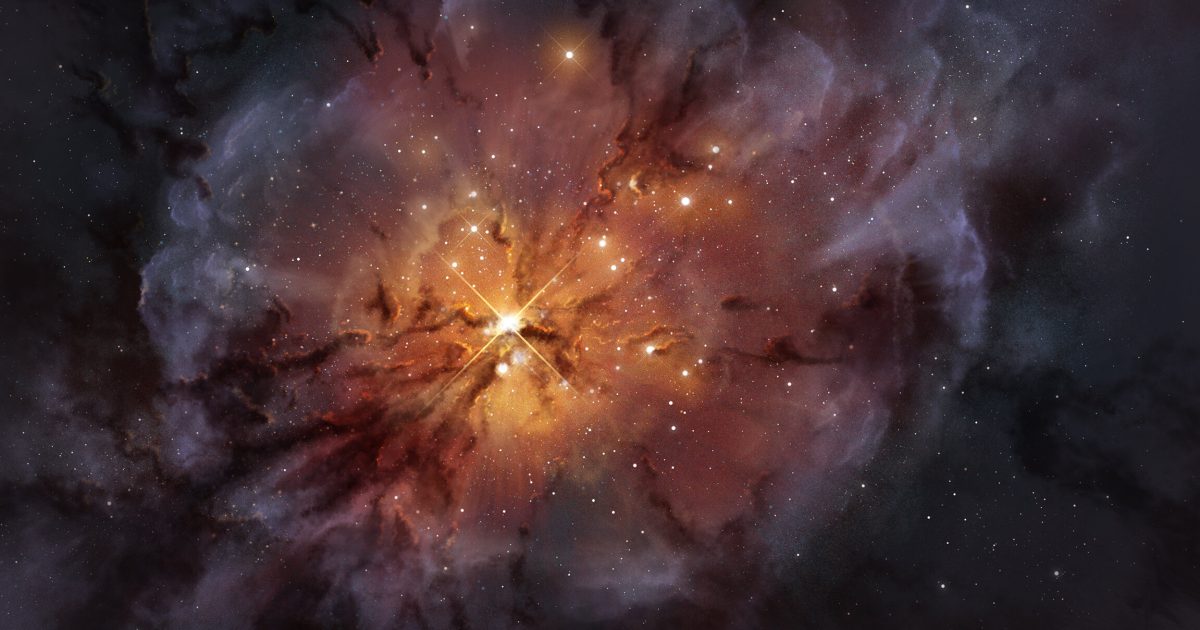
These ideas are best tested in galaxy groups. Most nearby galaxies are concentrated in them, and the influence of the environment on each galaxy lasts for billions of years.
Little cold gas
To investigate this, a team led by Jonathan Freundlich of the University of Strasbourg selected the COSMOS-Gr30 group. It lies at the intersection of major filaments of the cosmic web, and its light has been travelling toward us for about 6.5 billion years. The researchers searched for molecular gas in 17 of its 44 galaxies using two instruments operated by the Institute of Radio Astronomy in the Millimeter Range (IRAM): the radio interferometer known as the Northern Extended Millimeter Array (NOEMA) in France and the 30-meter radio telescope on Pico Veleta mountain in Spain.

This gas consists mainly of hydrogen molecules, which emit almost no radiation at low temperatures. Therefore, astronomers measured the signal from carbon monoxide, which is usually found alongside molecular hydrogen, and converted it into a hydrogen mass estimate. A sufficiently strong signal was detected in only four galaxies. For the rest, the researchers combined all 17 spectra because weak signals that are undetectable individually become measurable when added together.
It turned out that, on average, the group’s galaxies contain only 20–40% as much molecular gas as galaxies of the same mass and age in which stars are forming steadily. The study has been accepted for publication in the peer-reviewed journal Astronomy & Astrophysics.
A cloud between the galaxies
If gas is disappearing from galaxies, it makes sense to look nearby for it. Back in 2018, observations using the Multi Unit Spectroscopic Explorer (MUSE) on the European Southern Observatory’s Very Large Telescope revealed that eight galaxies in the group are surrounded by a common cloud of ionized gas. Its mass is approximately 50 billion solar masses, comparable to the mass of all the stars in the Milky Way.
How did the material get there? Probably through several processes at once. Some of it was pulled out by tidal forces, while some was carried away by outflows from star formation and the active nucleus of one of the eight galaxies. Another part may have been stripped away by ram pressure. A galaxy races through the group’s hot gas at hundreds of kilometers per second, and the oncoming flow pushes its own gas outward, just as wind blows smoke away from a fire. It is also possible that some of the cloud’s material came from the filaments of the cosmic web.
Observations from Pico Veleta covered the entire cloud. No cold gas was detected, and its upper mass limit is 20 billion solar masses. Thus, cold gas accounts for no more than one-third of all the material in the cloud, while the rest is too hot to form stars.
In the authors’ view, these results together form a coherent picture. The galaxies in the group are losing their cold gas, and the material stripped from them can, for the most part, no longer form new stars.
The limitations of the results
The authors openly acknowledge that the uncertainties are large. The star formation rate in individual galaxies is not known precisely, and the carbon monoxide signal is converted into a hydrogen mass using an average conversion factor. Therefore, more accurate measurements and a larger number of galaxy groups for comparison are needed.
Universe Today journalists see the next step in observations with the Atacama Large Millimeter/submillimeter Array (ALMA) in Chile. Its 66 antennas provide much higher resolution, making it possible to determine exactly where cold gas is located inside and around galaxies and establish whether its loss is indeed linked to the influence of the group.
