

On Friday, SpaceX launched its super-heavy Starship system into space. This was the 15th launch of the system. The planned attempt to catch the lower stage failed. However, the 22-hour mission itself is still underway. Its goal is to deploy satellites into orbit.
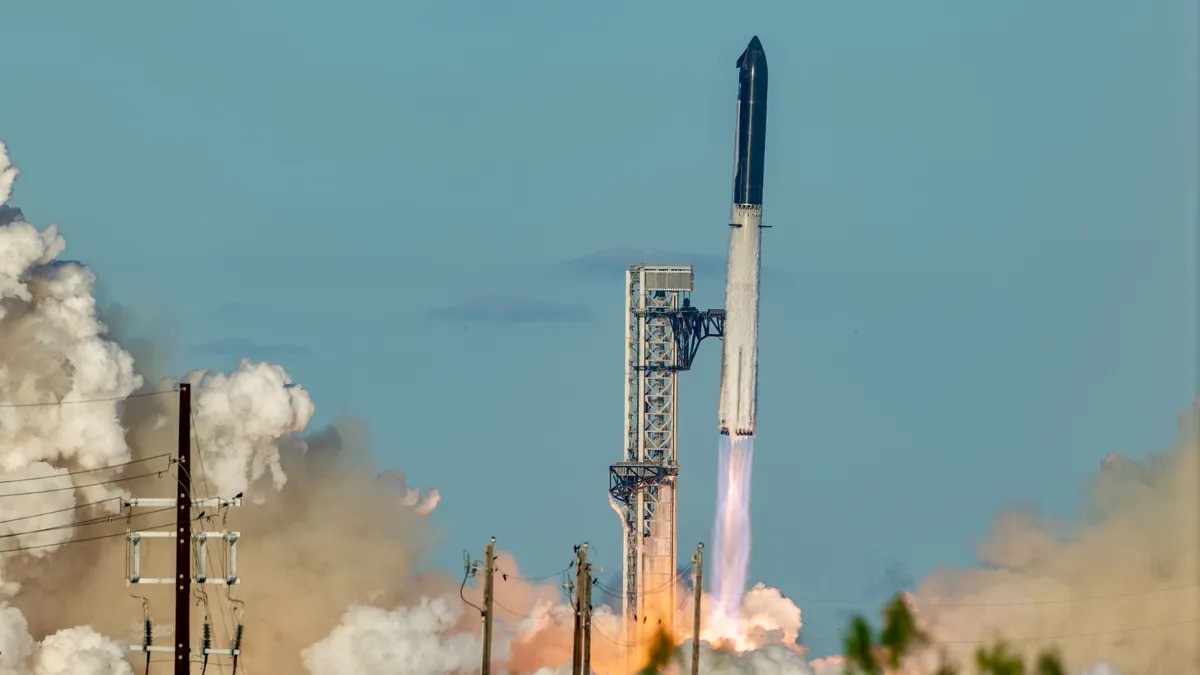
Starship’s 15th launch
As reported by Space.com, on Friday, November 13, SpaceX was not deterred by the unlucky date and attempted to send its super-heavy Starship rocket into space for the 15th time. The mission is still underway, but it is already clear that it has been only partially successful. The reason is that the giant first stage could not be caught by the equally enormous “chopsticks,” and it exploded.
The launch took place at 5:47 p.m. Eastern Time from the launch pad in South Texas. In Ukraine, it was already 12:47 a.m. on Saturday. The first stage completed its work successfully, separated, and began descending when it became clear that something was wrong with it. The attempt to catch it was officially called off. The upper stage, meanwhile, continued moving at a speed of 26,442 km/h.
This is actually a major setback, since the demonstration of the mechanical catching system was the most important element of the 15th mission. It would have been a significant achievement for SpaceX and its efforts to develop Starship as a fully reusable rocket. It would also have marked the first successful recovery of the V3 (Version 3) Super Heavy, which began flying earlier this year. The company had previously recovered three of its V1 Super Heavy boosters and reused two of them on subsequent flights.
The spacecraft reaches orbit and deploys Starlink V3 satellites
The spacecraft’s Raptor rocket engines continued operating after stage separation, completing their first burn just over eight minutes after liftoff. After that, everything went according to plan: a second engine burn lasting about 20 seconds placed the spacecraft into low Earth orbit at an altitude of approximately 170 miles (275 kilometers), 26 minutes and 10 seconds after liftoff.
The spacecraft first reached orbit on Flight 14, which launched on September 28. This time, it is scheduled to deliver 26 SpaceX Starlink V3 satellites, which were deployed into low Earth orbit according to schedule today over a 42-minute period, beginning 35 minutes after launch.
The upgraded wireless internet satellites are the second batch of V3 satellites to reach orbit, following the group of 26 satellites delivered on Flight 14. The V3 satellites are significantly more powerful than SpaceX’s Starlink V2 satellites, more than 11,000 of which are currently in low Earth orbit. According to the Flight 15 mission plan, adding this new batch of V3 satellites will increase network capacity by one terabit of data. This is equivalent to the capacity provided by 10 Starlink V2 launches carried out using the Falcon 9 rocket.
The launch team notes that Starship will return to the launch pad only if the flight control team is confident that the spacecraft’s systems, which are critical for atmospheric entry maneuvers, the final landing burn, and the approach to the tower, are in good condition. SpaceX engineers will have enough time to check all the spacecraft’s systems before making a final decision about the landing. The plan is for the spacecraft to complete 14 orbits of Earth, spending more than 21 hours in space before returning home.
How was the decision to catch the spacecraft made?
SpaceX has reserved three decision points in case of unforeseen circumstances during Flight 15, allowing the spacecraft to return to the Pacific Ocean early if engineers decide that an attempted catch is impossible or inadvisable. The first checkpoint will take place just 10 minutes after the Starlink satellites have been deployed, the second at T+7 hours and 15 minutes, and the final one at T+20 hours and 41 minutes.
If the spacecraft looks good at each of these stages, SpaceX will perform a 10-second deorbit burn at approximately T+21 hours and 36 minutes, placing the spacecraft on a trajectory back toward South Texas. Its atmospheric reentry will begin approximately 35 minutes later. SpaceX has also designated a backup splashdown zone in the Gulf of Mexico in case conditions do not allow the spacecraft to be safely caught during its final approach.
If everything goes according to plan, the Ship will return to Starbase on Saturday at approximately 4:17 p.m. U.S. Eastern Time (21:17 GMT; 3:17 p.m. Texas time), roughly 22.5 hours after liftoff. A successful landing would mark a major milestone for SpaceX — the world’s first recovery of a Starship upper stage.
The importance of reusable technology
Full reusability is key to the company’s ambitions to launch its Starlink V3 satellites, as well as its proposed constellation of orbital data centers envisioned by the company’s founder and CEO, Elon Musk. According to Musk, the next-generation Starlink constellation will consist of approximately 100,000 satellites, while the AI network will be 10 times larger.
Building and maintaining these constellations will require an incredible number of launches. In fact, according to Musk, SpaceX plans to reach 10,000 Starship launches per year by 2030. Some of the other planned Starship missions will not necessarily require full reusability, but the reliability of the spacecraft will be critical for NASA’s Artemis program and its efforts to return astronauts to the Moon.
The space agency selected Starship as one of the crewed lunar landers for the program, and it is expected to carry out a demonstration mission involving NASA’s Orion spacecraft and Artemis III astronauts in Earth orbit in the summer of 2027.
