

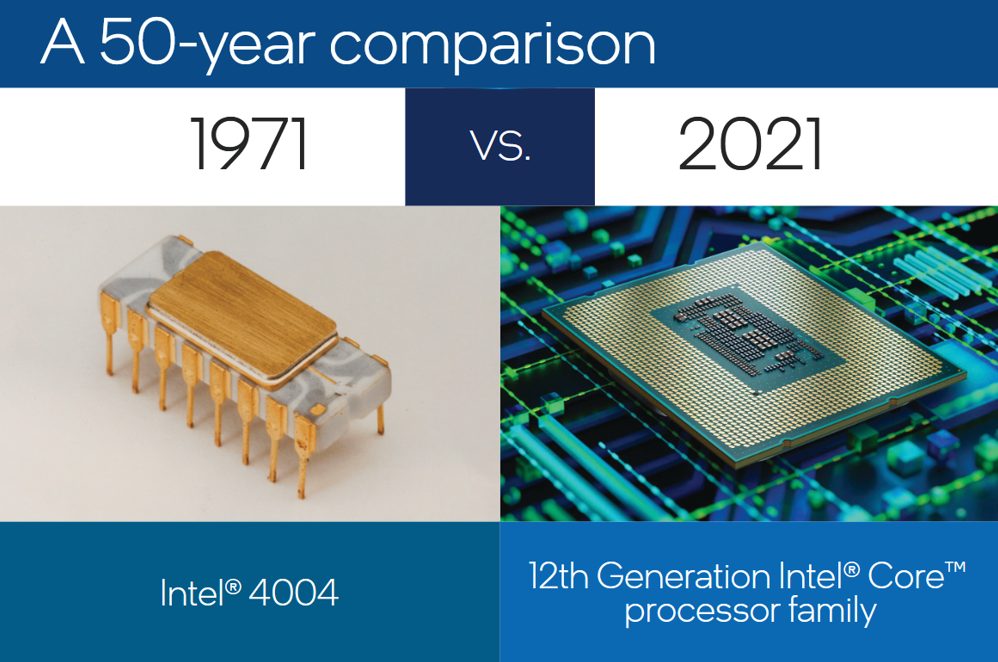
What do a standard calculator, a modern smartphone, and a spacecraft’s computer have in common? Each owes its development to a revolution that began with a tiny silicon crystal. In 1971, Intel introduced the 4004, the world’s first commercially available microprocessor. It contained only 2,300 transistors and was originally designed for a Japanese calculator. However, this engineering innovation, developed to perform arithmetic operations, transformed electronics forever. How did a microchip designed for a desktop computer become one of the cornerstones of the digital age?
Source: Intel Corporation
The calculator that unexpectedly changed the future
Imagine a company placing an order for a component for a desktop calculator and ultimately receiving one of the foundational elements of the future digital civilization. This is precisely how the story of the Intel 4004 began.
On November 15, 1971, Intel announced the MCS-4, a family of microchips centered on the 4-bit 4004 processor. The Smithsonian describes it as the first complete central processing unit on a single chip and the first commercially available microprocessor; the Computer History Museum takes a more cautious position, describing it as the first commercial single-chip microprocessor of its kind. Historians continue to debate who merits the undisputed title of “the first microprocessor,” as several teams were developing similar concepts in the late 1960s and early 1970s. However, the 4004 transformed the concept of a programmable processor into a commercial product that could be purchased and integrated into another device.
Source: Intel Corporate Timeline
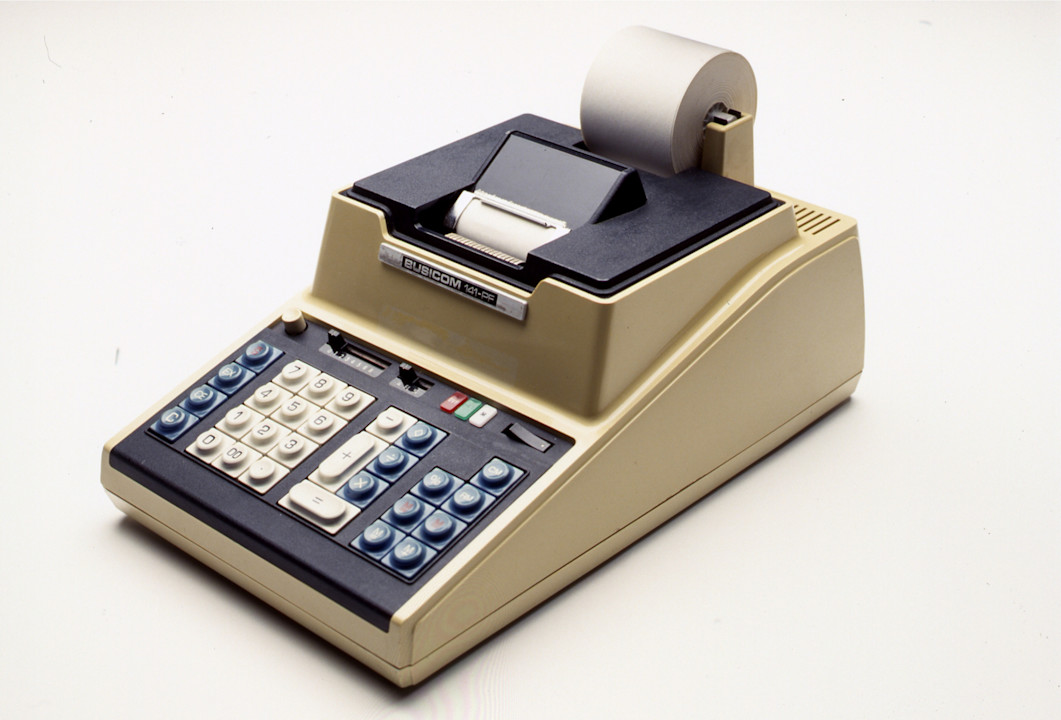
The paradox is that Intel had no intention of becoming a “processor” company at the time. Founded only in 1968, it was primarily engaged in semiconductor memory. In April 1969, the Japanese company Nippon Calculating Machine Corporation, known by the Busicom brand, approached the fledgling Intel with a request to develop the electronics for its 141-PF printing calculator. The initial concept called for approximately a dozen specialized integrated circuits.
For the manufacturer, this presented a significant challenge. Each specialized microchip required an independent design, testing, and preparation for production. Intel engineer Martian “Ted” Hoff proposed an alternative: rather than using multiple hard-wired circuits, the company could create a compact, general-purpose processor and use software to determine the calculator’s behavior. Together with Stanley Mazor, he developed the architecture for the future system. Busicom engineer Masatoshi Shima helped define the logic and confirmed that the new architecture could perform all of the calculator’s functions.
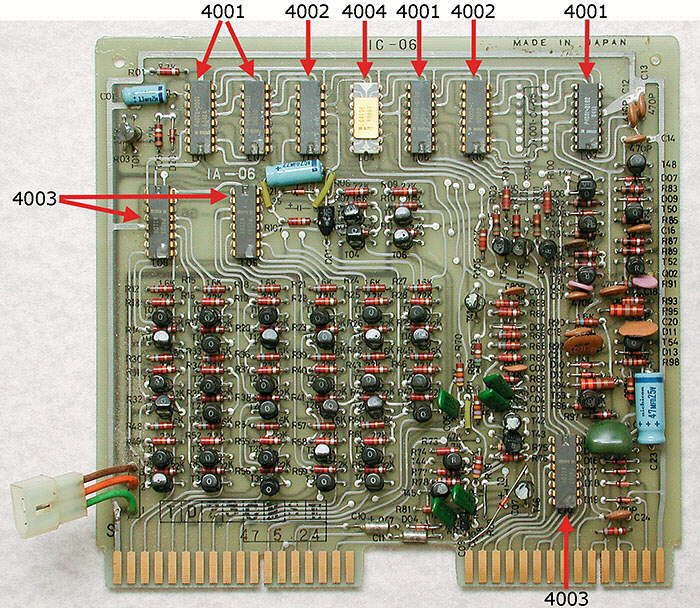
That is how the MCS-4 came into being: the 4004 processor, the 4001 read-only memory, the 4002 random-access memory, and the 4003 shift register. In other words, the challenge of “needing a lot of specialized hardware” was addressed through a different approach: building a small, general-purpose computer and programming it to perform the necessary tasks. This principle would later become fundamental to embedded electronics.
How 2,300 transistors became a central processing unit
The concept was only part of the challenge; it now needed to be physically implemented in silicon.
In April 1970, Italian engineer Federico Faggin joined Intel. He led the MCS-4 hardware design and transformed Hoff and Mazor’s architecture into functional microchips. Shima collaborated with him on the logic design. The Computer History Museum identifies Faggin as the MCS-4’s lead developer and project manager.
The key technological prerequisite was silicon-gate MOS, a technology for MOS transistors that uses a silicon gate, which Fajin had previously helped develop at Fairchild Semiconductor. This technology enabled the creation of circuits that were more compact and faster than those produced using earlier MOS processes. The Smithsonian explicitly states that this new silicon-gate technology made it possible to integrate approximately 2,300 transistors into the 4004.
Today, 2,300 transistors may seem like an exceptionally small number, but it is useful to consider the scale. If each transistor were represented by a separate light bulb, the entire processor would comprise a “panel” of only a few thousand bulbs. Modern processors contain billions of transistors — not merely one such panel, but millions of copies of it. In its anniversary article, Intel compared the 4004’s 2,300 transistors with the billions found in processors developed half a century later.
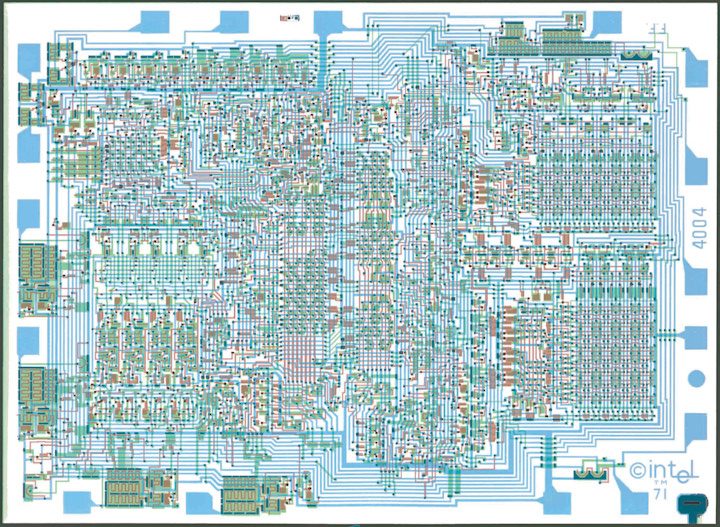
The Crystal 4004 had an area of approximately 12 mm² (0.019 square inches), or roughly 3 × 4 mm. This was smaller than the surface area of a pinky fingernail. It was manufactured on wafers with a diameter of approximately 50.8 mm (2 inches), using structural elements measuring about 10 micrometers (0.00039 inches). By comparison, a human hair is typically several tens of micrometers thick; therefore, the features of the 4004 were already noticeably thinner than a human hair.
Source: Intel Corporate Timeline
The processor operated on 4-bit words, which allowed for only 16 possible combinations, ranging from 0000 to 1111. This design was well suited to a calculator: a single decimal digit could be readily encoded using four bits, making the architecture appropriate for arithmetic operations and BCD encoding. Intel characterizes the 4004 instruction set accordingly—as a 4-bit, binary-coded decimal (BCD)-oriented architecture.
The original documentation specifies a minimum instruction cycle time of 10.8 μs. During a single cycle, light travels approximately 3.2 km in a vacuum — a considerable distance relative to the crystal itself. However, by the standards of the era’s electronics, this constituted impressive speed. The datasheet also lists 46 instructions and supports addressing up to 4 KB of program memory.
There is some historical ambiguity regarding the frequency. Intel’s current anniversary infographic lists 750 kHz, whereas the specifications in the original documentation — a minimum clock signal period of approximately 1.35 µs — correspond to roughly 740 kHz. Accordingly, it is more accurate to cite a maximum frequency of approximately 0.74–0.75 MHz, rather than conflate it with the instruction execution speed.
Four individuals and a schedule that nearly fell apart
The story of the 4004 is also noteworthy because this breakthrough nearly failed to materialize due to a decidedly mundane problem: a shortage of engineers.
When Shima returned to Intel in the spring of 1970, he expected the microchip design to be well underway. Instead, the work had effectively stalled. Hoff and Mazor were architects, but they were not the physical designers of MOS chips, and Intel was directing its resources toward memory. Fajin arrived at a critical point, as the team needed to convert the specifications into four functioning microchips within a matter of months. According to his later recollections, the schedule was so demanding that the team had to work 70–80 hours per week.
It is important to distinguish among the roles of the team members. Ted Hoff proposed the architectural concept for a universal CPU; Stanley Mazor helped shape the architecture and instruction set; Masatoshi Shima represented Busicom, defined the requirements, and contributed to the development and verification of the logic; and Federico Faggin led the physical design and implementation of the silicon chips. For this reason, historical sources generally credit all four, rather than identifying a single “inventor of the 4004.”
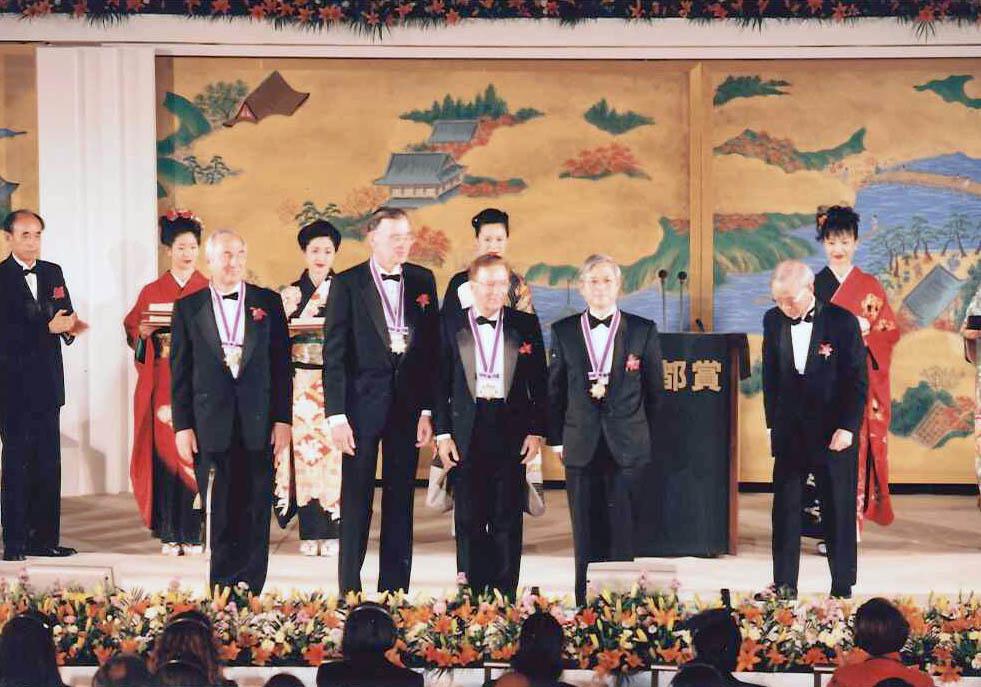
At the edge of the processor’s topology, Faggin even inscribed the microscopic initials “F.F.”—a form of signature that could not be seen without magnification.
By early 1971, the MCS-4 system was operational, and the Busicom 141-PF prototype served as its first practical demonstration. One of these prototypes was later acquired by the Computer History Museum; it includes all four members of the MCS-4 family.
The $60,000 agreement that opened the market
Although the processor was technically ready, Intel was not legally permitted to sell it to any interested party. Busicom had commissioned its development, and the rights to the chip belonged to Busicom.
This is where the technical narrative becomes a business one. While development was underway, the desktop calculator market grew considerably more competitive, and prices declined rapidly. Busicom asked Intel to reduce the cost of the microchips. Intel agreed, in return for the right to sell the MCS-4 to customers outside the calculator market. In May 1971, the company effectively repaid Busicom’s $60,000 investment in development and released the 4004 for broader use.
This decision proved to be as significant as the creation of the processor itself. Without it, the 4004 might have remained an obscure component in a single Japanese calculator.
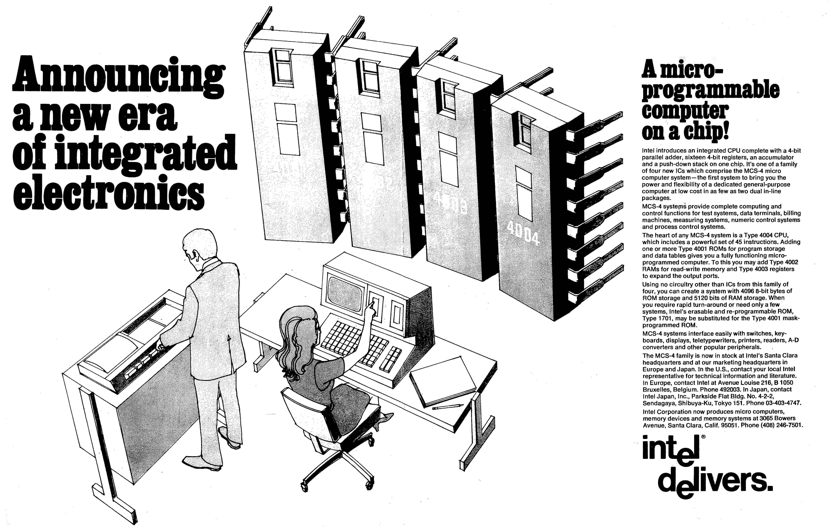
On November 15, 1971, an advertisement for the MCS-4 appeared in Electronic News. Its headline — “Announcing a New Era of Integrated Electronics” — proved nearly prophetic. The Computer History Museum identifies this date as the publication of the first advertisement for a commercial microprocessor.
The real revolution was not that the 4004 was exceptionally fast; it was not. Rather, the revolutionary development was a shift in the electronics industry: the same off-the-shelf processor could be installed in different devices, with its behavior modified through software instead of requiring the logic circuit to be redesigned for each product. Intel emphasizes this very advantage in its own history with the 4004.
Subsequent generations soon exposed the limitations of the initial architecture. In 1972, Intel introduced the 8-bit 8008, followed in 1974 by the considerably more practical 8080. Fagin later summarized the distinction succinctly: the 4004 and 8008 demonstrated the potential of a new market, whereas the 8080 made that market a reality.
How does space fit into all of this?
The simplest approach would be to say that the Intel 4004 “helped land on the Moon.” However, that would not be accurate.
The Apollo Guidance Computer did not use the Intel 4004. Its basic architecture was developed in the early 1960s, well before the 4004 was introduced. NASA states that the Apollo Guidance Computer featured a 16-bit architecture, a clock speed of approximately 1 MHz, ferrite-core memory, and logic assembled from discrete integrated circuits. The Block II version used specialized logic ICs rather than a microprocessor such as the 4004.
However, it is related to space exploration, although the connection is broader and more compelling.
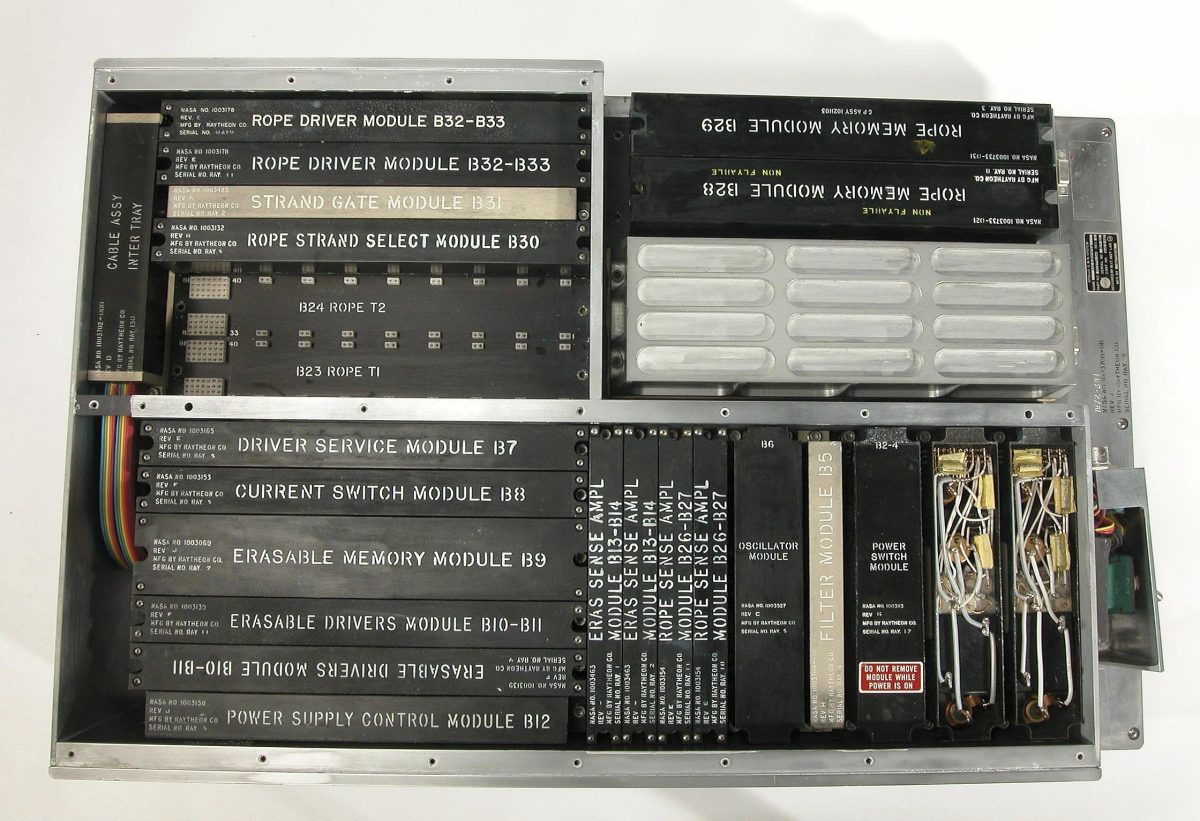
Apollo was among the projects that demonstrated that integrated circuits could be sufficiently compact and reliable for use in a mission-critical onboard computer. A single Block I computer used approximately 4,000 integrated circuits. By comparison, just a few years later, all 2,300 transistors in the 4004 central processing unit were contained on a single chip. This does not represent a direct technological lineage from “Apollo → 4004,” but it vividly illustrates the broader direction of electronics in the 1960s and 1970s: an increasing proportion of computer components was being integrated onto silicon.
The subsequent development of space technology has, in essence, become the history of microprocessors. Modern spacecraft rely on onboard processors for navigation, control, data processing, autonomous operations, and system monitoring. NASA traces a direct historical lineage from the Apollo onboard computers to today’s high-performance, radiation-hardened processors used in space missions. Although the 4004 never flew to the Moon, it became a key example demonstrating that a central processing unit could be made a standard, compact component — a principle upon which countless onboard systems would later be built.
A modest chip, a significant milestone
The Intel 4004 was not the computer of the future as we understand it today. It was slow, 4-bit, had only 46 instructions, and was designed for a calculator. However, these very limitations help us appreciate the magnitude of the breakthrough: for the first time, a central processing unit became a mass-produced microchip that could be programmed to perform a variety of tasks.
In 1971, a 12 mm² chip contained 2,300 transistors. The most significant development was not merely the number of transistors, but what they could accomplish collectively. From that point onward, a device’s complexity could increasingly be defined not by the number of specialized circuits it contained, but by its program code.
The Busicom calculator was the Intel 4004’s first application, marking the beginning of its journey into the global market, where it would power thousands of devices and support millions of tasks.
The computing revolution took place not only on Earth but also in space. Even before the Intel 4004 was introduced, NASA engineers had developed an onboard computer based on integrated circuits for the Apollo program. Its software was created by a team led by Margaret Hamilton, whose engineering solutions helped ensure the success of the 1969 moon landing. Learn about this distinguished engineer’s contributions to the history of space exploration and programming in our article, “In Memory of Margaret Hamilton: She Programmed the Apollo Spacecraft’s Computer.”

