

For the first time, astronomers have tracked how a planet orbiting a single star stopped passing in front of its disk. In fact, it did not disappear. The gravitational pull of an unseen companion is gradually tilting the gas giant’s orbit, and it now revolves without crossing the star’s disk from the perspective of an observer on Earth.
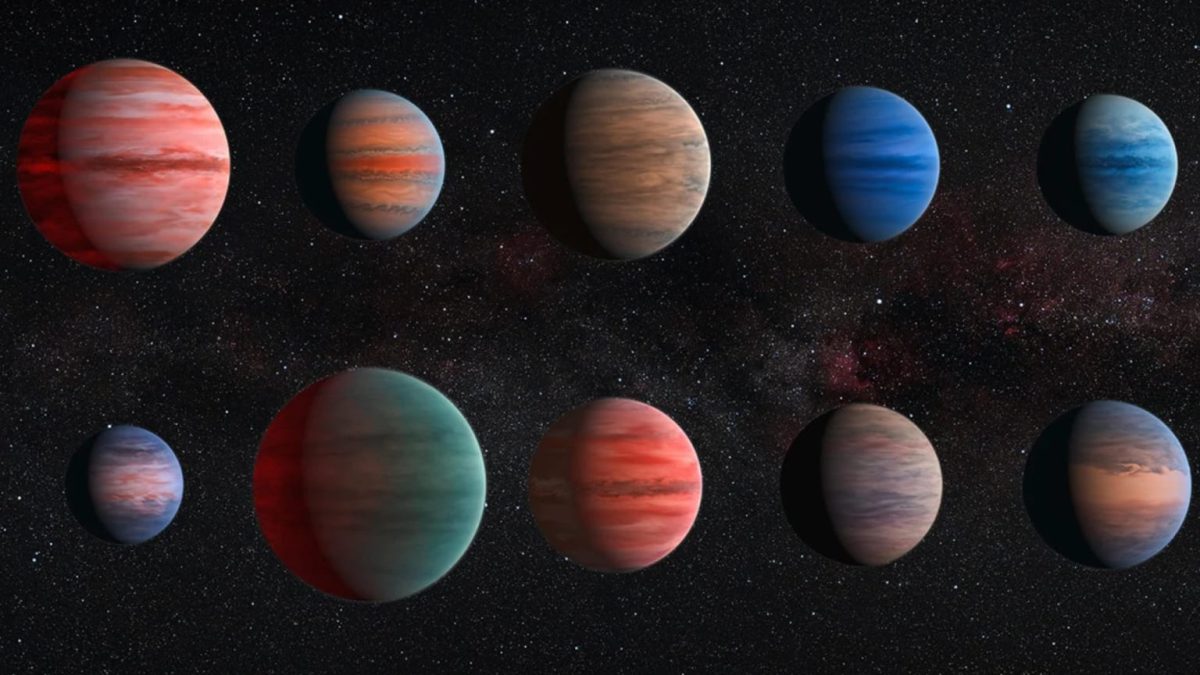
Record orbital tilt
The fastest change in orbital inclination ever measured for an exoplanet orbiting a single star has been recorded in the hot Jupiter TOI-2535b, according to a study published in the peer-reviewed journal The Astrophysical Journal Letters. Over seven years, its orbital plane shifted so much that by March 2026, transits were no longer observed.
The gas giant, which orbits an orange dwarf of spectral type K once every 8.2 days, was discovered in 2019 thanks to the TESS telescope. The telescope searches for planets by detecting transits, or drops in a star’s brightness when a planet passes between it and Earth. If the orbital plane deviates from our line of sight by just a few degrees, transits are no longer visible from Earth.

The planet’s path across the star’s disk most likely crossed its equator and shifted toward the edge, while the transits gradually became shorter. “The planet’s orbit is tilting so rapidly that its transit disappeared while we were watching,” says the study’s lead author, Samuel Yee of the University of California, Los Angeles.
Disappearing transits have so far been observed mainly in planets orbiting binary stars. The candidate KOI-120.01, identified in Kepler data, also stopped transiting its star, but its system is binary, so this could have been an eclipse involving the stars. In addition, the orbital tilts of neighboring planets preserve clues about how hot Jupiters ended up so close to their stars.
An unseen companion
So what is changing the orbit? A clue came from transits that shifted by as much as six hours from their predicted times. This is a record for hot Jupiters.

These timing shifts, as well as the change in orbital inclination, can be explained by a second planet with a mass of at least 0.3 Jupiter masses. The orbital periods of the two giants are most likely in a 2:1 or 3:2 ratio, meaning that gravitational perturbations recur at the same points in their orbits and accumulate over time.
The orbital planes are inclined to each other by at least 5 degrees. Each planet’s gravity pulls the other’s orbit toward its own plane, causing both planes to slowly rotate, like the axis of a spinning top. The full cycle takes 30–50 years, so transits will return in several decades, according to the University of California, Los Angeles.
Study co-author Erik Petigura compares this to solar eclipses occurring every month if the Moon’s orbit lay in the same plane as Earth’s. The Moon’s orbital inclination is about 5 degrees, almost exactly the same as the minimum mutual inclination of the orbits in the TOI-2535 system.
The mystery of its origins
According to classical models, a gas giant could not have formed so close to its star, so hot Jupiters are thought to have migrated inward from cooler regions farther out. They may have been thrown into such orbits by a sudden increase in orbital eccentricity or slowly drifted inward along with the protoplanetary disk.

The first scenario would not have left a second giant planet nearby. Therefore, both planets probably migrated within the disk and became trapped in resonance there, reports ScienceAlert. However, the disk should have aligned their orbits, and what tilted them afterward remains unknown.
What comes next
It is no longer possible to track TOI-2535b through its transits, so researchers will search for its companion using the radial velocity method. The planets’ gravitational pull makes the star wobble slightly toward and away from us, and a spectrograph detects this through shifts in the lines of its spectrum.
According to the authors’ estimates, the companion makes the star wobble at a speed of 30–120 m/s, so more frequent measurements should reveal it. The scatter in the existing data also hints at the presence of a third planet.
