

More than half a century ago, humanity deliberately transmitted a radio message from Earth to other stars for the first time. An image comprising 1,679 pixels conveyed the story of humankind. No response is anticipated, and the telescope used to transmit the message no longer exists. Consequently, the message offered little practical benefit to humanity itself; however, its composition required people to consider what they regarded as most important to communicate about themselves.
Three minutes over the jungle
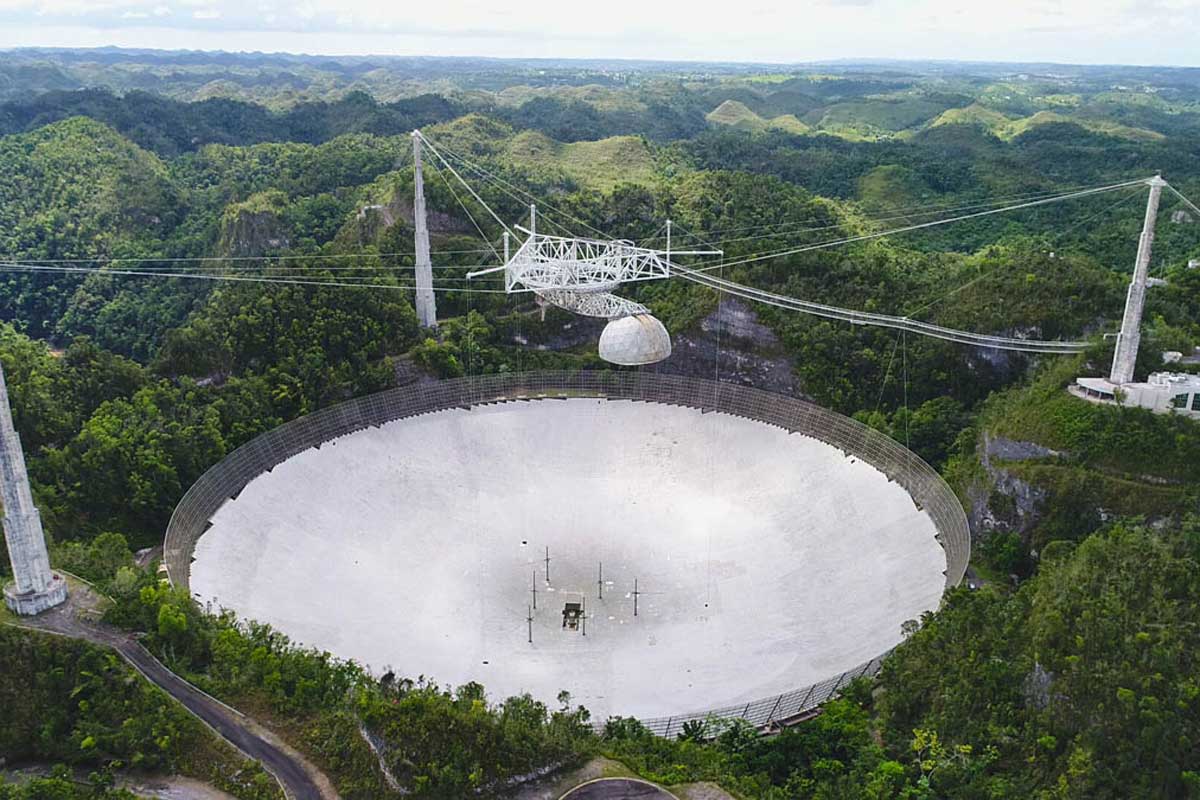
At 1:00 p.m. on November 16, 1974, guests assembled in the mountains of Puerto Rico for a ceremony at the Arecibo Observatory. They were marking the completion of the radio telescope’s modernization. Its dish was located in a karst depression amid the jungle. Among those in attendance was astronomer Frank Drake, who had been commissioned the previous month to compose a special message for the occasion. By then, he was already one of the founders of SETI, the scientific field devoted to the search for extraterrestrial intelligence. In 1960, he became the first to attempt to detect radio signals from other civilizations, and he later proposed an equation that is still used to estimate how many such civilizations may exist in the Milky Way.
At the conclusion of the ceremony, the transmitter was activated, and a steady tone resonated across the surrounding hillsides. For nearly three minutes, a sequence of 1,679 zeros and ones was transmitted from the 305-meter-diameter antenna. The transmission was directed toward the globular cluster M13 in the constellation Hercules, a dense sphere containing hundreds of thousands of stars.
This was the first radio message deliberately transmitted by humans to other stars. However, the star cluster is so distant that the signal will not reach it for another 25,000 years. Even if someone there were to read the message and respond immediately, people on Earth would not receive the response for at least 50,000 years after it was sent. Everyone present fully understood that they would not receive a reply within their lifetime. This is what makes the Arecibo message particularly compelling: people chose to share information about themselves despite having only three minutes of airtime and a very limited amount of information to convey.
A letter written without a shared language
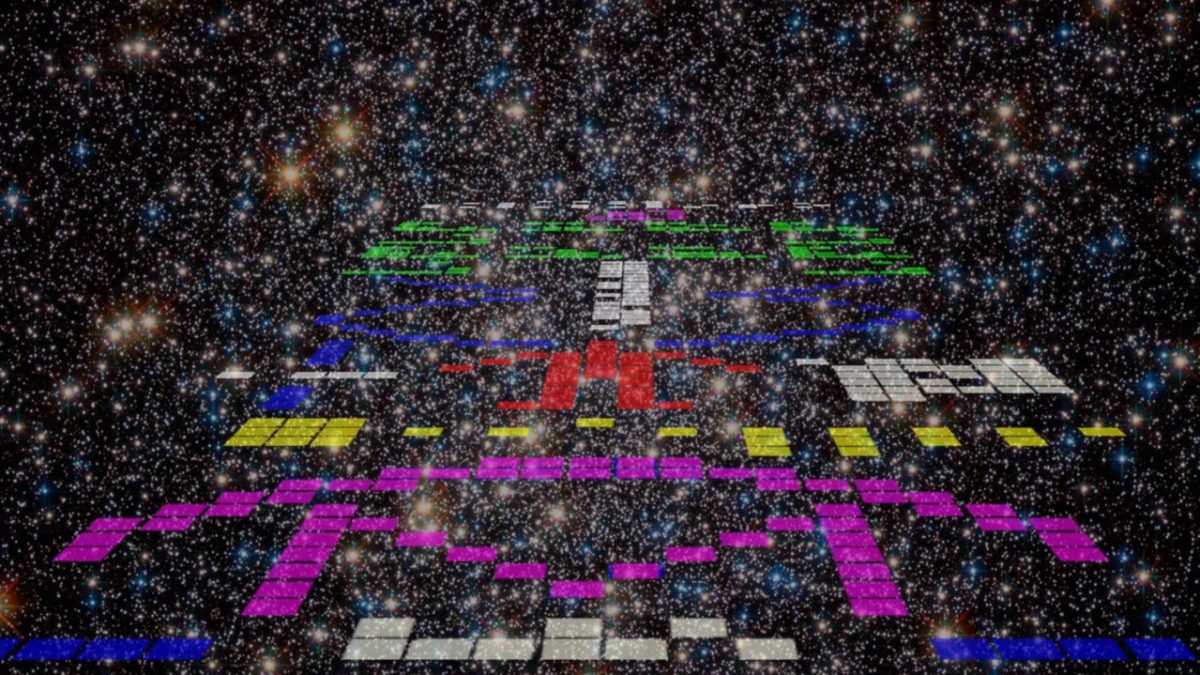
How can one write a letter to a recipient who understands no human language? The only concepts one might share with an unknown recipient are the laws of nature and mathematics. Frank Drake chose to send a drawing rather than text. He created a grid and filled selected squares to form simple shapes. Each cell was represented as a zero or a one, depending on whether it was empty or filled, thereby converting the image into a sequence of signals.

The remaining task was to explain how to reassemble this sequence into an image. After counting the signals, the recipient would obtain the number 1,679. This number has exactly two prime factors, 23 and 73 — that is, numbers divisible without a remainder only by one and themselves. With this number of squares, only two rectangular arrangements are possible, allowing the recipient to determine the grid dimensions independently. A meaningful image emerges when the squares are arranged in 73 rows of 23 each.
While still on Earth, Frank Drake tested whether an outsider could understand the message. He sent it to Carl Sagan, an astronomer who had not been involved in the project and was unfamiliar with its content. Sagan deciphered nearly all of it, and did so quickly. The only section he could not interpret concerned chemistry, although the biochemists to whom Drake later showed the message understood it almost immediately.
There was no genuine expectation of establishing communication with another civilization. Cornell University, which built and operated the telescope, explained in 1999 that the message was primarily intended to demonstrate the capabilities of the upgraded equipment. Frank Drake himself described the goal in broader terms. According to him, it was meant to inform the recipients that we exist and to tell them a little about who we are. “And at the same time, it was a message to ourselves.” That is how he recalled the transmission forty years later.
The contents of the message
When the signals are arranged in a grid, an image emerges that is read from top to bottom. The numbers one through ten appear at the top, enabling the recipient to understand how quantities are represented in the message. Below them are the atomic numbers of five chemical elements from the periodic table: hydrogen, carbon, nitrogen, oxygen, and phosphorus. These elements are the building blocks of DNA, the molecule in which living organisms on Earth store their genetic information. The next section depicts the structure of its components and the double helix. This was the part that stumped Carl Sagan.
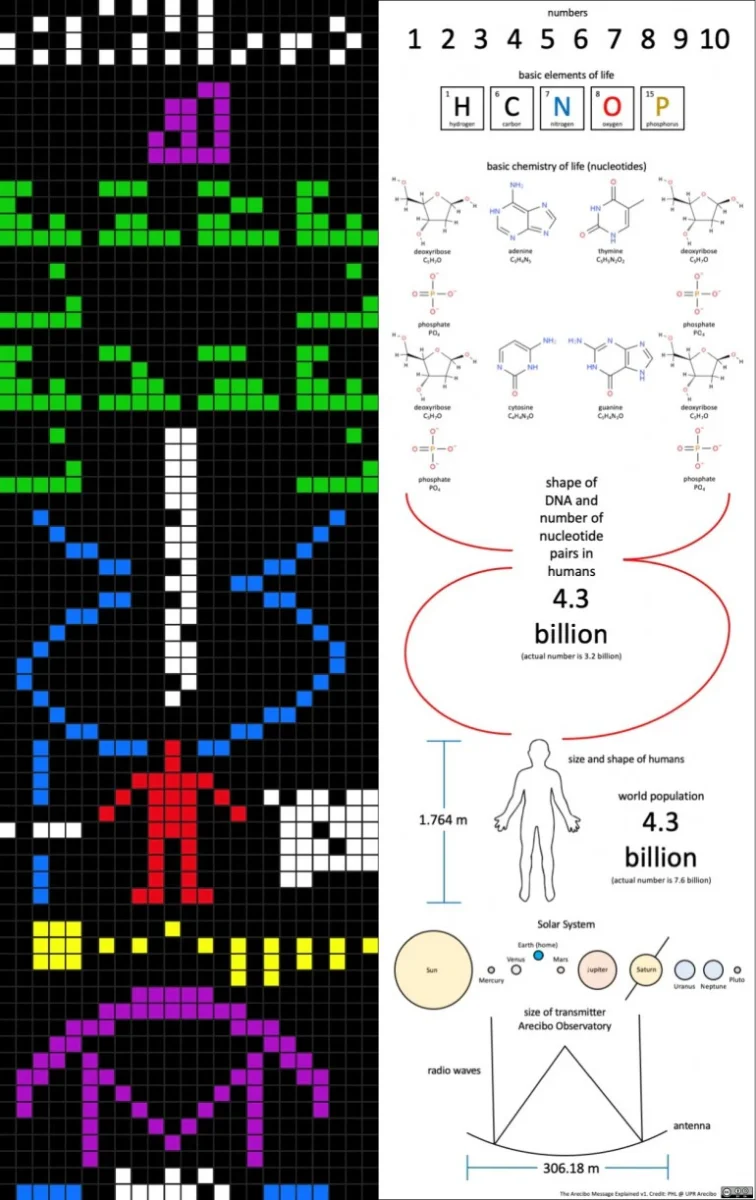
A person is depicted beneath the spiral, accompanied by two numbers. The first represents the person’s height, expressed in unusual units: the length of the radio waves used to transmit the broadcast. Fourteen waves, each 12.6 centimeters long, measure approximately 176 centimeters in total. The second number indicates the population of Earth at the time — approximately four billion. Below these figures are the Sun and the nine planets. Pluto was still classified as a planet at the time; it was not reclassified as a dwarf planet until 2006. Earth is positioned slightly closer to the human figure to indicate the signal’s origin. At the bottom is a depiction of the Arecibo telescope, accompanied by a label indicating its size.
A modern smartphone app icon contains more than 30,000 pixels, whereas the entire Arecibo message comprises only 1,679. It conveys nothing about art, language, or history. Frank Drake had one month to decide what humanity should communicate first and foremost. He chose numbers, the chemistry of life, the human body, a home in the Solar System, and the instrument through which humans reached for the stars. The Arecibo message is addressed first and foremost to humanity itself, as it is a self-portrait through which humans sought to reveal what they considered most essential about themselves.
Why M13?
The target could not be selected based on a map of the most promising stars; instead, it had to be chosen according to the ceremony’s schedule. The Arecibo dish remained stationary in the valley, and the telescope’s beam could be adjusted only within a narrow range. Consequently, the target needed to be positioned approximately above the observatory at the precise moment the transmitter was activated. Frank Drake reviewed the star charts and selected M13 in the constellation Hercules.
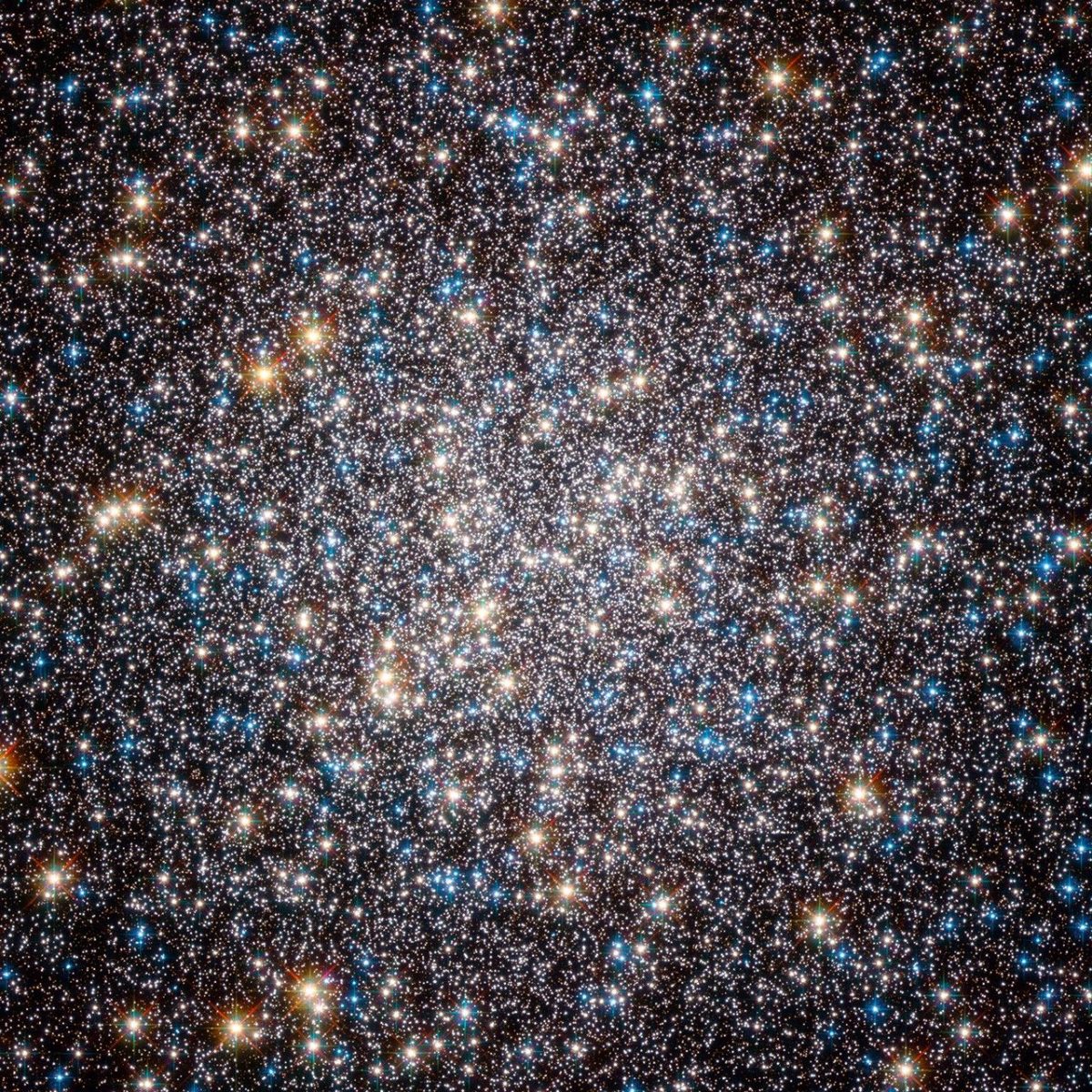
A globular cluster was an appropriate choice for several reasons. It contains more than 300,000 stars, increasing the likelihood that at least one hosts a planet with a civilization compared with a single star. Moreover, the cluster’s central, densest region fit entirely within the telescope’s field of view, and the signal encompassed a substantial portion of its stars simultaneously.
However, the cluster is not stationary. Both the Sun and M13 orbit the center of the Galaxy, each following its own path and moving at its own speed. Over the 25,000 years required for the signal to travel, their relative positions will change, and the stars in the cluster will no longer be located where the beam was aimed.
Twenty-seven years after the transmission, a purported “response” appeared. In 2001, a trampled pattern emerged in a field near the British Chilbolton Observatory, closely replicating the message on the same grid. It was, of course, a prank.
The final months of Arecibo
The Arecibo radio telescope began operations in 1963. Hurricane Maria damaged the facility in 2017, and the observatory subsequently sustained further damage from earthquakes. The most serious incident occurred on August 10, 2020, when one of the support cables holding the receiver platform above the dish detached from its mount. As the platform fell, it tore a large hole in the reflector. In early November, one of the main cables had also snapped. The U.S. National Science Foundation, which owned the observatory, determined that repairs would pose excessive risks to workers and announced on November 19 that the telescope would be decommissioned.

Credit: Arecibo Observatory/NAIC
They did not have sufficient time to dismantle the telescope. On the morning of December 1, 2020, several additional cables snapped, causing the 900-metric-ton platform to fall from a height of more than 120 meters and land directly on the dish. No one was injured.
Forty-six years elapsed between the ceremony at which the message was transmitted and the collapse. Today, the signal is 52 light-years from Earth and has traveled less than one-hundredth of the distance to M13. Since then, the global population has grown to more than eight billion — twice the number recorded in the message — and the telescope depicted at the bottom no longer exists. The self-portrait humanity sent into space remains an enduring snapshot of 1974. At the signal’s rate of travel, it will take so long to reach M13 that approximately a thousand generations will have lived and died on Earth in the meantime.
