

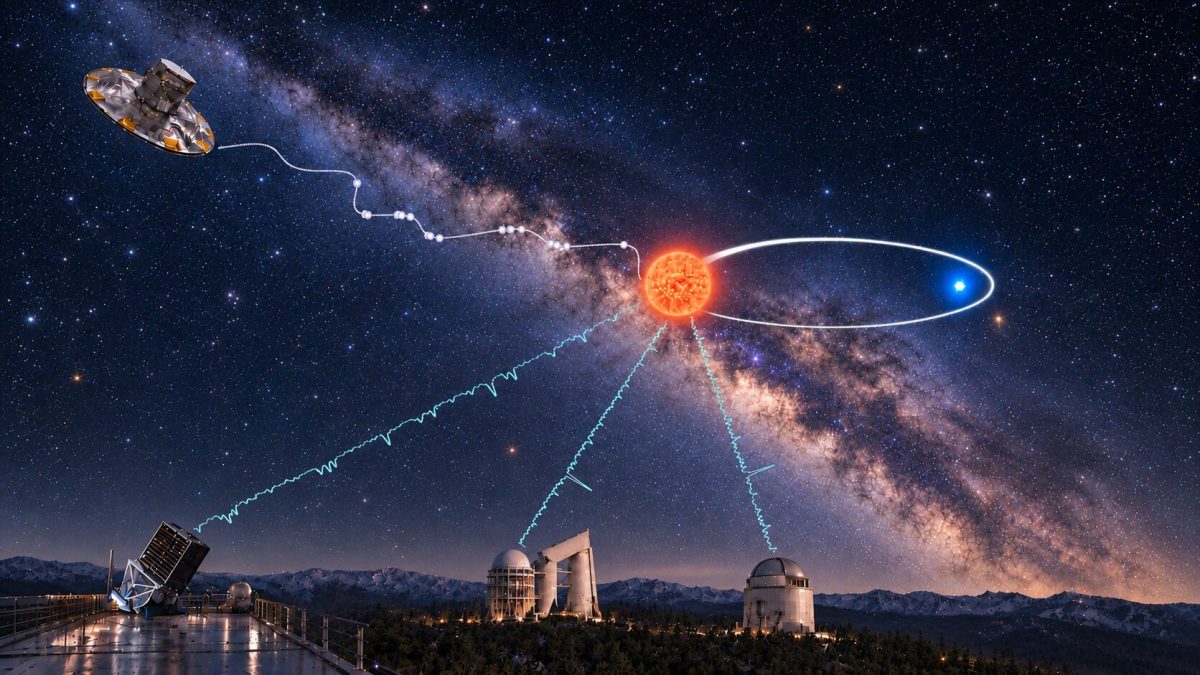
Researchers have discovered the binary system J0008+0128. One of its components is an invisible object approximately 2.2 times more massive than the Sun. Scientists suspect that it is an unusually massive neutron star, filling the gap between this class of objects and black holes.
An invisible component in a binary system
Scientists working with the Sky Area MultiObject Fiber Spectroscopic Telescope (LAMOST) and the Apache Point Observatory Galactic Evolution Experiment (APOGEE) report that they may have discovered an object that fills the mysterious gap between neutron stars and black holes. As reported by Phys.org, a paper on the discovery has been published in the journal Science Advances.
The system in question is J0008+0128. It consists of two objects, one of which is a red giant. The other, however, cannot be seen through any telescope. Yet something is causing the dying giant star to orbit a common center of mass with an unseen companion whose mass is estimated to be between 1.8 and 2.8 solar masses. One complete orbit takes 3.3 years.
The object’s estimated mass range, combined with the fact that it cannot be observed directly through a telescope, leads scientists to suspect that they are dealing with a very massive neutron star. These are extremely dense objects that form as a result of supernova explosions and possess extraordinarily powerful magnetic fields. They do emit light, but their radiation in the visible spectrum is very faint.
The gap between neutron stars and black holes
However, the mass range of the invisible component in the J0008+0128 system raises some interesting questions. All this mass is concentrated within a sphere only about 20 km in diameter, making such objects extremely intriguing. But that is not the main issue. So far, no neutron star with a mass greater than 2.5 solar masses has been discovered.
On the other hand, very low-mass black holes have also not been observed in space. In fact, there is a mass gap between 2.5 and 5 solar masses in which scientists have not observed any supernova remnants. There are theoretical explanations of the threshold beyond which a black hole, rather than a neutron star, should form, but these have not been confirmed by any observations.
This is precisely why the object in the J0008+0128 system is so interesting. Most likely, it is a neutron star with a mass of about 2.2 solar masses. However, it may actually be more massive. In that case, this discovery would significantly narrow the range of uncertainty. There are also theories suggesting that when more massive stars explode as supernovae, some of their mass falls back onto the newly formed black hole or neutron star, meaning that such objects simply cannot have masses within a certain range.
However, the researchers point out that other possibilities also exist. This binary system may actually be a triple system: it could consist of two smaller neutron stars orbiting very close to each other and a red giant, or of a neutron star, a white dwarf, and a red giant. It is also possible that it was previously a triple system in which two smaller objects merged into one. It cannot even be ruled out that this object is a very small black hole, although no black holes this small have ever been detected.
In the future, new data about this system may help researchers better understand its nature. In any case, this system provides additional information that contributes to our understanding of the “mass gap” between neutron stars and black holes.
