

Astronomers have solved the mystery of why hot Jupiters are so common on orbits with periods of around three Earth days, while Neptunes are not. Waves traveling through their atmospheres are responsible.
The “Neptune Desert” Offers Scientists Clues
Using advanced simulations, a team of U.S. astronomers has developed a promising new theory of how giant gaseous exoplanets migrate into extremely close orbits around their stars. Led by J. J. Zanazzi of Pennsylvania State University, the team demonstrated how both massive hot Jupiters and smaller Neptune-sized planets can migrate from distant, elliptical orbits by releasing energy through powerful shock waves in their outer atmospheres. The findings are reported by phys.org.
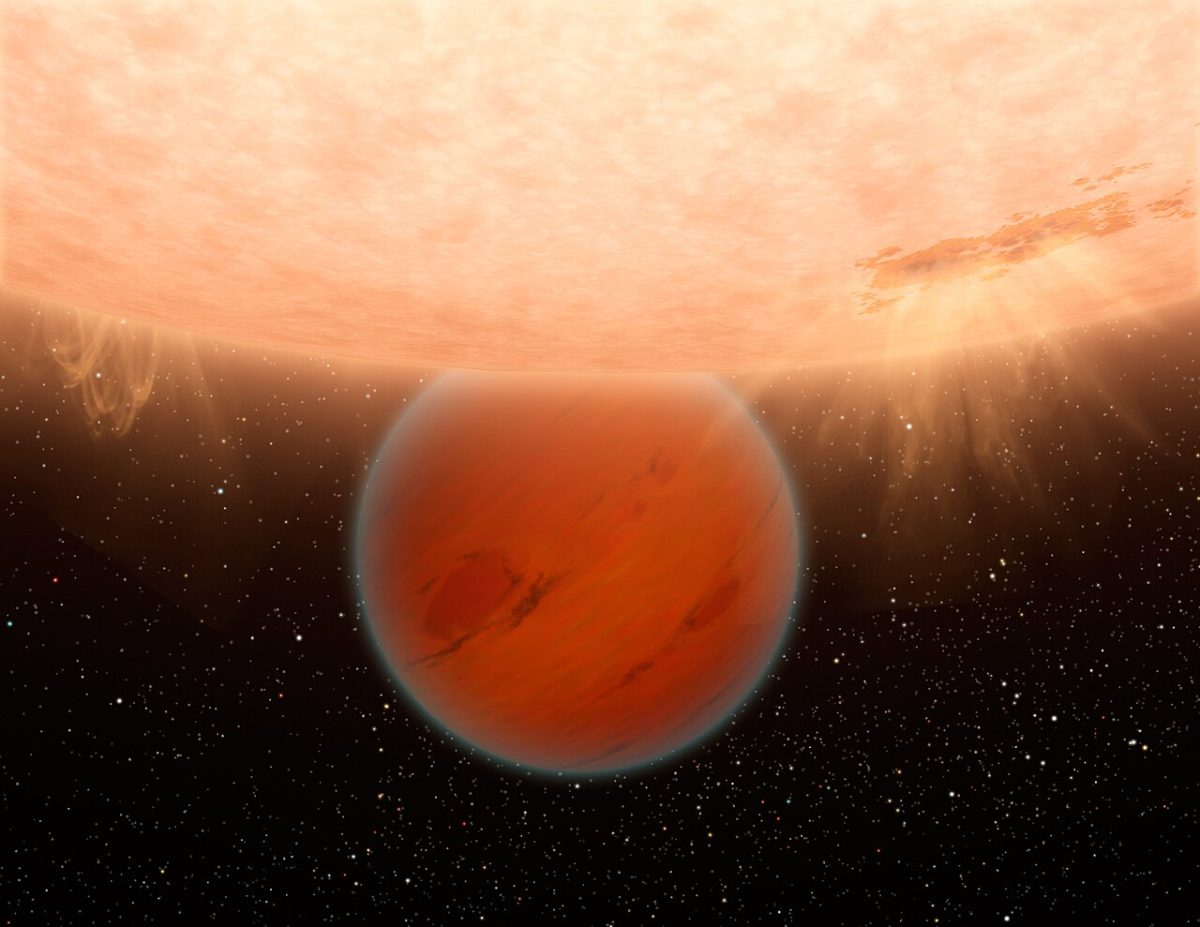
Hot Jupiters are a class of exoplanets with masses comparable to that of the largest planet in our Solar System, but they orbit extremely close to their stars, resulting in temperatures that can exceed approximately 2,000 kelvins. Their orbital periods are not only exceptionally short but also tend to cluster between three and five days—a phenomenon known as the “hot Jupiter pile-up.”
A similar concentration is observed among smaller gas giants with masses between those of Neptune and Saturn, known as the “Neptune ridge.” Unlike hot Jupiters, however, these planets are extremely rare on orbits lasting less than three days, creating a clear gap in observations called the “Neptune desert.”
For astronomers, these features offer clues to the dramatic histories of these exoplanets. A widely accepted hypothesis proposes that they began on highly elliptical orbits much farther out in their stellar systems. As tidal forces from their host stars extracted energy from their orbits, they likely migrated inward, eventually reaching stable, circular orbits of remarkably similar sizes.
But for their orbits to change shape in this way, the planets themselves must have absorbed enormous amounts of orbital energy. “It has always puzzled me that, although all this energy is thought to pass through the planet—enough to strip away most of its mass entirely—few people have attempted to determine exactly what process causes this,” says Zanazzi.
Surface Gravity Waves Reshape Planetary Orbits
To investigate, the team analyzed detailed simulations of giant migrating exoplanets conducted by co-author Morgan MacLeod of Harvard University. At the closest approach along an elliptical orbit, a planet experiences intense gravitational forces from its host star. In the simulations, these forces produced planet-wide oscillations known as “surface gravity waves,” which traveled horizontally across the planet’s surface.
In the tenuous outer atmosphere, where density drops sharply, MacLeod’s simulations showed that these waves can move faster than the speed of sound in the gas. At that point, the supersonic flow becomes a shock wave—a sudden jump in pressure and density that rapidly converts the wave’s energy into heat. Since this energy is drawn from the planet’s orbit, each shock wave shifts its trajectory toward a more circular, lower-energy orbit. In some cases, the heat also supplied the energy needed for gas to escape the planet’s gravitational pull.
The Lifeless Cores of Giant Planets
In the simulations, each planet’s ultimate fate depended on how deep in its atmosphere the shock front formed. The researchers found that shallow shock fronts allowed gas giants to retain their mass, while deeper ones stripped away their gaseous envelopes, leaving behind the lifeless cores of giant planets.
The team suggested that this more violent outcome could explain the existence of dense, rocky exoplanets with masses tens of times greater than Earth’s, which are often found orbiting extremely close to their host stars.
Explaining the “Neptune Desert”
In the team’s model, a planet’s fate depended on how quickly its orbit became elongated. This usually happens slowly: once the planet approaches sufficiently close to its star, shocks produced by surface gravity waves begin to circularize its orbit, preventing further elongation. As a result, both hot Jupiters and smaller gas giants settle at a safe distance, explaining both the hot Jupiter pile-up and the Neptune ridge observed by astronomers.
But if a planet’s orbit becomes elongated more quickly, it can approach too close to its star before the waves take effect, losing gas with each passage. This provides a new explanation for the Neptune desert, whose boundary nearly coincides with the distance at which this gas-loss process begins. It would also explain why the rare exoplanets found within the Neptune desert have exceptionally high densities: likely because of the mass they lost during migration.
The team suggests that hot Jupiters on these closer orbits may subsequently have been pulled farther inward by tidal forces raised on their host stars. “Whether our predictions are confirmed as scientists gather more observational data will show whether our ideas stand up to scrutiny,” says Zanazzi.
