

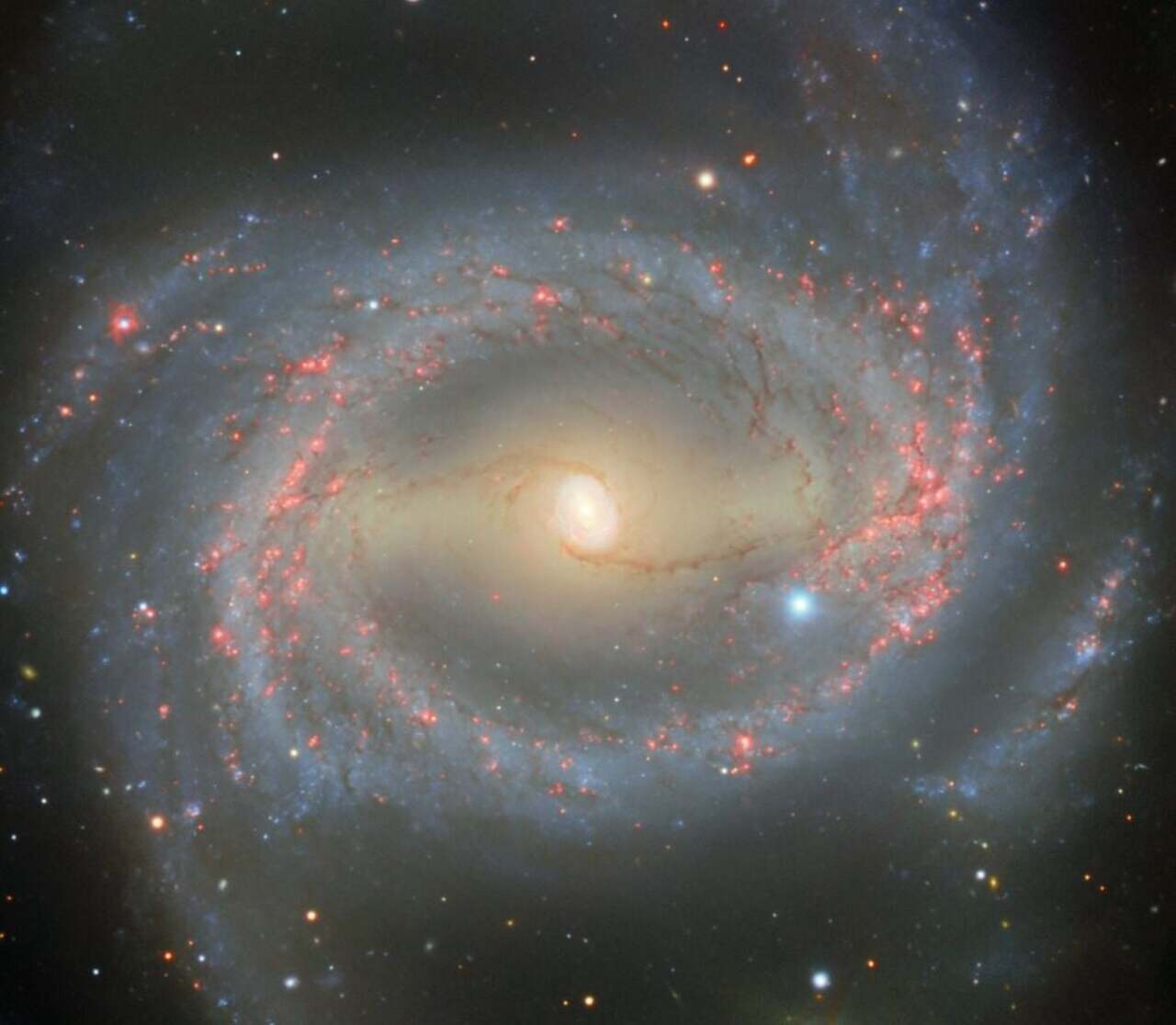
A white dwarf exploded in the galaxy NGC 1433. A white dwarf is the dense remnant of a star similar to the Sun. The resulting Type Ia supernova, which occurs only during such explosions, was detected within the first few days. The white dwarf could have gained enough mass to explode in one of two main ways: gradually accreting material from a neighboring star or merging with another white dwarf. In the first scenario, it could have produced detectable X-ray emission, but there are no traces of it in earlier images of this region. Now scientists need to determine exactly how this supernova formed and refine the distance to the galaxy. The existing estimates differ by a factor of two, and the distance determines how confidently researchers can rule out the possibility that the supernova resulted from a white dwarf accreting mass from a neighboring star.
A rare opportunity
The supernova SN 2026ahvu was discovered on November 2, 2026, using the Asteroid Terrestrial-impact Last Alert System (ATLAS). At the time, its brightness corresponded to a magnitude of 17, and within a few days it had reached magnitude 13.5. The lower the number, the brighter the object, so the supernova became approximately 25 times brighter. As early as November 3, astronomers from the California Institute of Technology identified it as a Type Ia supernova, meaning a thermonuclear explosion of a white dwarf, based on a spectrum obtained with the Keck II telescope.
According to the National Optical-Infrared Astronomy Research Laboratory (NOIRLab), SN 2026ahvu is one of the closest Type Ia supernovae detected since 2011. At their peak, all Type Ia supernovae have approximately the same intrinsic brightness. Therefore, astronomers use how bright a supernova appears from Earth to calculate the distance to its host galaxy. However, the exact types of systems that produce these supernovae remain unknown.

A scenario without evidence
For an explosion to occur, a white dwarf usually has to approach the Chandrasekhar limit, or approximately 1.4 solar masses. It can gain this mass in two main ways. In the first scenario, it gradually pulls material from a companion star. Hydrogen transferred from the companion burns on the white dwarf’s surface, potentially heating it to nearly a million degrees and making it a source of soft X-ray emission even before the explosion. In the second scenario, two white dwarfs gradually move closer together and merge. In this case, no hydrogen is supplied to the surface, so X-ray emission from its burning is not expected before the explosion.
Astrophysicists Akos Bogdan of Eureka Scientific and Tonima Tasnim Ananna of Wayne State University checked whether such a source could be seen in earlier images of this region. The images were taken by the Chandra X-ray Observatory in 2015 and 2024, long before the explosion. Not a single X-ray photon was detected at the supernova’s location. Therefore, a white dwarf heated to nearly a million degrees, as predicted by the first scenario, was most likely not present there.

However, it is too early to rule out this scenario. If the white dwarf’s surface was cooler, for example, because its outer layers had expanded, or if it was surrounded by dense gas, its X-ray emission may have been too weak to be detected in these images. The conclusions of the preprint on arXiv have not yet undergone peer review.
Similarly, searches for a hot white dwarf before the explosions of two other nearby supernovae of this type, SN 2011fe and SN 2014J, which exploded in 2011 and 2014, respectively, were also unsuccessful. The authors believe this is more consistent with the second scenario, since no X-ray emission is expected before an explosion caused by the merger of two white dwarfs. However, the first scenario has not been definitively ruled out.
A distance differing by a factor of two
How convincing this conclusion is depends on the distance to the galaxy. Some measurements give approximately 30 million light-years, while others give about 62 million. If the galaxy is twice as far away, the same source appears approximately 4.3 times fainter from Earth. Therefore, the distance determines how much X-ray emission could have gone undetected.
Since Type Ia supernovae have approximately the same brightness at their peak, the distance can also be estimated from SN 2026ahvu itself. A preliminary calculation gives approximately 58 million light-years, but the supernova has not yet reached its maximum brightness, so this is only an approximate estimate. Universe Today and NOIRLab give a rounded estimate of 50 million light-years. The peak is expected between November 18 and 23, when its brightness will reach between magnitudes 10.5 and 12.1. These observations will help refine the distance.
What will be observed next
NOIRLab is coordinating observations of the supernova using the Gemini South telescope and the 4-meter Blanco telescope equipped with the Dark Energy Camera (DECam). The new images are being compared with images of the galaxy taken before the explosion using the same camera during the Dark Energy Survey.

The supernova can already be observed with an amateur telescope, but not from Ukraine. The galaxy NGC 1433 lies approximately 47 degrees south of the celestial equator, while from Kyiv only objects located no farther than 40 degrees south of the equator rise above the horizon.
If the white dwarf really was surrounded by dense gas, the material ejected by the explosion will collide with it, producing radio and X-ray emission. On the fifth day after the discovery, no radio emission was detected by the MeerKAT telescope. The decisive evidence will come from X-ray observations after the explosion, which will show whether there was gas around the white dwarf capable of hiding it in archival images. If no gas is found, the gas-related explanation will be ruled out, leaving only one possibility within the first scenario: a cooler white dwarf surface. If gas is detected, it may have concealed the X-ray emission, making the first scenario entirely plausible again.
