

A massive, unstable star in a distant galaxy has been experiencing regular outbursts for more than a decade, and astronomers have now discovered why. An unseen companion orbits nearby, most likely a black hole or a neutron star. During a recent brightness surge, astronomers detected X-ray emission of a power that can only be produced by matter falling onto such an object. Each time the companion makes its closest approach to the star, it pulls some of its material away, and this is what fuels the outbursts.
Outbursts on a schedule
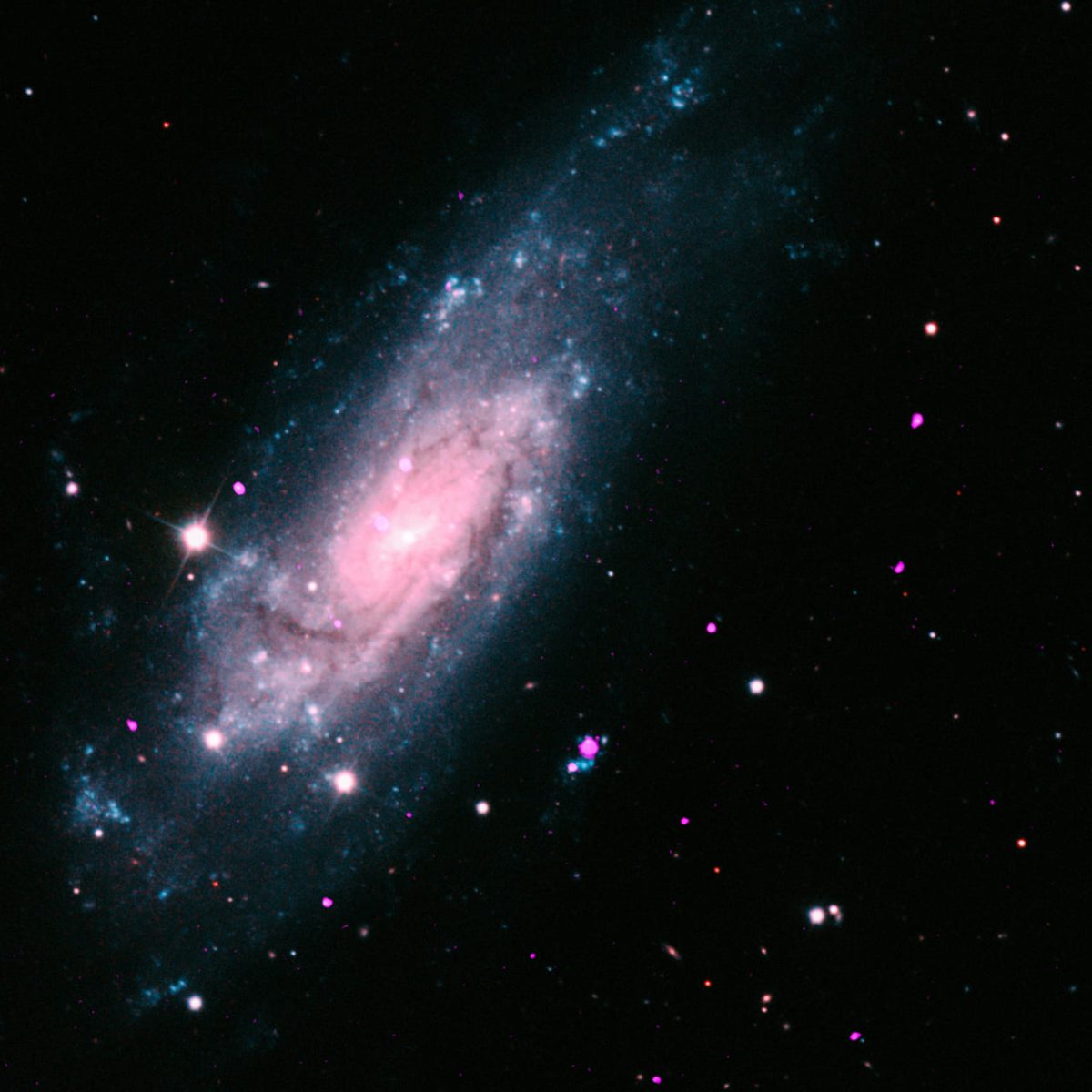
The star AT 2016blu is located in the galaxy NGC 4559, approximately 30 million light-years from us, and is at least 33 times more massive than the Sun. Its brightness remained stable until 2012, but since then astronomers have recorded 27 outbursts that recur approximately every 113 days, according to NASA.
The star belongs to the class of luminous blue variables, massive stars that occasionally eject part of their outer envelopes. Such ejections are usually irregular, so the clear rhythm of AT 2016blu has long pointed to a second object in orbit. Similar outbursts were also produced for years by the supernova progenitor SN 2009ip, and a companion could explain why such stars explode earlier than models predict.
The X-ray signature
The nature of the companion is most directly revealed by X-ray data. Collisions between stellar winds, meaning streams of gas from two massive stars, produce only moderate X-ray emission, whereas matter falling onto a black hole or neutron star shines incomparably more brightly.
The regularity made it possible to predict an outburst in March 2026, and immediately after it reached its peak, a team led by Mojgan Aghakhanloo of the University of Virginia conducted observations using the Chandra X-ray Observatory. Only this observatory can distinguish AT 2016blu from a neighboring, much more powerful X-ray source. Without data obtained at the right time, the team would not have been able to understand what was causing the outbursts, according to Mojgan Aghakhanloo.
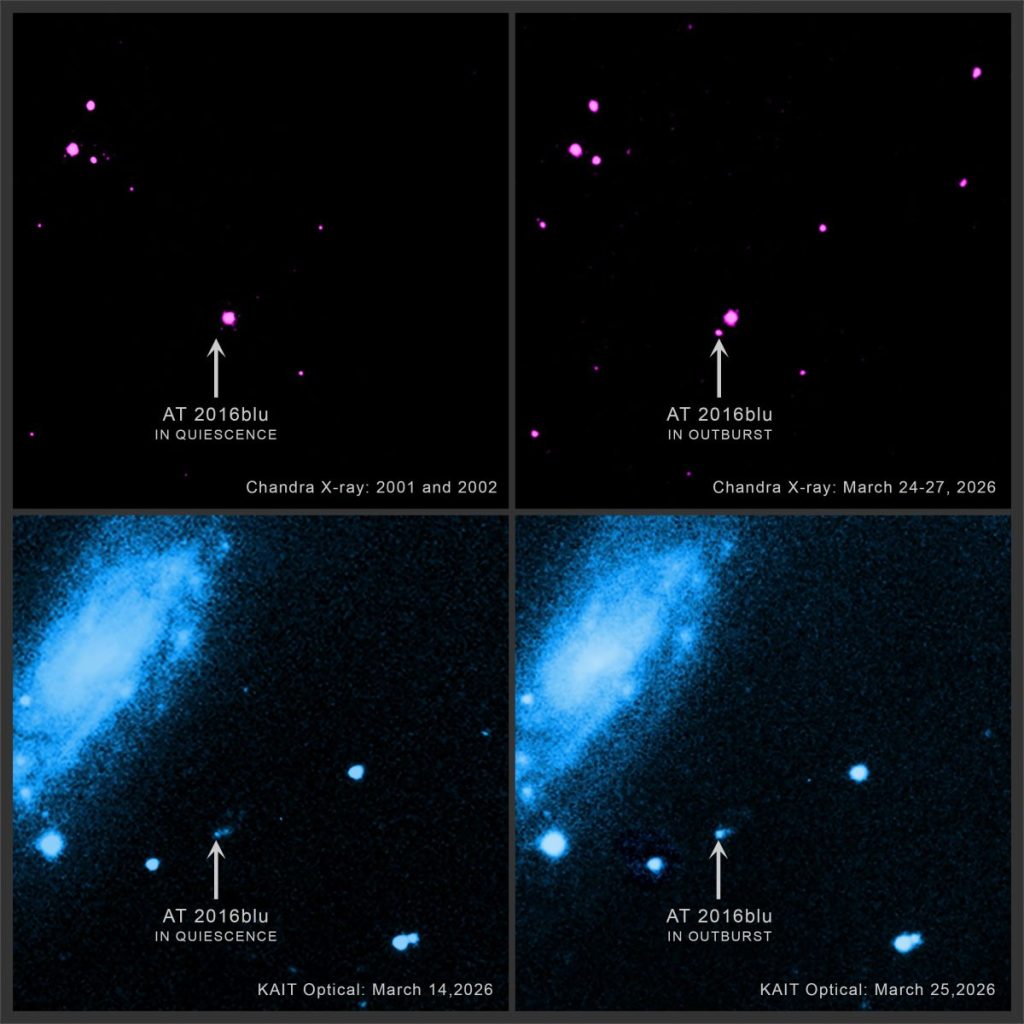
In archival Chandra images from 2001 and 2002, nothing was visible at this location, but now its X-ray luminosity has increased by at least a factor of 100. The system emits approximately 100,000 times more energy in X-rays than the Sun emits across all wavelengths. In Eta Carinae, the Galaxy’s most famous luminous blue variable, collisions between stellar winds and its companion produce only about 50 times the Sun’s luminosity at their peak. Only matter falling onto a compact object can produce such power.
The mechanism behind the outbursts
The companion’s orbit is elongated, so once every 113 days it approaches the star particularly closely and likely captures part of its stellar wind at that point. The gas spirals into a disk around the compact object, where friction and compression heat it to millions of degrees, causing it to shine in X-rays.
The visible outburst, meanwhile, is approximately 100 times brighter than the X-ray emission. Dense gas ejected by the star absorbs almost all the X-rays and re-emits their energy as visible light, so only about 1% of the radiation escapes in X-rays, according to the authors of the study published in the peer-reviewed journal The Astrophysical Journal.
A black hole or a neutron star?
The type of companion remains unknown. Regular X-ray pulsations caused by its rotation would indicate a neutron star, but only a few dozen photons were recorded over four days, which is not enough to search for such pulsations.

The system’s luminosity nearly reaches the threshold for ultraluminous X-ray sources, and its true peak may have been missed. Therefore, the authors consider AT 2016blu a candidate for this class of sources, whose origins are still not fully understood.
The outbursts probably began in 2012 because the star gradually increased in size, as indicated by its rising brightness in data from the Gaia space telescope. While the star was smaller, its companion received too little material from it. If the star expands only temporarily, the outbursts will eventually stop, and observations over the coming years will reveal whether this is the case.
