

The red giant Mira ejected a loop of gas into space, and for the first time, scientists have established that it was accelerated by a magnetic field. Until now, it was believed that such stars lose gas differently, as radiation pressure on dust particles pushes it outward. Therefore, magnetic eruptions may be the primary mechanism of mass loss in stars during the late stages of their evolution.
A Magnetic Loop Near Mira
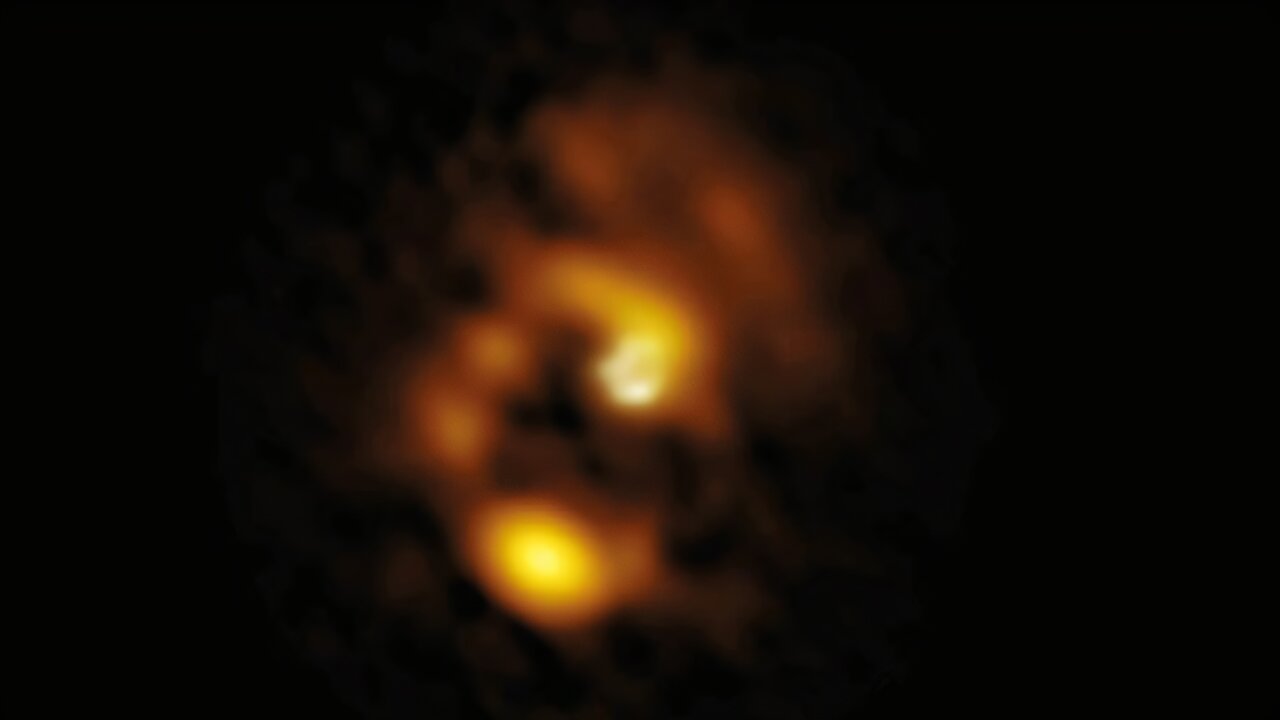
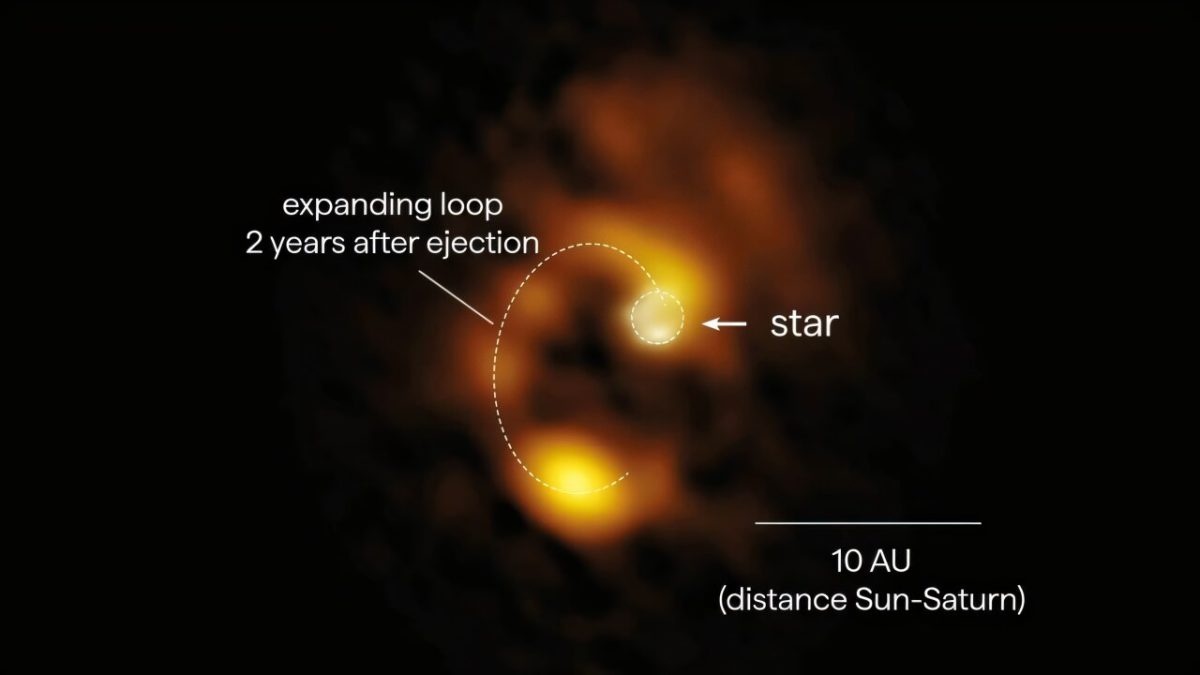
The star Mira is located 330 light-years away in the constellation Cetus. On August 10, 2025, astronomers from Chalmers University of Technology observed it using the ALMA radio telescope and discovered a loop of gas 12 astronomical units long, 12 times the distance between Earth and the Sun. Analysis of the loop’s radio emission revealed that it is permeated by a strong magnetic field. This is the first direct evidence that magnetism ejects material from a star during the late stages of its evolution.
How stars lose matter during the late stages of their evolution determines how carbon, oxygen, and nitrogen from their interiors enter new stars and planets. In several billion years, the Sun will become similar to Mira.
The authors explicitly call the event an analogue of coronal mass ejections, which on the Sun originate above sunspots and are often accompanied by powerful flares. The gas in the loop near Mira is much colder, and the energy of the ejection exceeds that of solar coronal mass ejections by several orders of magnitude. Magnetic field lines anchored in the surface stretch like elastic threads. When the tension exceeds the force of gravity, the field lines break away together with the gas and carry it out into space.
The radio emission from the loop comes from silicon monoxide molecules. In very dense gas, they act as a natural maser, the radio equivalent of a laser. At such a great distance from Mira, ordinary gas is too diffuse, so the authors believe that the loop is a shock front where the gas is strongly compressed.
This emission is polarized, and the direction of polarization follows the curve of the loop. Such an ordered pattern is stable only in a sufficiently strong magnetic field, meaning that the field inside the loop is at least 0.7 gauss. This is stronger than the magnetic field at Earth’s surface, which does not exceed 0.65 gauss, even though the loop is billions of kilometers away from the star. The results have been published in the peer-reviewed journal Astronomy & Astrophysics.
A Hot Spot Before the Ejection
The loop is moving away from the star by inertia, and based on its motion, the authors calculated that the eruption began sometime between mid-2023 and early 2024, at a speed of about 35 km/s. In June 2023, a hot spot was observed on Mira’s surface, at least 4,200 degrees hotter than the surrounding surface. The spot was located where the loop begins.
According to phys.org, the brightest regions on Mira’s surface are located in different places each time. Miora Andriantsaralaza and her colleagues analyzed 19 ALMA observing sessions from 2017 to 2025 in a second paper and found that hot spots recur from one cycle to the next. Mira’s brightness varies with a period of 331 days, and the spots appear near the maximum and last for several weeks. Their nature remains unknown.
Dust as a Consequence
During the previous major ejection, at the turn of 2010 and 2011, dust formed only at the outer boundaries of the gas. Therefore, dust appears to be a consequence of the eruption rather than its driving force. The mass of the new ejection is at least one-millionth of the Sun’s mass, or more than one-third of Earth’s mass.
The animation shows how a flare on the surface of the red giant Mira in 2023 formed a magnetized loop of gas, which was detected by ALMA in 2025. Credit: Chalmers / W. Vlemmings et al. Source: Onsala Space Observatory
According to Wouter Vlemmings and his colleagues, the energy of the ejection exceeds that of superflares on Sun-like stars by up to several orders of magnitude. Such eruptions may form planetary nebulae.
The authors believe that models of stellar winds from red giants and possibly supergiants must now take magnetic fields into account. To find out whether every hot spot ends in an ejection, the team proposes regularly observing such stars with ALMA at the highest possible resolution.
