

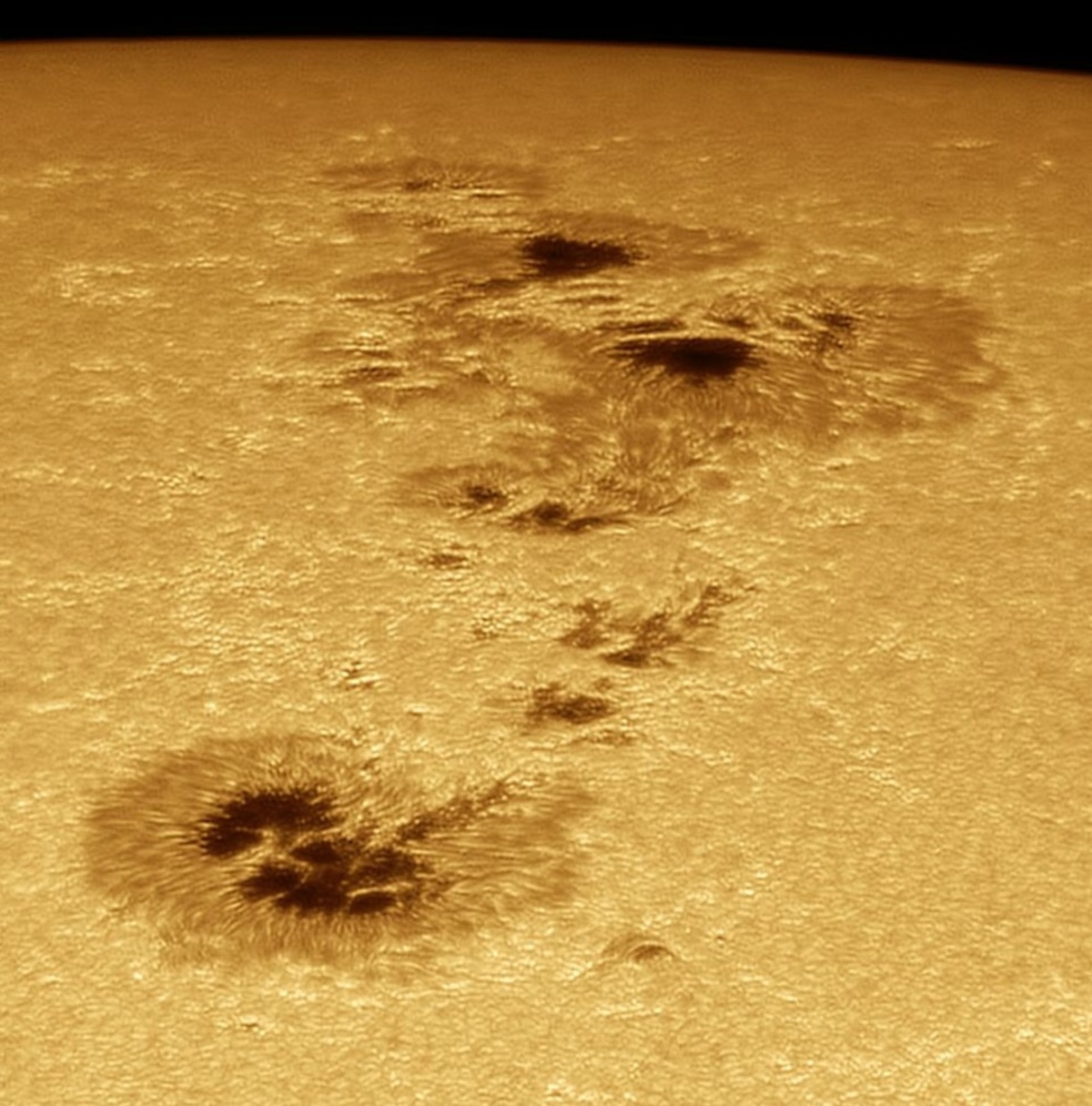
One of the largest groups of sunspots in recent years has become visible on the Sun’s disk. The active region is visible to the naked eye through special eclipse-viewing glasses. The tangled magnetic fields in this region are capable of generating powerful coronal mass ejections toward Earth.
Formation on the far side
Active region AR 4478 was detected on June 24, 2026, when it emerged from behind the eastern edge of the solar disk. Even before that, it had been tracked by the Solar Orbiter spacecraft while the active region was forming on the far side of the Sun.
Experts confirmed that AR 4478 has a beta-gamma-delta configuration according to the Mount Wilson classification. This is the most complex type of magnetic structure in sunspots, where fields of opposite polarity are tightly intertwined, and it is precisely these regions that most often generate powerful solar flares.
Scale and Threats
The group of sunspots contains at least nine distinct dark cores, and its total area reaches hundreds of MSH—that is, millionths of the area of our Sun’s visible hemisphere. This is the standard unit of measurement for sunspot area in heliophysics. In terms of size, AR 4478 is comparable to the famous AR 3664, which in May 2024 triggered a G5-level geomagnetic storm—the most powerful in 20 years.
According to estimates by the Space Weather Prediction Center (SWPC), the probability of M-class flares is 50%, while that of the highest class, X-class, is 10%. If a coronal mass ejection (CME) strikes the magnetosphere directly, it could cause malfunctions in satellites in orbit, power surges in electrical grids, and disruptions in radio communications. For comparison, in February of this year, an X8.11-class flare was recorded in active region AR 4366, making it the third-strongest flare of the current solar cycle.
Slow CME and Forecast
According to the SWPC, the coronal mass ejection (CME) detected on June 26 is traveling mostly south of the Sun–Earth line. It may deliver a glancing blow to the edge of Earth’s magnetosphere around June 30, but a significant geomagnetic storm is considered unlikely.
Even so, aurora watchers around the world remain on alert. When charged particles from coronal mass ejections enter the upper atmosphere, they excite oxygen and nitrogen atoms, causing them to emit the characteristic green, red, and purple lights of the aurora.
What Happened Before
In May 2024, active region AR 3664 stretched across approximately 200,000 km, making it about 15 times wider than Earth. It produced 12 X-class solar flares, including an X8.7 event. The resulting G5-class geomagnetic storm triggered spectacular auroras that were visible from Puerto Rico to Ukraine, including the Odesa, Kharkiv, Chernihiv, and Sumy regions.
So far, AR 4478 has produced only a handful of C-class flares. However, regions with a beta-gamma-delta magnetic configuration are highly unpredictable, and conditions can change within hours. Astrophotographer Alfredo Vidal Perez captured the sunspot group in visible light from Barcelona, and the image was selected as NASA’s Astronomy Picture of the Day (APOD) on June 28, 2026.
According to NASA APOD