

A thin, curved band of stars extending from a globular cluster has been detected beyond the Milky Way for the first time. Similar structures had long been predicted in distant galaxies, but they are too faint to observe. The discovery has provided astronomers with a new way to weigh dark matter in a distant galaxy.
The Galaxy’s Dark Background
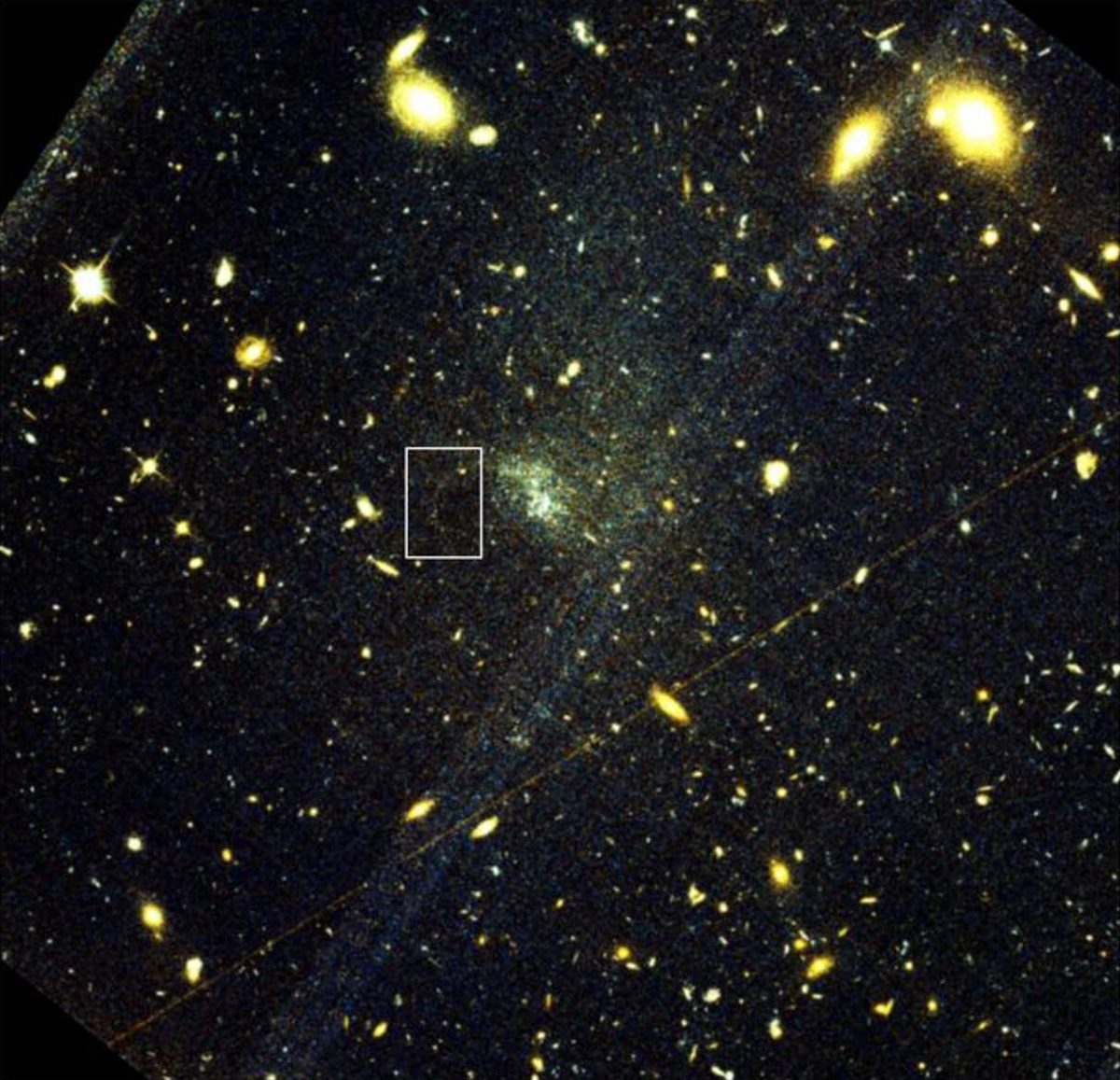
The faint structure could be detected thanks to the characteristics of the environment in which it is located. The ultra-diffuse galaxy UGC 9050-Dw1 has such a sparse population of stars that its own glow remains extremely faint. Against this background, the stream stood out clearly despite the 115 million light-years separating it from Earth.
This dwarf system orbits the spiral galaxy UGC 9050 as a satellite. Several dozen globular clusters had previously been counted in it, an unusually large number for an object of such low brightness.
A Trace of a Disrupted Cluster
The stream was named “Oyashio.” It extends for approximately 6,000 light-years, and a compact source can be seen near one of its ends.
The shape of the stream and the color of its stars indicate that the material was stripped specifically from a globular cluster rather than from an absorbed dwarf galaxy. Tidal forces gradually pull stars out of such a structure and stretch them along a common orbit.
How Dark Matter Is Weighed
The stars in the stream move along nearly the same orbit, whose shape is determined by the galaxy’s gravitational field. By modeling this field, astronomers can estimate the total mass of the system.
“We already know approximately what fraction of this mass is made up of visible matter such as stars, so the rest must be dark matter,” Tjitske Starkenburg of Northwestern University, a co-author of the study, explained in an EurekAlert release. For UGC 9050-Dw1, the calculation showed that visible matter accounts for only a few percent of the total mass.
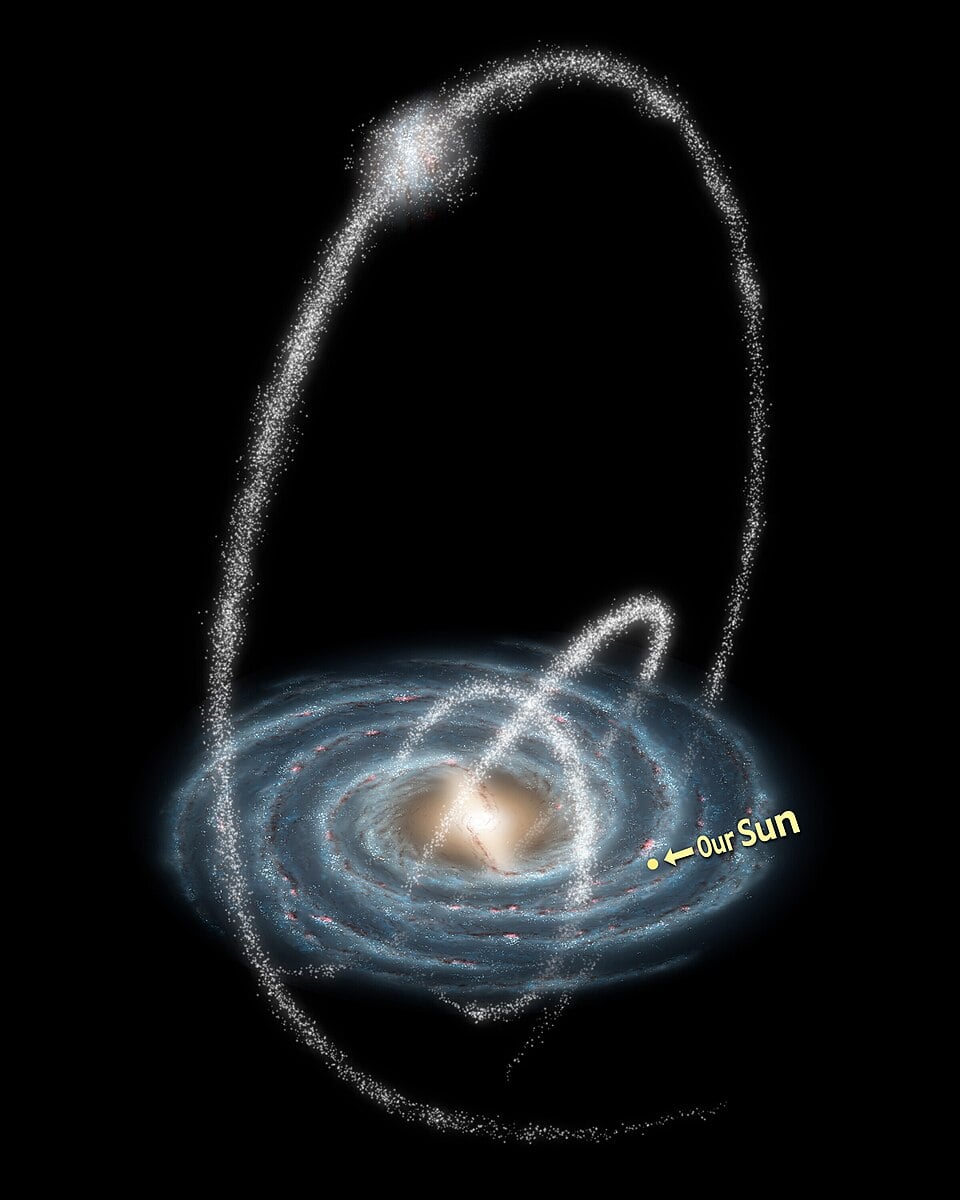
About a dozen streams originating from globular clusters are known in the Milky Way. Astronomers have spent years refining this technique using them, especially Palomar 5 and GD-1, and until now it had remained a method for studying the halo of just one galaxy — our own.
Agreement with Previous Estimates
The results were published in the peer-reviewed journal Nature on August 12. The values obtained matched those previously determined for the same dwarf system using traditional methods.
“We are measuring it with a completely new tool for this type of galaxy and showing that the approach also works beyond our Galaxy,” said Julie Kihl Holm of the University of Copenhagen, co-leader of the study. As Universe Today reports, the team believes that similar structures are likely to be found in other galaxies as well.
Searching for the Next Streams
The band of stars was identified in archival Hubble Space Telescope images obtained as part of an observing program focused on globular clusters. Technically, nothing prevented it from being discovered earlier, since the data had been publicly available for several years.
The greatest hopes are associated with the Nancy Grace Roman Space Telescope. Its field of view is one hundred times larger than that available to Hubble.