

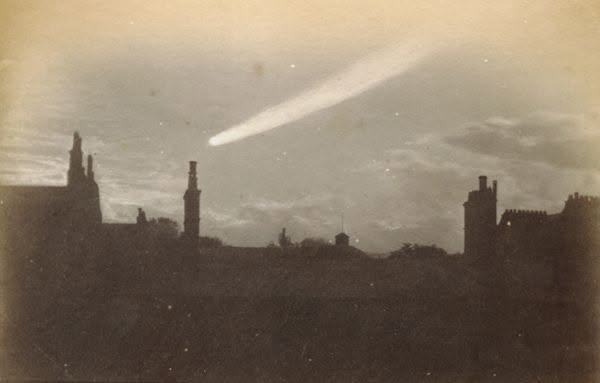
In early September 1882, astronomers at the observatory at the Cape of Good Hope in South Africa spotted a remarkable celestial body. Over the following weeks, the comet rapidly brightened, reaching an impressive magnitude of −2 by 15 September. When it passed through perihelion two days later, its glow was so powerful that it could be clearly seen even in broad daylight.
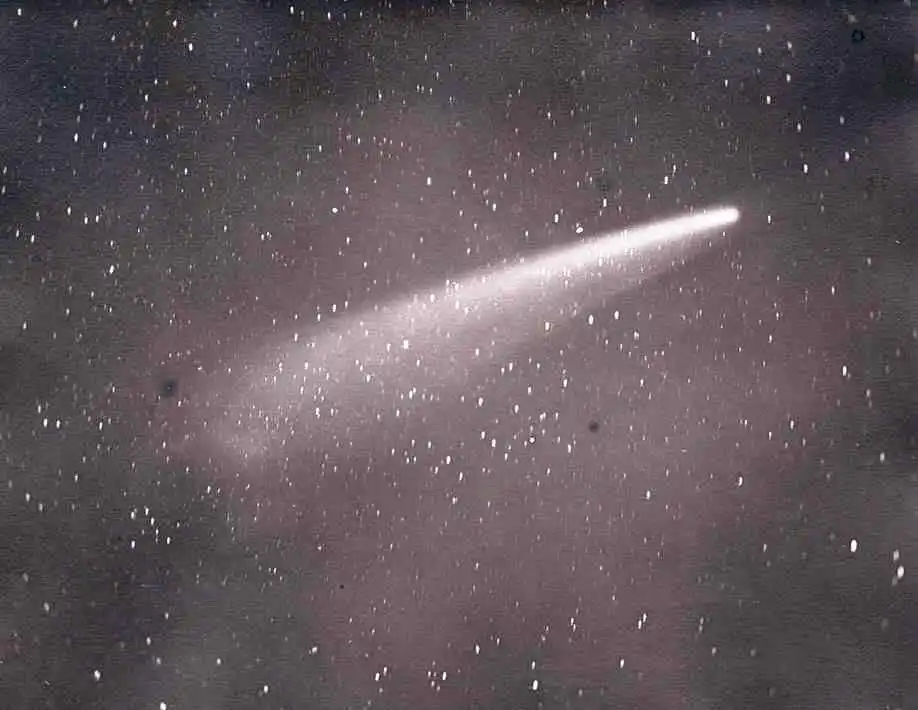
At the time, David Gill, director of the Cape Observatory, was fully occupied with another scientific task: observing the rocky asteroids Victoria and Sappho. It was only on 12 October, after completing his ongoing measurements, that he was able to turn his telescopes towards the unusual visitor and begin photographing it.
An Image That Made History
Gill took a series of photographs of the Great Comet on 12, 20 and 21 October, followed by 7, 13 and 14 November. However, it was the image captured on 7 November that brought him worldwide fame and secured his place in the history of science. Although it was far from the first photograph of a comet, it marked a fundamental shift in how the scientific community viewed and used astrophotography.
The Great Comet of 1882 reached perihelion, its closest point to the Sun, on 17 September 1882. This exceptionally bright comet belonged to the Kreutz sungrazers, a family of comets that pass within one solar radius (1 R☉) of the Sun’s photosphere at perihelion. The comet was so bright that it could be seen beside the Sun in the daytime sky during its closest approach.
Creating this image required a 100-minute exposure. The resulting glass photographic plate recorded not only the comet’s spectacular tail, stretching across 18°, but also an enormous number of faint stars, down to magnitude 10. At the time, such clarity and depth seemed almost unbelievable.
From a Comet to Half a Million Stars
Seeing the vast number of stars captured in a single long exposure, Gill immediately recognised the enormous potential of photographic plates for systematically mapping the stars. This inspiration launched an ambitious project called the Cape Photographic Durchmusterung—the German term Durchmusterung translates as “thorough survey” or “detailed examination”.
As part of this project, scientists undertook the monumental task of cataloguing 450,000 stars in the southern sky. Gill actively shared his achievements with colleagues around the world. News of the new technique’s capabilities stirred the scientific community and became the main catalyst for convening the first major international astronomical conference in history.
Thanks to this breakthrough, astronomers around the world began moving away from the traditional, laborious and time-consuming practice of plotting stars by hand. It was replaced by far more efficient and precise photographic techniques, which laid the foundations of modern astronomy.
We previously explained why comets fascinate us so much.
Based on reporting by Astronomy.
