

British writer M. John Harrison has won the 2026 Booker Prize for his science fiction novel The End of Everything. For the first time, the winner is a writer who emerged directly from the world of genre science fiction. He is also the oldest winner in the prize’s history.

A Science Fiction Writer Among the Winners
Many authors on Booker Prize lists have borrowed techniques from science fiction, but no previous winner came from within the genre itself. Gaby Wood, chief executive of the Booker Prize Foundation, emphasised this distinction in comments to NPR. The writer is 81, and The End of Everything is his thirteenth novel.
M. John Harrison sold his first short story back in 1965. He later joined the British science fiction magazine New Worlds, where he edited the books section until 1978. He won the Arthur C. Clarke Award for his novel Nova Swing and served on the Booker judging panel himself in 2022. The End of Everything earned him his first nomination, and the victory brought him £50,000.
A World After Catastrophe
The judging panel, chaired by classicist Mary Beard, spent an entire day discussing the six shortlisted novels. Its decision was unanimous.
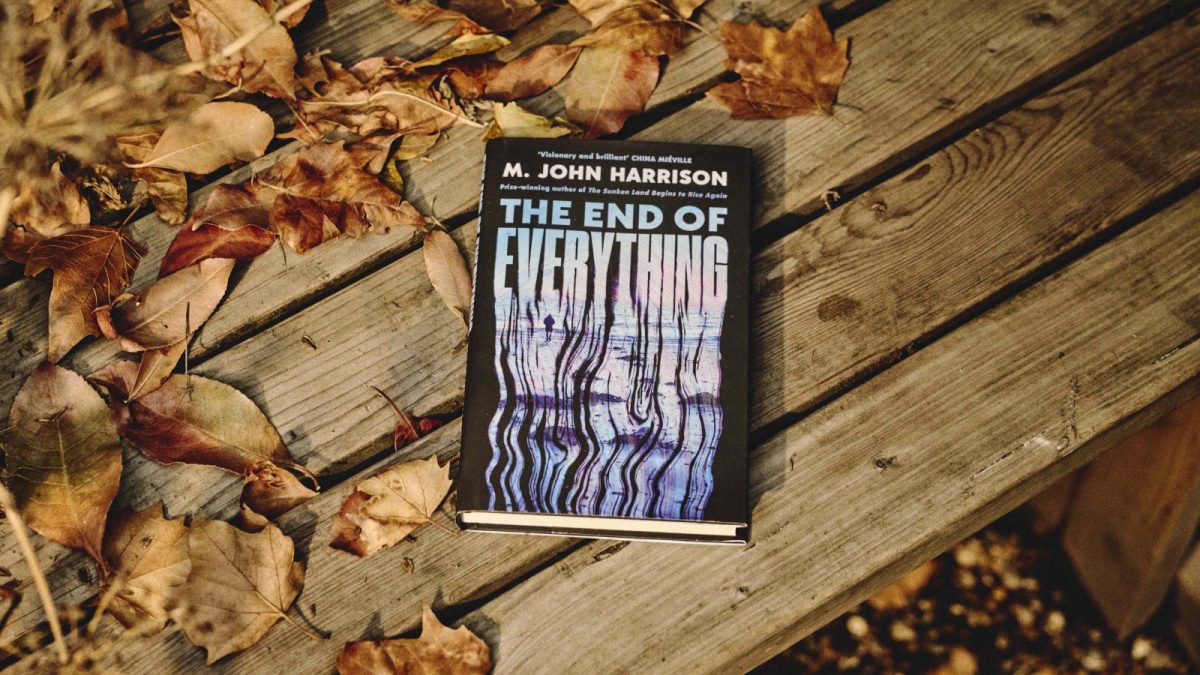
The novel is set on England’s south coast several decades after a mysterious invasion by the iGhetti, creatures capable of changing shape. The letter “i” hints at something digital, although Mary Beard cautions that this cannot be said with certainty. The state barely functions, and vigilante groups maintain order.
The protagonist, Phillip Tennent, collects objects washed ashore from the English Channel. One day, he finds a jelly-like blob that grows rapidly, begins to speak and starts giving people orders. Mary Beard stresses that the apocalypse in the book is fundamentally incomprehensible, so the old rules no longer carry any weight. “This is the politics of the present seen through the lens of the future,” she explained in a statement published by the Booker Prize.
A Crisis of Explanation
According to M. John Harrison, the initial inspiration for the novel came from the financial crisis of 2008. He wanted to write about how society loses its ability to explain the world, and catastrophe offered a useful starting point.
In a real disaster, he believes, it is not even about survival. The world simply stops working the way it used to. And everything a person knew suddenly loses its foundation.
The Boundary Between Genres
Science fiction has long had its own awards. The Hugo Awards have been presented since 1953, the Nebula Awards since 1966, and Britain’s Arthur C. Clarke Award since 1987. For a long time, major literary prizes rarely recognised genre fiction.
There have, however, been exceptions. Margaret Atwood’s dystopian novel The Handmaid’s Tale was shortlisted for the Booker Prize in 1986. In 2019, she won the prize for The Testaments, a continuation of the same story, sharing it with British writer Bernardine Evaristo. The 2007 Nobel Prize in Literature went to Doris Lessing, author of the science fiction series Canopus in Argos. Kazuo Ishiguro’s Never Let Me Go, whose characters are clones, was also shortlisted for the Booker Prize in 2005.
All of these writers began outside the genre and turned to speculative fiction after establishing themselves as novelists. M. John Harrison took the opposite path. His victory was also a first for publisher Serpent’s Tail, although this was the fifth time one of its books had been nominated for the Booker Prize.
