

No method has yet detected planets around pairs of white dwarfs, the remnants of stars like the Sun. Gravitational waves will offer a way to search for them. The gravitational pull of a massive planet causes the binary system to wobble slightly, leaving an imprint on the gravitational waves it emits. The future space-based gravitational-wave observatory LISA will detect this signature, and the discoveries will be checked using the James Webb Space Telescope.
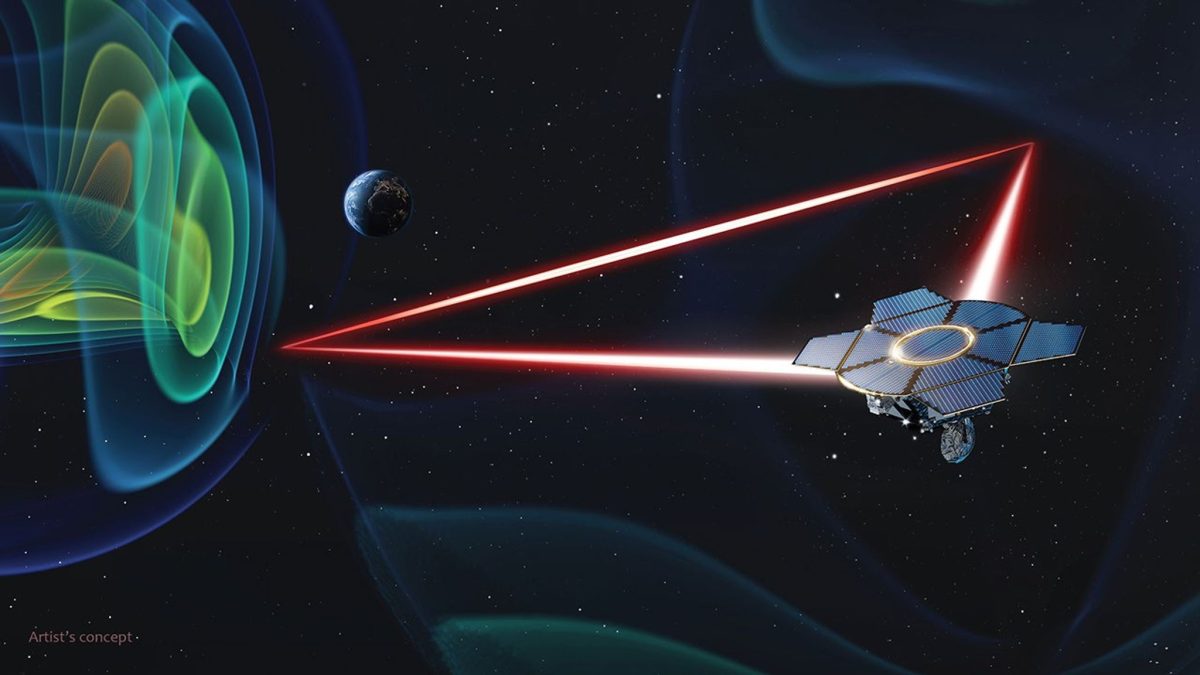
How a Planet Changes the Signal
White dwarfs in close binary systems orbit one another and emit gravitational waves at an almost constant frequency. If a sufficiently massive planet is nearby, the pair moves around a centre of mass shared with the planet, periodically approaching us and then moving away. As the pair approaches, the wave crests reach Earth more frequently, increasing their frequency—a blueshift. As it recedes, the frequency decreases, producing a redshift. Both are manifestations of the Doppler effect, and for gravitational waves these terms refer only to a shift in frequency, not colour.
How gravitational waves will help find exoplanets around double white dwarfs. Video: NASA Goddard Space Flight Center’s YouTube channel
In LISA’s data, this will appear as sidebands: weaker signals slightly above and below the main frequency. Without a planet, the pair produces a single narrow peak in the spectrum. The periodic variation in frequency redistributes part of the signal into two additional peaks on either side. Their separation from the main peak corresponds to the planet’s orbital frequency, while their strength can be used to estimate its mass. Casey McGrath of NASA’s Goddard Space Flight Center and the University of Maryland, Baltimore County, compares them to sidebands in radio communications. This approach will make it possible to detect a Jupiter-mass planet thousands of light-years away.
A similar approach has long been used to search for exoplanets. The radial velocity method finds planets through Doppler shifts in the spectral lines of their host stars; here, however, waves in spacetime replace light. Japanese astronomer Naoki Seto proposed applying this method to double white dwarfs back in 2008. Now, a paper published in the peer-reviewed journal The Astrophysical Journal has determined the planetary masses and orbital periods for which it works best.
A New Population of Planets
Planets have already been found around several single white dwarfs, but none around double white dwarfs. The best-known example, the Jupiter-sized giant WD 1856+534 b, was spotted in 2020 using the TESS telescope, and its year lasts 34 hours. According to NASA, LISA’s discoveries will constitute a distinct, previously unknown population of exoplanets. Scientists will then need to determine how these planets survived both stars expanding into red giants—or whether they formed afterwards.
There will be plenty of targets. The Galaxy is estimated to contain around 10 million double white dwarf systems with orbital periods of less than an hour. LISA will be able to distinguish approximately 10,000 of these systems individually, along with around a hundred mixed pairs in which a white dwarf has a neutron star or black hole as its companion.
Confirmation in the Infrared
A second paper in the same journal focuses on confirming the discoveries. A cold planet emits primarily in the infrared, making a system containing one brighter at these wavelengths than the white dwarfs alone. James Webb can detect this excess out to distances of at least 500 light-years.
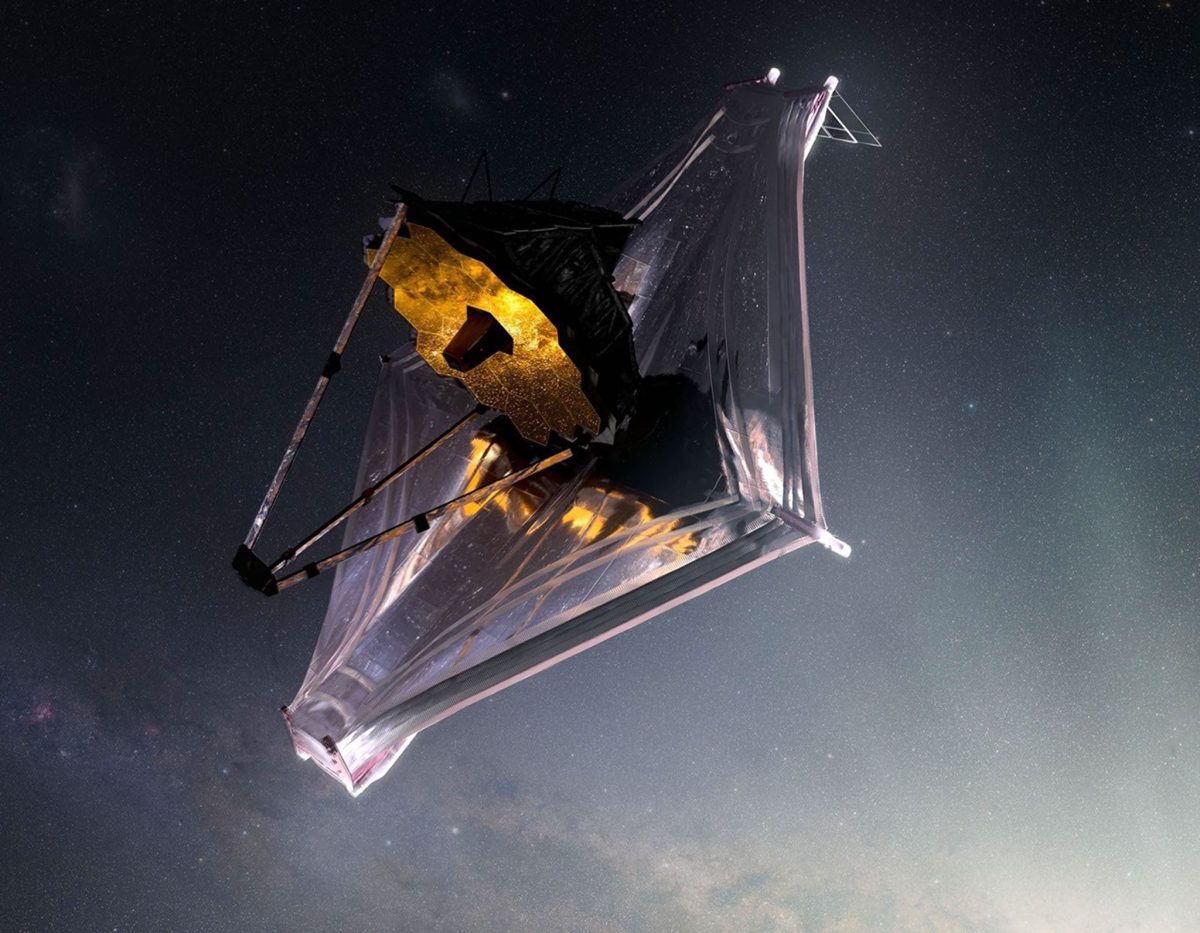
The two instruments differ in sensitivity. At this distance, the telescope will be able to detect a planet approximately five times as massive as Jupiter. Under ideal conditions, even a planet less massive than Jupiter will be detectable in LISA’s data.
Mary Anne Limbach of the University of Michigan emphasises that joint observations will help distinguish real planets from false signals. Theorist Scott Noble of Goddard also contributed to the research.
Launch in the 2030s
The LISA mission is led by the European Space Agency, with launch scheduled for the mid-2030s. Three spacecraft will travel around the Sun along Earth’s orbit, forming a triangle with sides 2.5 million kilometres long. This is approximately six and a half times the distance between Earth and the Moon, which is 384,000 kilometres.
Infrared laser beams will measure how gravitational waves change the distances between the spacecraft, even though these changes are smaller than the diameter of a helium atom. The sidebands produced by a planet are weaker than the main signal, so researchers will need to search for them among the tiniest fluctuations in these data.
