

The Japanese Martian Moons eXploration (MMX) probe is expected to launch toward Phobos within the next few months. It is intended not only to land on this Martian moon, but also to return samples of its soil to Earth.
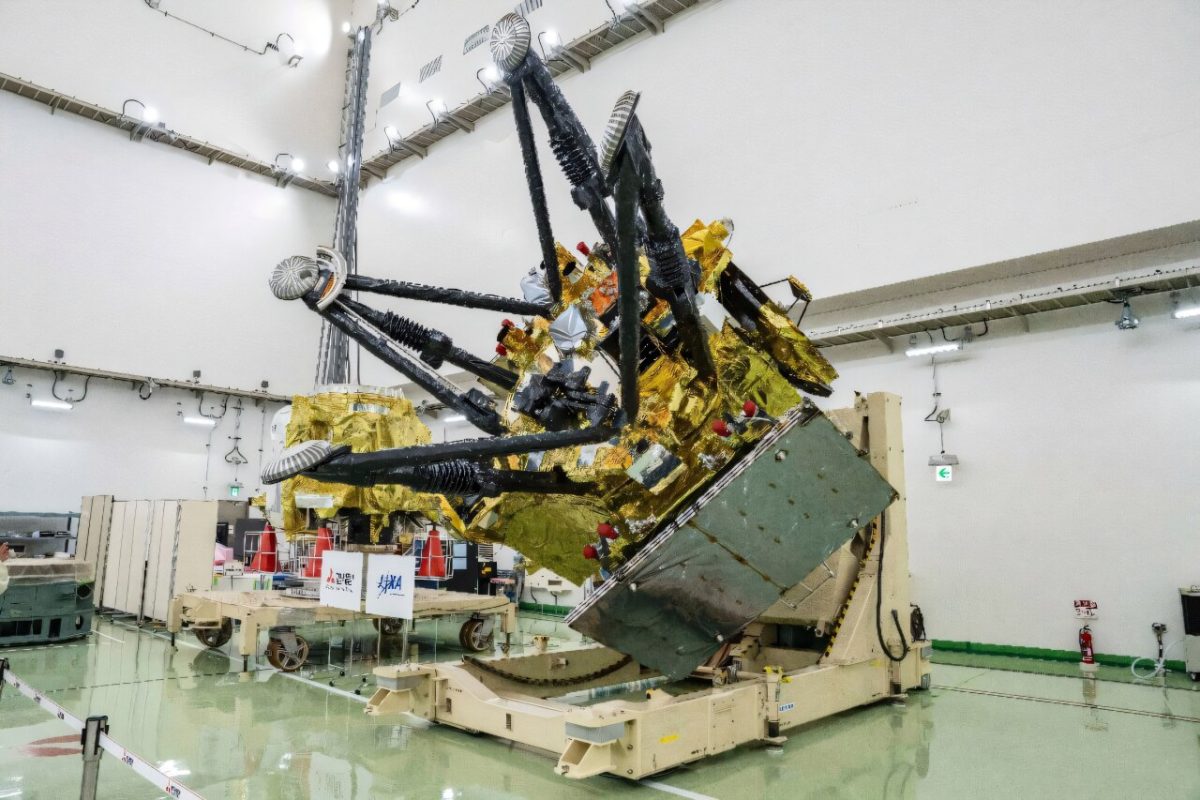
MMX Mission
As Phys.org reports, the Japanese space agency JAXA is preparing to launch the Martian Moons eXploration (MMX) probe. It is expected to lift off from the Tanegashima Space Center within the next few months. Its destination will be the Martian moon Phobos.
Japan is not the only participant in the project. MMX is a joint mission involving JAXA, the French National Centre for Space Studies (CNES), the German Aerospace Center (DLR), NASA, and the European Space Agency (ESA), as well as a number of universities and technology companies.
As announced last Thursday, the spacecraft will travel to Mars and remain near the planet for about three years. In 2031, it is expected to return to Earth — not alone, but carrying 10 grams of soil samples from the Martian moon on which it is intended to land.
What They Will Look for on Phobos
In general, MMX has a very broad scientific program. The landing on Phobos alone is of enormous importance for future missions. This Martian moon is located extremely close to the planet and is therefore considered a promising location for a future base. The Japanese probe is expected to help determine how realistic and practical this idea actually is.
The spacecraft will also carry the IDEFIX rover. It was built by the European partners so that it can travel across the surface of Phobos and photograph its landscapes. Nevertheless, the primary objective of the mission is geological research. This work will be carried out both by the spacecraft itself and by scientists on Earth after it returns the samples.
The main question MMX is expected to answer concerns the origin of the moons of Mars. There are currently two competing theories. One suggests that they formed after a large body collided with Mars. The other holds that Phobos and Deimos are asteroids captured by the planet’s gravity.
The question of the moons’ origin is closely connected with the problem of how water was transported from the outer parts of the Solar System to the inner regions. Asteroids like Phobos and Deimos may have been responsible for this process. This issue concerns not only Mars, but also Earth, Venus, and Mercury.
The broader context of the mission is also worth noting. Japan has already returned asteroid samples to Earth as part of the Hayabusa and Hayabusa2 missions. It also has the partially successful SLIM lunar mission to its credit. Now Japan wants to repeat that success together with its European partners.
In addition, samples from Phobos may reach Earth even before samples from Mars itself. The return of samples collected by NASA’s Perseverance rover has been delayed. Meanwhile, China expects its mission designed to accomplish the same goal to conclude in 2031 as well. So we may be on the verge of a new space race.
