

Based on the composition of dust in the Cassiopeia A supernova remnant, astronomers have obtained new evidence about what happened inside the star near the end of its life. The data are best explained by the merging of its oxygen and carbon layers, possibly just a few hours before the explosion. Signs of this merger have been found in most of the matter ejected by the explosion.
Dust in Individual Clumps
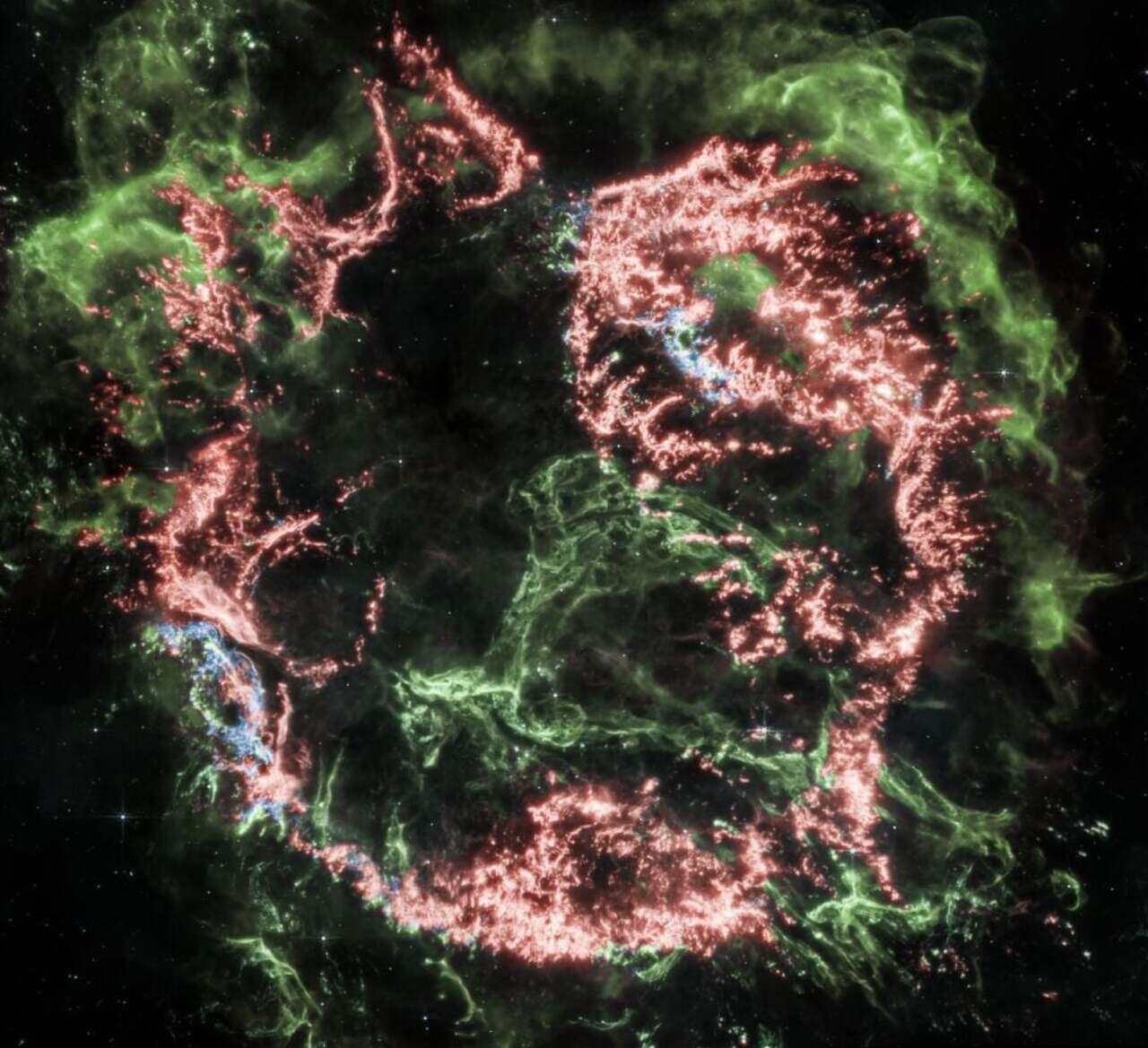
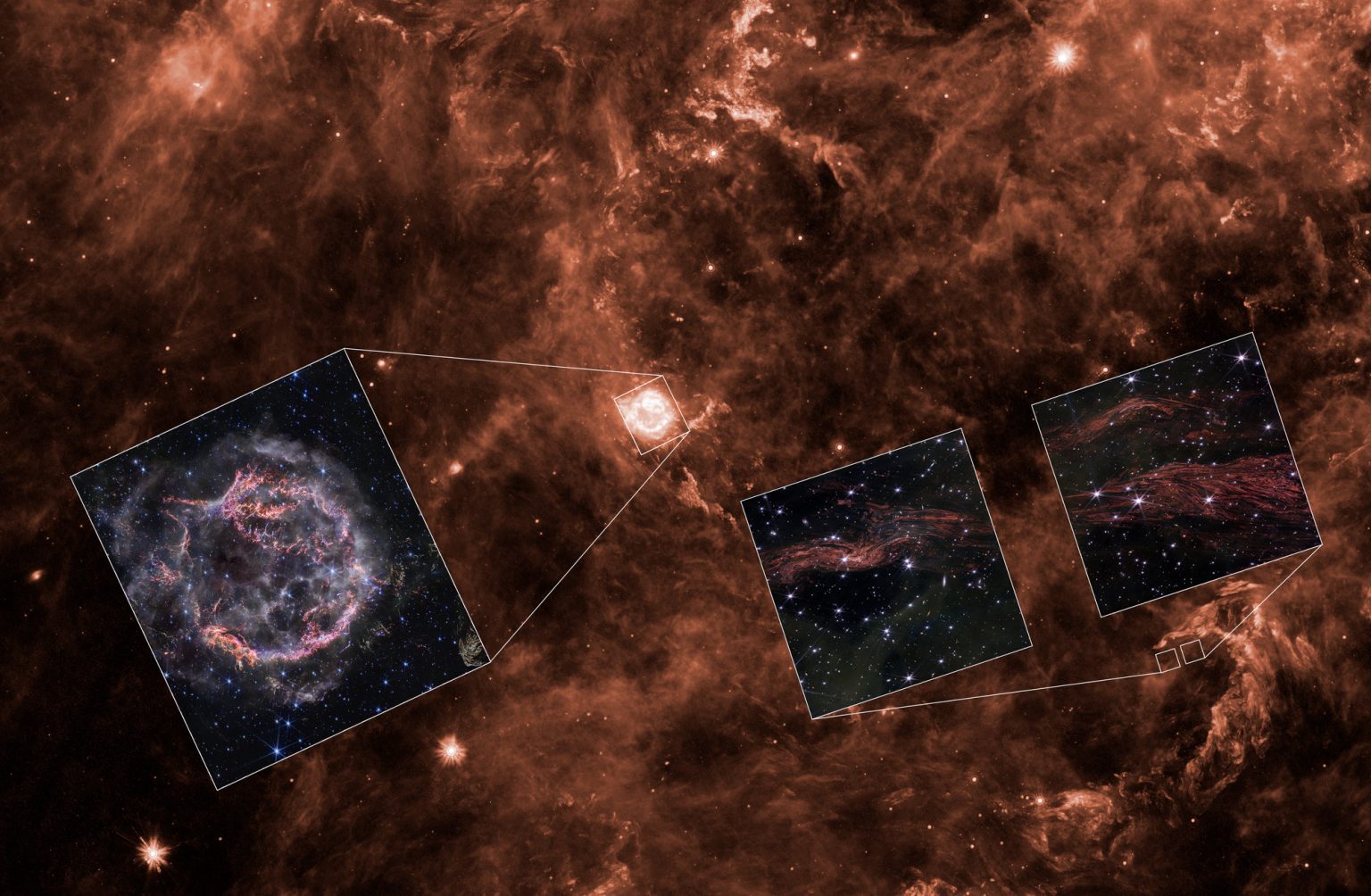
The Cassiopeia A supernova remnant, a cloud of gas and dust left behind after the explosion of a massive star, lies in our Galaxy about 11,000 light-years from Earth. According to Universe Today, a team led by Tea Temim from Columbia University used the spectrograph of the James Webb Space Telescope to determine, for the first time, the composition of dust in individual clumps of ejected material, each about the size of the Solar System.
A close-up of the Cassiopeia A supernova remnant in an image from the James Webb Space Telescope’s infrared instrument. Source: ESA/Webb
In regions where argon emits brightly, silica dust grains predominate, while in areas with strong neon emissions, the dust is carbon-based. This combination of dust is best explained by the merging of two inner layers of the star before the explosion. Thus, the composition of the dust can reveal the structure of a star that no longer exists.
At the end of its life, a massive star resembles an onion, with different elements burning in each layer, and the deeper the layer, the heavier the nuclei being fused. The contents of the layers mix and can blur the boundaries between them. In that case, material from the carbon layer enters the oxygen layer, oxygen burning intensifies, and the amounts of silicon and argon increase, while neon and magnesium decrease.
How Dust Forms
The merging of the layers also left its mark on the dust. When there is more silicon than magnesium, the excess silicon combines with oxygen to form silica, the material that makes up quartz sand. Carbon dust forms in regions where there is more carbon than oxygen, because oxygen first binds with carbon to form carbon monoxide, while the carbon left over due to insufficient oxygen condenses into dust grains.
Among the computer models of the explosion, both types of clumps appear together only in those where the layers merged. Whether or not the layers merge determines which elements the supernova ejects into the galaxy and what new stars and planets will eventually form from them. “We can connect an explosion to the composition of its progenitor star hundreds of years after the event,” says Dan Milisavljevic of Purdue University in an ESA/Webb release.
Traces Throughout the Remnant
Based on the spectra of the studied clumps, similar regions were identified across the entire image of the remnant. Silica dust is found in most of the ejected material, meaning that the traces of the merger are not limited to individual clumps. The third region studied, the “Green Monster,” contains magnesium silicate dust, but originates from material that the star lost before the explosion.
The study has been published in the peer-reviewed journal The Astrophysical Journal Letters and complements data from the Chandra and XRISM X-ray observatories. XRISM data had previously revealed an excess of phosphorus, chlorine, and potassium, characteristic of the merging of stellar layers.

The clear spectra of individual clumps also revealed the origin of an old confusion. In spectra from the Spitzer telescope, emissions from neighboring clumps blended together, so each region had to be modeled using a mixture of several types of dust. Now it is clear that a clump predominantly contains just one type of dust grain.

The conclusion about mixtures of dust also applies to supernovae in other galaxies, where individual clumps cannot be distinguished because of insufficient angular resolution. Their infrared emissions probably also come from chemically different regions, and how this affects estimates of dust composition remains to be determined.
The scenario can ultimately be tested using three-dimensional explosion models, because the one-dimensional models used by the authors do not account for mixing. The authors also consider spectra from other regions of the remnant taken by James Webb to be important in determining whether the dust composition found in the studied clumps is characteristic of all the ejected material.
