

In the new images, a familiar galaxy looks entirely different. Thick layers of dust had long prevented astronomers from seeing its heart, but now a picture more complex than anything observed before has emerged there. No telescope in the history of astronomy has ever had such observational sensitivity.
Anniversary of the Most Powerful Telescope
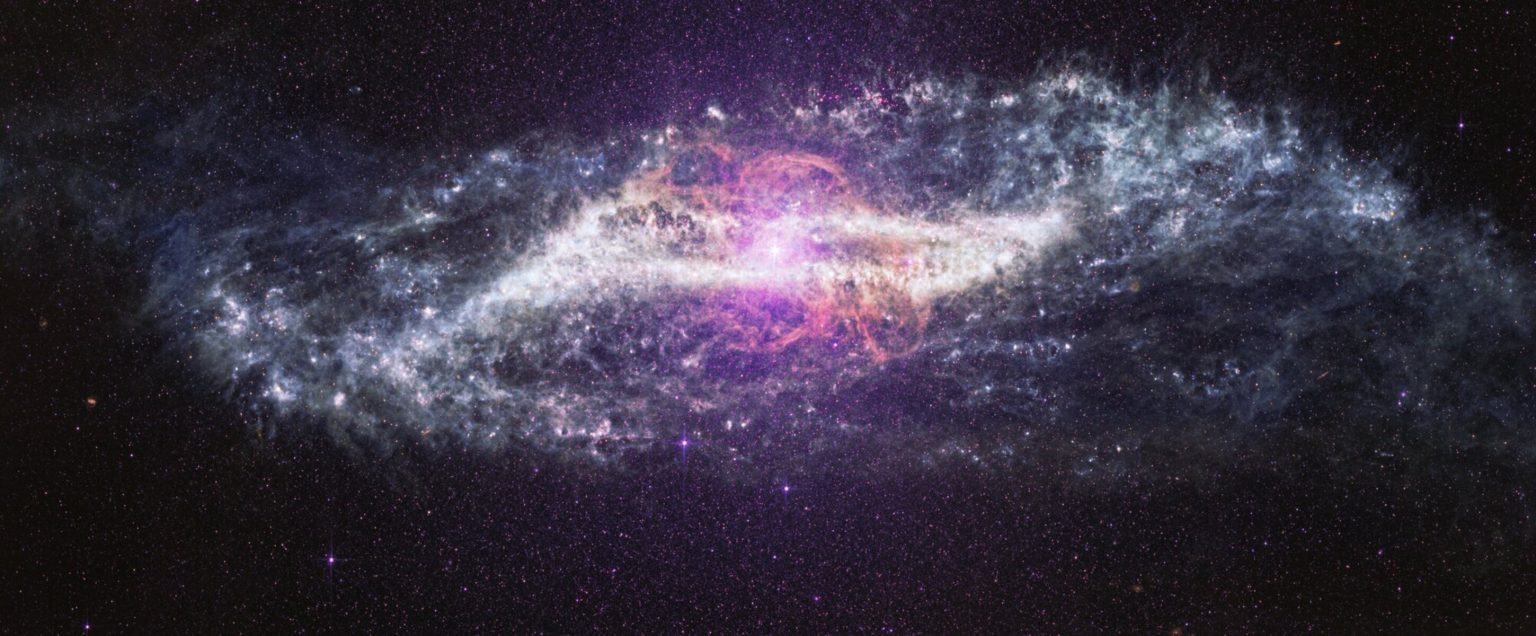
The new images of the galaxy Centaurus A marked the fourth year of scientific operations of the James Webb Space Telescope. The sensitivity of its instruments in the near- and mid-infrared ranges has proven higher than ever before. This made it possible to see light through dense dust clouds that hide the galaxy’s center in the visible spectrum, phys.org reports.
Over four years, the instruments have exceeded initial engineering expectations, and the observatory remains the most powerful ever launched into space. As a result, astronomers can now examine regions of the sky that were inaccessible to any previous instrument.

According to ESA/Webb, other results were also obtained with the James Webb Space Telescope during the same anniversary week. The data include evidence of a black hole that formed before its own galaxy and the first signs of a possible planet near Alpha Centauri.
Consequences of an Ancient Collision
The galaxy Centaurus A is located 11 million light-years from Earth, which is considered nearby by cosmic standards. Unlike most neighboring galaxies, it remains highly active. This makes it a convenient natural laboratory for studying how supermassive black holes influence the evolution of such systems as a whole.
At its center, a supermassive black hole is actively accumulating surrounding matter, while powerful jets carry enormous amounts of energy beyond the galaxy and affect its shape. The present appearance of Centaurus A preserves traces of a collision with another galaxy that occurred approximately two billion years ago, and these consequences are still visible in its unusual structure and ongoing star formation.
Limitations of Previous Telescopes
Observations in visible light with the Hubble telescope could not reveal the central part of the galaxy, which was obscured by dust, while the now-retired Spitzer observatory captured only large-scale structures without individual stars.
Shawn Domagal-Goldman, director of the Astrophysics Division at NASA Headquarters in Washington, noted that “no single telescope tells the whole story,” because every new observatory builds on the achievements of previous missions. According to him, James Webb has become the most powerful step in this sequence and has opened access to wavelengths that were previously unreachable.
A Mysterious Dust Structure
Using the Mid-Infrared Instrument, or MIRI, aboard the James Webb Space Telescope, astronomers were able to see unusual dust outlines in the center of the galaxy. A distorted parallelogram-shaped band passes through the center, and thin elongated clouds of matter are visible on either side of it. An S-shaped structure is also notable; it had never been seen so clearly before, and astronomers still have to determine exactly what formed it.
The numerous bright red dots in the MIRI image correspond to dust-rich stars or regions of star formation, where old stars shed material into the surrounding space while new ones are only beginning to form. This dust is the raw material for future generations of stars and planets.
Stellar Chronology and Gas Motion
Thanks to the high resolution of the James Webb Space Telescope, astronomers examined Centaurus A star by star, including its long-hidden central region. What at first appears to be a grainy image is actually a dense field of individual stars, and each detected star adds a detail to the galaxy’s chronology, from ancient star formation to the burst triggered by the collision.
Astronomers also used spectroscopy to trace the motion of gas inside the galaxy. Ionized gas is moving outward at high speed under the influence of the black hole, while warmer molecular hydrogen forms a warped disk near the center. By compressing the gas, it accelerates new bursts of star formation, but by pushing matter outward, it simultaneously slows that process down. Centaurus A offers a rare opportunity to observe this interaction nearby.
