

This year’s Nobel Prize in Physics went to American particle physicist Francis Halzen. He was recognized for work that made it possible to build the IceCube neutrino detector. But why is this subject so important? Read on to find out.
A Nobel Prize for Neutrinos
On October 6, the Nobel Committee announced that the most prestigious scientific award in physics for 2026 would go to Francis Halzen. According to the announcement, he was honored for his decisive contributions to the construction of the IceCube Neutrino Observatory and the discovery of high-energy neutrinos of astrophysical origin.
To understand why this detector is so important, we need to explain things step by step. Neutrinos are among the most mysterious elementary particles. We have already discussed them in detail here.
In brief, this tiny particle is produced by the beta decay of a neutron and several other high-energy reactions. It carries no electric charge and therefore does not participate in electromagnetic interactions. Consequently, it cannot be detected using methods that work in other cases, such as deflection by magnetic fields or collisions.
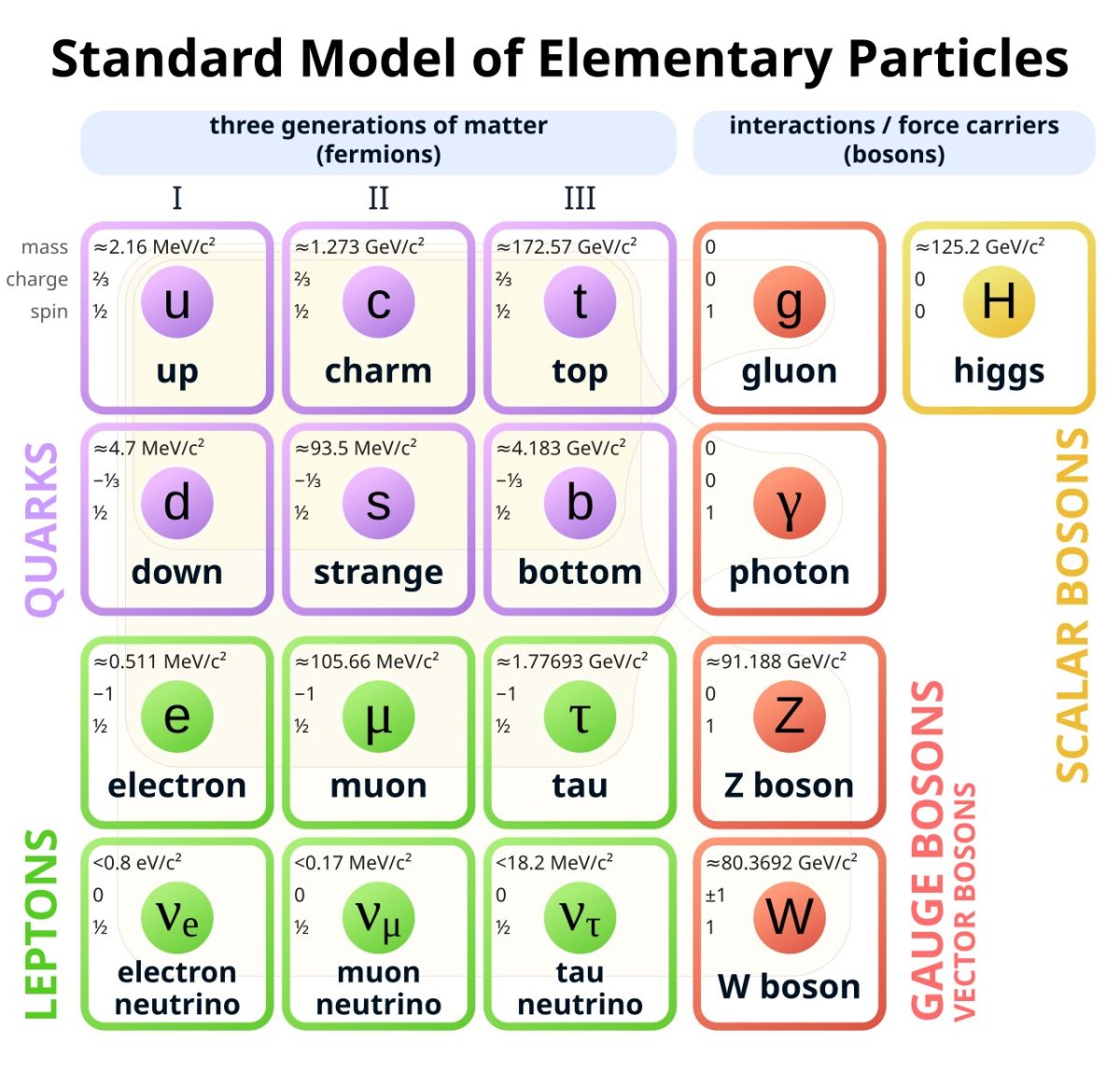
Another important characteristic of neutrinos is their mass, which is almost zero. Some might say that physics does not work that way: a particle either has mass or it does not. However, in the case of this tiny particle, its mass is just 0.28 eV, which is so small that quantum effects come into play.
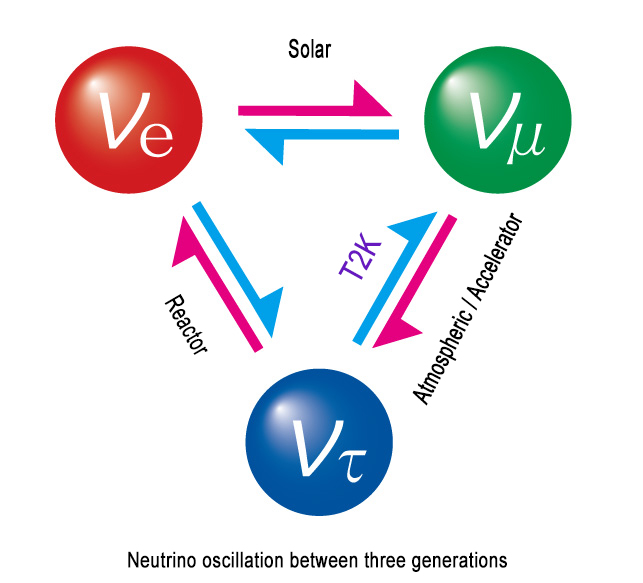
More specifically, this figure actually represents a superposition of three quantum states. A neutrino is like Schrödinger’s cat: it is simultaneously one particle and three different ones, each with its own mass and properties. Which of these states manifests itself when the particle interacts with matter depends on the conditions of observation and what it has experienced along its journey.
The problem is that such interactions are extremely rare. But when one occurs, each type of neutrino produces its corresponding lepton: an electron, a muon, or a tau. These particles can then be tracked relatively easily through the photons they produce.
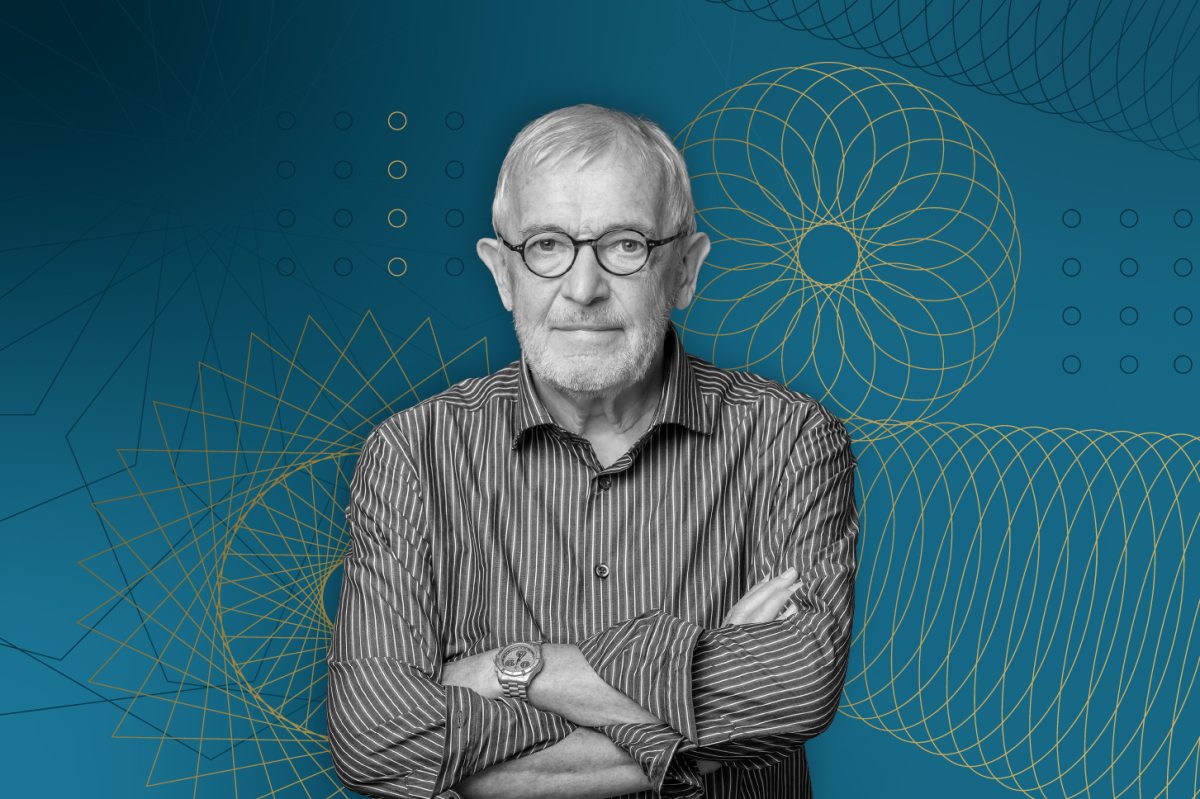
Francis Halzen
This is where Francis Halzen comes in. He was born in Belgium in 1944 and received his education in physics there. He subsequently worked at CERN, the European nuclear research center, before moving to the University of Wisconsin–Madison in the United States in 1972, where he has worked ever since.
Halzen has devoted his career to cosmic rays. This term refers to the entire range of elementary particles that reach us from space. More precisely, photons, electrons, alpha particles, and sometimes neutrons and protons, as well as neutrinos, travel through space. Meanwhile, particles such as muons and some electrons can be produced in the upper atmosphere through interactions with the gas molecules found there.
All these particles potentially carry information about distant astronomical objects, but neutrinos remain the most mysterious because they are almost impossible to capture. At the same time, their oscillations can provide more information about where they originated—for example, the surroundings of a black hole.
Scientists had developed the basic approach to this research before Halzen’s work. A large volume of water is particularly suitable: as electrons, muons, and tau particles produced by neutrinos travel through it, they generate showers of secondary particles that can be detected. This is why the first detectors of these elusive particles were placed at the bottom of flooded mines.
Halzen’s contribution was to be the first to recognize that detectors for photons and other particles could be placed directly in the Antarctic ice. This would provide numerous collisions and signals to analyze.
In the 1990s, researchers began drilling deep holes directly into the ice near the South Pole and lowering strings of photodetectors into them. There were 677 detectors in total, mounted on 19 separate strings that together formed a cylindrical structure. The entire installation was called the Antarctic Muon And Neutrino Detector Array (AMANDA). It could not only detect neutrinos through secondary radiation but also locate their sources to within 2 degrees, because photons from a single event reached different detectors from a particular direction.
AMANDA began operating in 1996 and continued until 2005. During that time, it demonstrated that celestial neutrino sources could indeed be precisely located and studied. By then, however, its successor, IceCube, was already under construction. It was for his contribution to its creation that Halzen received the Nobel Prize.
The IceCube Detector
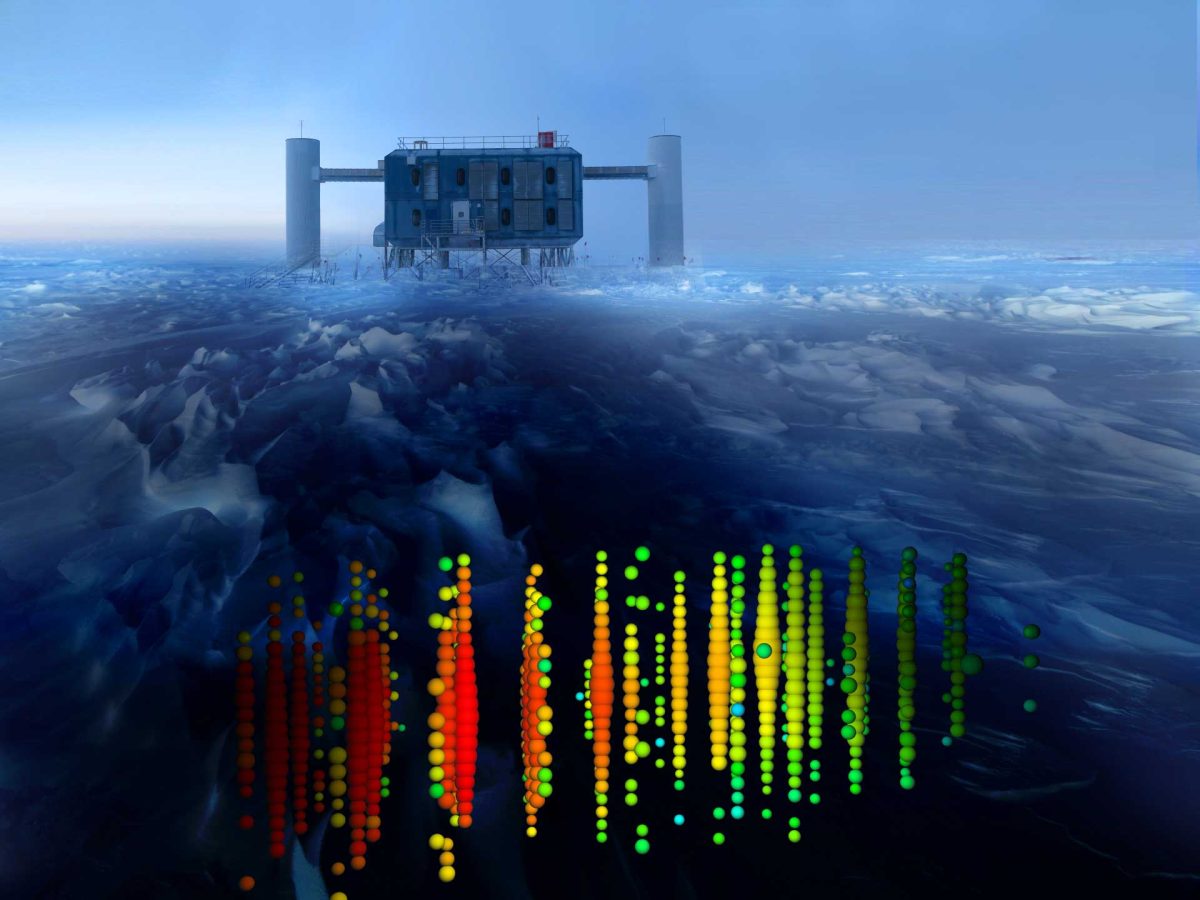
Construction of IceCube began in 2005, and it was operational by 2010. This scientific instrument follows the same basic design as AMANDA: detectors attached to cables suspended in boreholes within the Antarctic ice sheet.
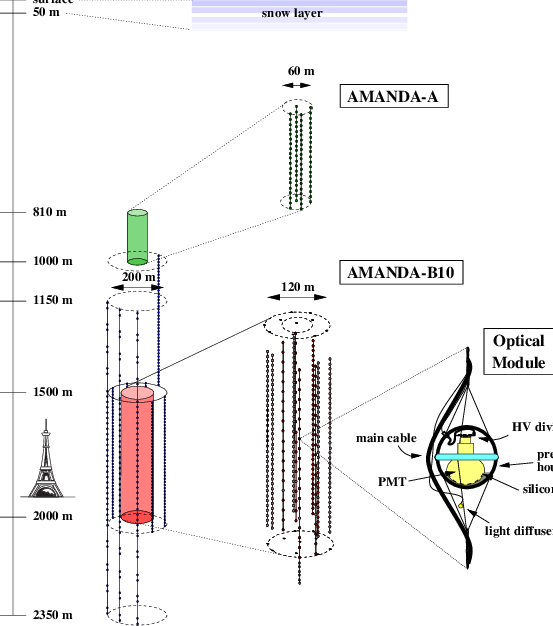
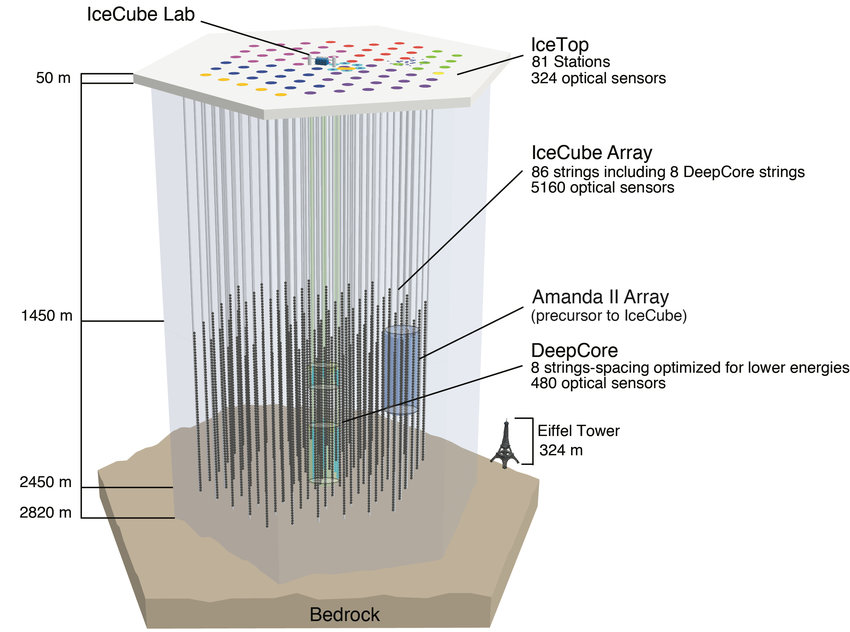
Only the scale changed. IceCube effectively consists of three parts: an upper section of 81 stations extending no more than 50 meters into the ice, a main array of 86 strings reaching from the surface to a depth of 2,450 meters, and a specialized deep section within that array.
The upper section contains a total of 324 optical sensors. In the main array, the first 1,450 meters consist simply of cables; the sensors themselves are positioned between depths of 1,450 and 2,450 meters. There are 5,160 of them in total. The six strings in the deep section contain another 480 sensors optimized for operation at great depths.
IceCube’s primary task is to study neutrino sources. However, its design also allows researchers to study other events, such as collisions between protons and other protons or photons. These produce particles such as pi mesons, which decay into muons and muon neutrinos that the instrument is well suited to studying. In this way, it can investigate the most powerful supernova explosions and other similar events.
The detector is also important to physicists because it allows them to study neutrino oscillations themselves, many aspects of which remain poorly understood. In addition, some models of dark matter contain predictions that it can test.
IceCube could also potentially confirm or refute certain predictions of string theory. These predict another type of neutrino, or an additional oscillation into a sterile state. There may even be more than one such particle.
IceCube made several important discoveries early in its operation. One concerned our Moon. Neutrinos generally pass straight through celestial bodies. However, some still interact with matter, and scientists were able not only to show that our natural satellite blocks a fraction of them but also to estimate the magnitude of this effect.
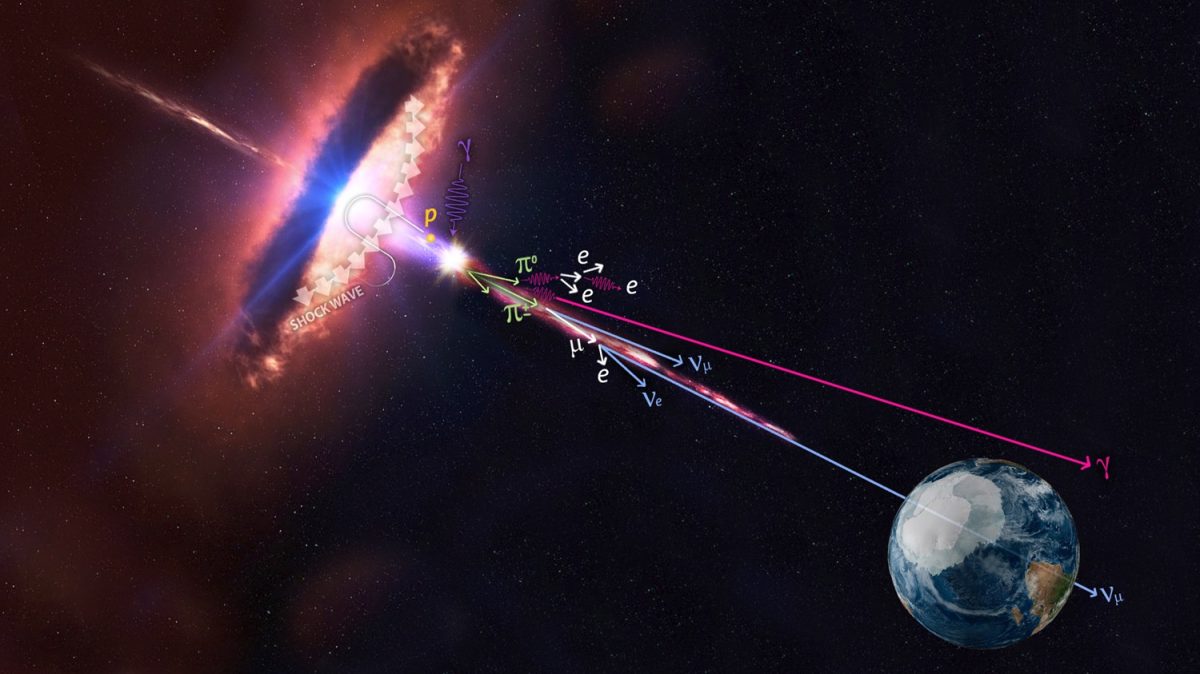
Another important milestone was the discovery of neutrinos originating beyond the Sun. Our star is the source of most of these particles, predominantly producing electron neutrinos. IceCube, however, was also able to identify those that had reached us from deep space.
The main achievements of IceCube’s 16 years of operation have been the detection of truly high-energy neutrinos. For example, on September 22, 2017, it detected a particle with an energy of 290 TeV. This particle was found to have come from the blazar TXS 0506+056. Such objects are supermassive black holes at the centers of galaxies that not only actively consume matter but are also oriented so that the relativistic jets emerging from their poles point toward us.
In February 2021, the detector identified a neutrino source associated with the tidal disruption event AT2019fdr. A star had ventured too close to a black hole and was torn apart, producing a stream of ghostly particles.
In 2023, IceCube discovered that the galactic plane of our own Galaxy also produces high-energy neutrinos, albeit very rarely. Scientists are still uncertain about the process responsible.
The research continues, and it was for making these investigations possible that Francis Halzen received the Nobel Prize.