

Researchers have for the first time detected toroidal magnetic fields that for decades had remained a theoretical explanation of how young stars launch powerful jets of gas. The observations were carried out using the ALMA radio telescope array.
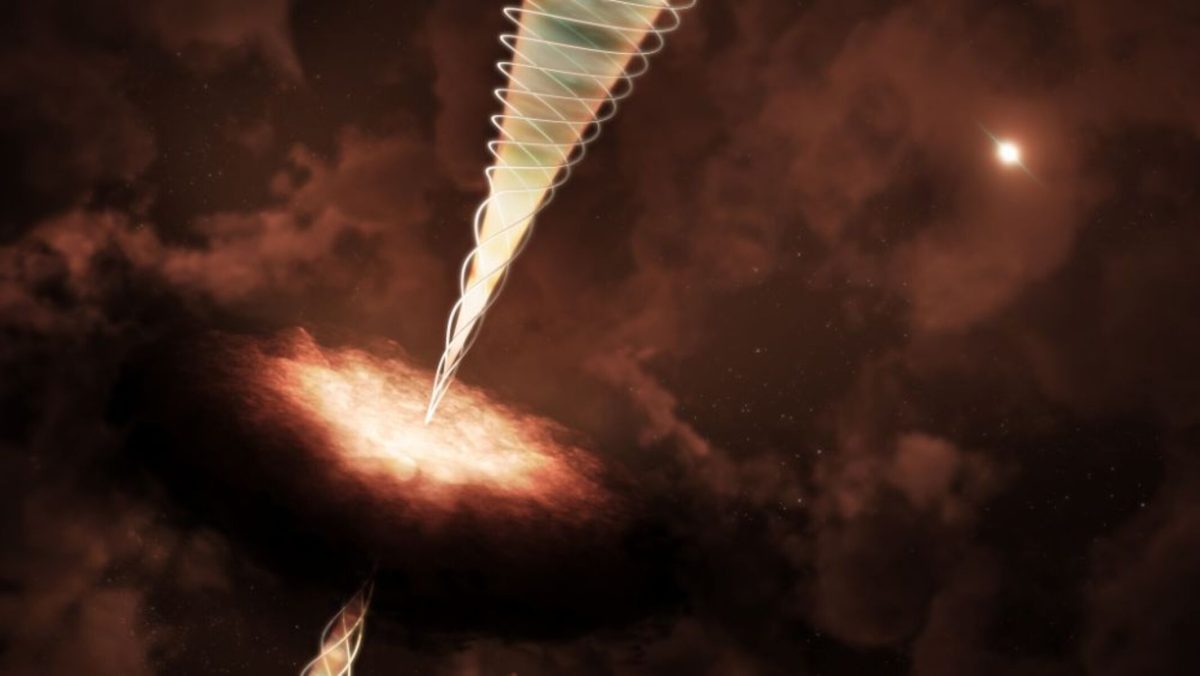
Toroidal Field Around the Jets
When a protostar draws in material from the surrounding disk, part of this gas is ejected from the poles in the form of narrow jets. They carry away excess energy, allowing material to continue accreting onto the protostar. Without this removal, the gas would continue rotating in the disk, and the star would not gain mass.
Until now, astrophysicists believed that magnetic fields were responsible for shaping these jets. The rapid rotation of the gas twists the magnetic field into a toroidal configuration that narrows and accelerates the flow. Direct observations were lacking until a team led by Tao-Chung Ching analyzed the polarization of carbon monoxide (CO) emission in the NGC 1333 IRAS 4A system. The results were published in Nature Communications.
The system is located 960 light-years away in the Perseus molecular cloud. Its jets extend for several hundred astronomical units, while known outflows can reach tens of light-years, and the longest one in the Milky Way stretches for 32.6 light-years.
Field Strength and Implications
The detected fields turned out to be weak, on the order of a few milligauss, Universe Today reports. For comparison, the magnetic field of an ordinary refrigerator magnet can reach approximately 100 gauss. Despite such weakness, this is enough to compress and accelerate the outflow at distances of several hundred astronomical units from the protostar, the authors note.
ALMA observations showed that the field lines wrap around the jets perpendicular to the direction of gas motion, while remaining aligned with its rotation. This is exactly the geometry predicted by theoretical models. It is the first observation of this kind at the highest resolution on scales of several hundred astronomical units.
The confirmation is significant beyond the context of star formation as well. A similar mechanism probably operates near supermassive black holes, where magnetic fields likewise direct part of the material away from the accretion disk. The results of Ching’s team provide the first direct evidence that this general mechanism operates in nature.
