

A stream of plasma emerging from the vicinity of the supermassive black hole in the distant galaxy 3C 279 bends almost directly toward Earth. Because of this bend, the brightest part is not the base of the jet but the region where it turns toward us. This was discovered using the Event Horizon Telescope network of radio telescopes.
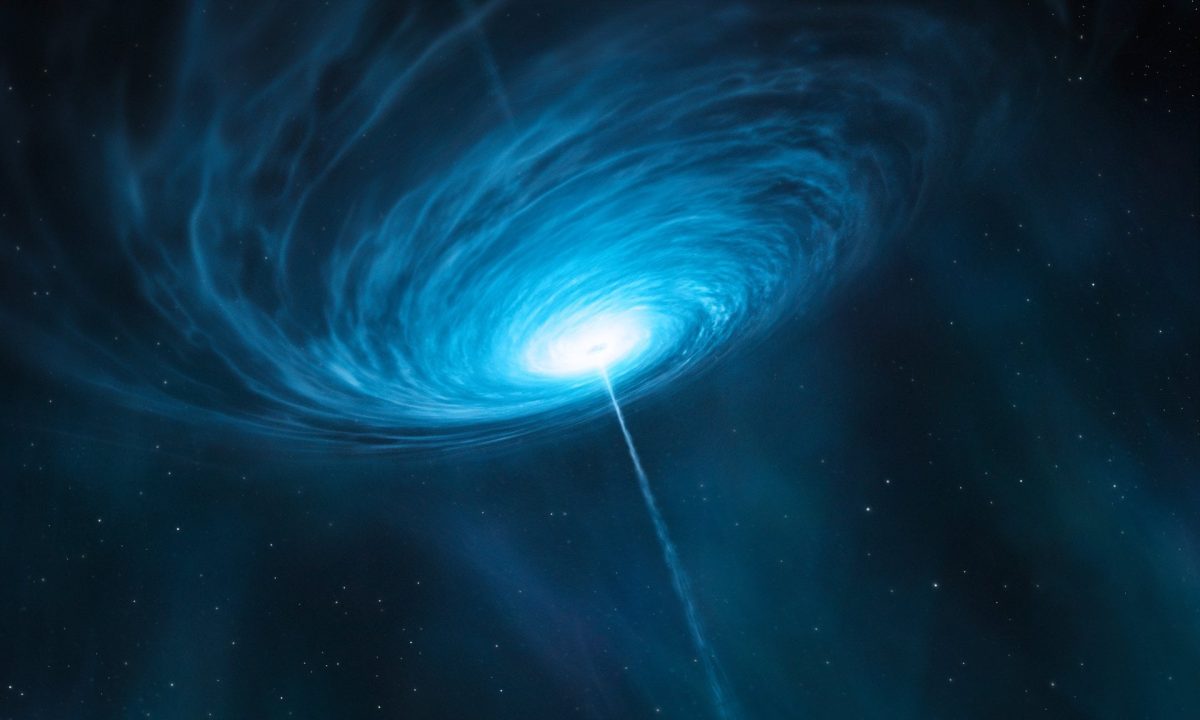
A Bend Toward Earth
The galaxy 3C 279 belongs to a class of objects known as blazars, in which a supermassive black hole ejects a stream of plasma almost directly toward Earth. It is located approximately 5 billion light-years away and is known for powerful gamma-ray flares. The mass of its black hole is estimated at 800 million solar masses. How such jets are launched and accelerated is still not fully understood.
In April 2021, astronomers observed the blazar’s core three times at a frequency of 230 GHz. Over five days, individual plasma knots shifted across the sky as though they were moving ten times faster than light. This is an illusion. A knot moves almost directly toward Earth and nearly as fast as its own radiation, so signals emitted a year apart reach us only a few days apart. A displacement that took a year is seen by us over just a few days, making it appear superfast. Such superluminal motion was first observed in 3C 279 itself back in 1971.
Knots located farther from the base appear to move more slowly, at speeds ranging from nine to approximately one times the speed of light. The authors explain this not as deceleration, but as the result of the jet turning even more directly toward us. The illusion is strongest when the angle to the direction of Earth is a few degrees. At an even smaller angle, the knot barely shifts sideways across the sky and appears slower. For the slowest knot, the angle is less than 0.3 degrees, smaller than the angular diameter of the Moon.
How the Details Were Resolved
Such clarity was achieved because, in 2021, a 12-meter radio telescope on Kitt Peak in Arizona and the NOEMA interferometer in the French Alps joined the network for the first time. Lead author Hendrik Müller from the U.S. National Radio Astronomy Observatory explained to Universe Today that the distance between antennas determines which details can be resolved, and the new stations filled the gap between nearby and distant pairs of antennas.

In all the images, the core is elongated from north to south, almost perpendicular to the main jet. This is exactly how a jet that initially points almost directly toward us and then bends appears in projection. The authors consider a faint spot at the northern edge of this structure to be the base of the jet, and all the measured velocities depend on this assumption.
Brightness and Speed
The emission from plasma moving at nearly the speed of light is concentrated along its path. Therefore, the brightest region appears to be the point where the jet bends toward us, while a shock wave where the jet is compressed most likely also contributes to its brightness.
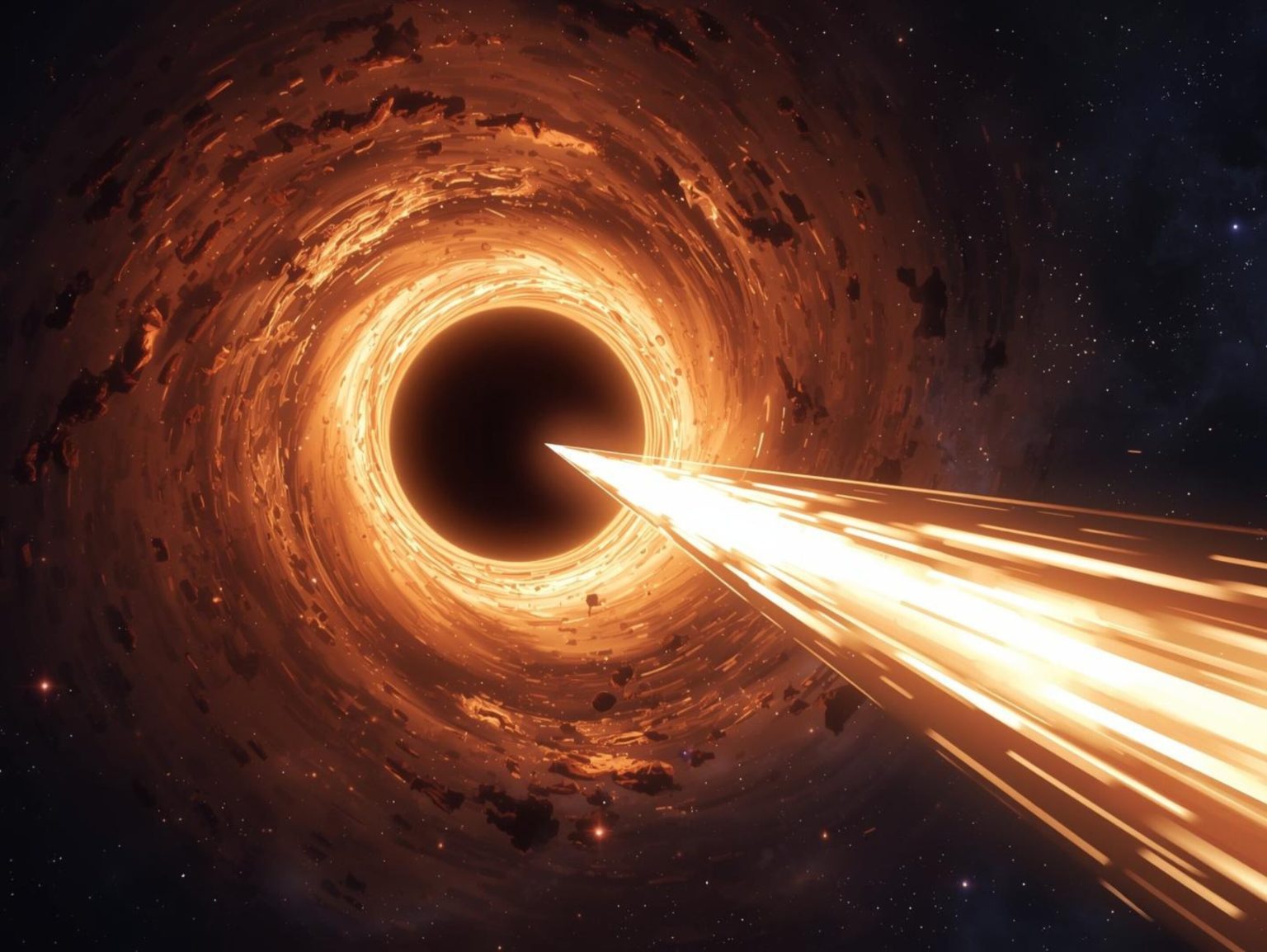
Near its base, the plasma is already moving at no less than 99.5% of the speed of light, just as it does in the distant parts of the jet. This means that it accelerates over a very short distance. The results are described in a preprint on arXiv, whose conclusions have not yet undergone formal peer review.
What Bends the Jet?
Compared with previous observations from 2011 and 2017, the region closest to the base has turned noticeably, although the jet remains straight farther out. The authors cannot yet explain why this happens. Among the possible causes they identify interactions with surrounding gas, instabilities within the flow itself, changes in the magnetic field near the event horizon, and wobbling of the jet’s axis caused by a second black hole.
Hendrik Müller describes the current study as only the beginning. The team is already processing several years of Event Horizon Telescope data together with observations at other frequencies to distinguish genuine changes in the jet from differences caused by the observing frequency itself.
