

Envision observing an astronaut descending into a black hole. As he approaches the event horizon, his velocity diminishes progressively. The light reflected from his spacesuit exhibits a redshift and diminishes in brightness until it ultimately vanishes. Mathematically, this process entails an infinite duration; however, practically, the astronaut would become imperceptible within a relatively short period. Due to the progressively attenuated radiation, there exists a point beyond which the astronaut becomes effectively invisible to the observer.
Consider the experience of the astronaut himself. If the black hole possesses sufficient mass, he will not perceive any definitive boundary and will traverse the event horizon within a matter of minutes according to his own timekeeping. This presents two perspectives of a single event, each of which is valid. More precisely, these are two equally legitimate descriptions of the same event from the viewpoints of different observers. This illustrates the peculiar nature of a black hole. Let us begin by examining its true nature.

Is this truly a hole?
A black hole is not a mere void in space. It represents a region in which matter is compressed to an extraordinarily high density, resulting in a gravitational pull that prevents even light from escaping its confines. The fundamental concept in this context is the event horizon, which NASA characterizes as a point of no return. Any object or signal that traverses this invisible boundary will not return to the external universe, including light itself. This phenomenon is the basis for its designation as a black hole.
In the central region, the general theory of relativity predicts a singularity. In this domain, the curvature of spacetime and its density become infinite, and the laws of physics, as currently understood, cease to be applicable. It remains uncertain whether this represents a physical reality or merely a mathematical limit beyond which the theory becomes meaningless. However, the processes leading to a singularity are relatively well understood. Furthermore, the trajectory towards a singularity varies among different black holes.
A journey within
If one were to fall into a black hole with a stellar mass, it would not be possible to emerge intact, not even upon reaching the event horizon. The underlying cause of this phenomenon is attributed to tidal forces. The gravitational field varies so swiftly with distance that the parts of the body nearer to the center are subjected to significantly stronger pulls than those farther away. In reality, it is not gravity itself that causes destruction, but rather the difference in gravitational force exerted on different parts of the body. The body undergoes elongation along the axis of fall and is simultaneously compressed from the sides. This displacement is known as spaghettification. A black hole of stellar mass annihilates any object before it can even cross the event horizon.

Supermassive black holes exhibit distinct behaviors. In the cases of M87* and Sagittarius A*, the event horizon is sufficiently extensive that the spacetime curvature in this region remains relatively mild. Consequently, gravitational effects act nearly uniformly across the entire body, without abrupt variations. A hypothetical traveler could traverse this boundary without perceiving any immediate or significant alterations. However, tidal forces would become apparent further inward, nearer to the singularity.
For an individual in a state of decline, the precise moment at which they cross the horizon holds no particular significance. There is no wall or barrier; only a boundary beyond which there is no possibility of reversal.
From an observer’s perspective
Now, let us reconsider the perspective of the external observer. They perceive a markedly different scenario. Light reflected from the spacesuit or signals transmitted from the spacecraft reach the observer with an increasingly pronounced gravitational redshift. The intensity of the light diminishes while its wavelength lengthens, resulting in a redder appearance. The temporal intervals between signals become extended. The astronaut’s watch appears to decelerate, giving the impression that it is approaching a halt at the horizon.
This does not imply that the falling object is actually suspended at that location. For the object itself, crossing the horizon occurred over a precise duration. However, this information will never be accessible to us. The final photons are extended indefinitely, causing the figure on the horizon to gradually vanish.
What is the reason for this phenomenon? The reality is that time is not an absolute entity. The general theory of relativity demonstrates that the passage of time varies in regions with intense gravitational fields. As one approaches the event horizon, the passage of seconds appears to slow from the perspective of an external observer. However, for the traveler himself, all processes occur at the standard rate. He does not perceive any deceleration.

The paradox of lost information
Both realities coexist. However, alongside them emerges a more profound issue. Any object is not merely matter but also encompasses information regarding its structure, atoms, and quantum states. When it crosses the event horizon, this information appears to vanish from our universe. Nevertheless, quantum mechanics maintains a strict principle: information does not disappear without leaving a trace. All events leave a trace, even if it is beyond our capacity to interpret.
Let us now consider the phenomenon of a black hole. Stephen Hawking’s research demonstrated that, owing to quantum effects in the vicinity of the event horizon, a black hole should gradually lose mass by emitting energy, a process known as Hawking radiation. The issue arises from Hawking’s original formulation, which depicted this radiation as purely thermal and devoid of any information concerning the matter that had fallen into the black hole. This is analogous to heat emanating from a radiator — uniform and impersonal. Consequently, when a black hole ultimately evaporates, all matter it has consumed will also vanish. This situation directly conflicts with the principles of quantum mechanics.
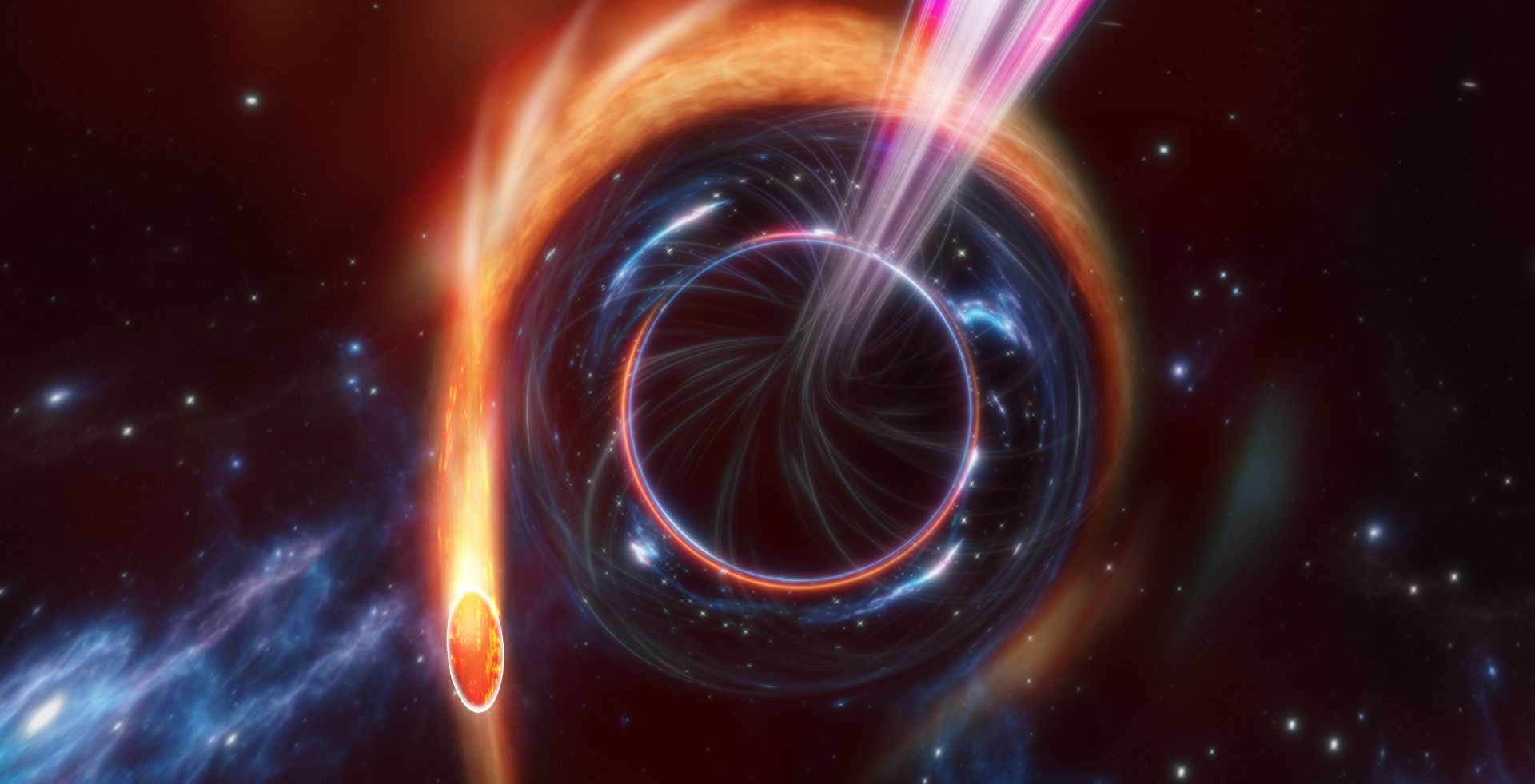
This conflict is recognized as the black hole information paradox. It remains unresolved with certainty. Nonetheless, recent advancements in mathematical models grounded in the holographic principle offer accumulating evidence that information is not irrevocably lost. Instead, it gradually escapes concomitant with Hawking radiation; however, the precise mechanism remains elusive. It is important to note that these calculations pertain to simplified theoretical models. Concerning actual astrophysical black holes, there is currently no experimental validation.
The shadows we observed

While researchers continue working to resolve these paradoxes, observers have already obtained actual images of these objects. In 2019, the Event Horizon Telescope (EHT) collaboration published the first-ever image of the shadow of a black hole at the center of the M87 galaxy. The object itself, designated M87*, has an approximate mass of 6.5 billion solar masses. Three years later, the EHT released an image of Sagittarius A* — the black hole at the core of our Milky Way galaxy. It is situated approximately 26,000 light-years from Earth, with a significantly smaller mass of approximately 4 million solar masses.
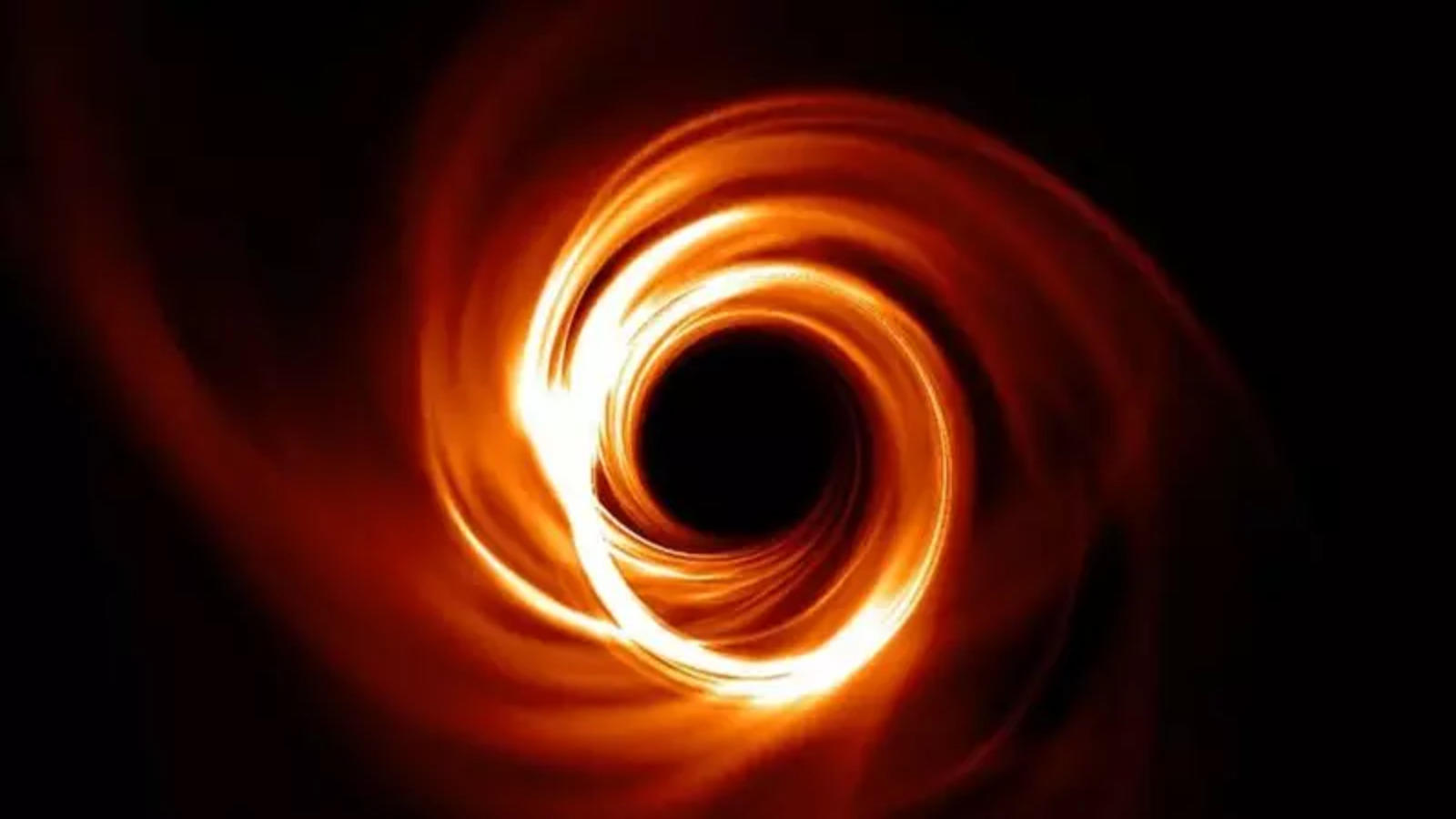
In these images, the event horizon itself is not visible; rather, only its shadow and a luminous ring generated by radiation from the hot plasma of the accretion disk are observed. The Event Horizon Telescope (EHT) compiled these images utilizing a network of radio telescopes distributed worldwide. Operating collaboratively as a unified virtual antenna of Earth’s scale, they succeeded in detecting an object whose existence had previously been corroborated solely through indirect observations.
And now we understand the appearance of the point of no return.