

Astronomers have proposed a new explanation for the mysterious “Cygnus Bubble” — a huge cloud of ultra-high-energy gamma rays stretching across thousands of light-years of the sky. Although this “bubble” is usually associated with the Cygnus X star-forming region, a new study argues that the highest-energy emission is more logically explained by the existence of a microquasar.
Cosmic Accelerators of the Highest-Energy Particles
For many years, astronomers have been trying to determine where the highest-energy cosmic rays in our Galaxy come from — particles accelerated to energies of a quadrillion electronvolts, or petaelectronvolts. These sources are called Galactic PeVatrons, and they are extremely difficult to localize. PeVatrons may be any astrophysical objects powerful enough to accelerate particles to extreme energies: supernova remnants, pulsar wind nebulae, star clusters, or binary star systems.
Accelerated particles travel outward and emit ultra-high-energy gamma rays whenever they eventually collide with surrounding gas — sometimes hundreds or thousands of light-years away from their true source. One of the brightest gamma-ray structures in the sky, the “Cygnus Bubble,” has long been associated with the nearby cluster of massive young stars in the Cygnus X star-forming region, located about 4,600 light-years away.
In a study reported by Phys.org, a team of astronomers led by Zhaodong Shi of the University of Science and Technology of China investigates whether a microquasar could be the very PeVatron that created the “Cygnus Bubble.”
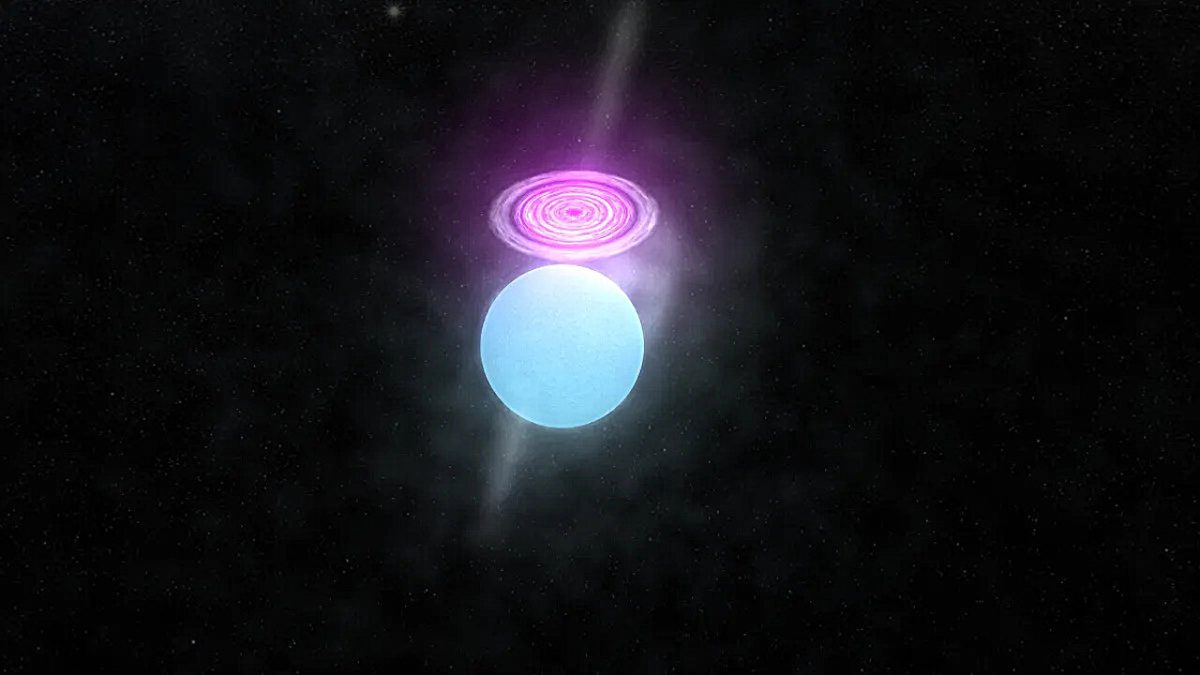
A microquasar is a type of binary system consisting of a compact object — a black hole or neutron star — orbiting an ordinary star, with the compact object drawing matter from its companion and producing powerful jets or winds. The microquasar in question, Cygnus X-3, is located much farther away than is usually assumed — approximately 31,600 light-years from Earth. The system’s orbital period is 4.8 hours.
Super-PeVatron
This hypothesis has gained additional weight thanks to a separate recent discovery by LHAASO: Cygnus X-3 was confirmed as the first super-PeVatron in the Milky Way, accelerating particles to at least 30 PeV in synchronization with its 4.8-hour orbit. This provides direct evidence that extreme particle acceleration occurs directly within the binary system itself.
To test their hypothesis, the scientists created a model that simulates Cygnus X-3 as a continuous source emitting high-energy protons into space over hundreds of thousands of years. As these particles slowly spread through the surrounding gas, they occasionally collide with its atoms, producing gamma rays that are detected on Earth.
Connection Between the “Cygnus Bubble” and Cygnus X-3
When the team adjusted the model to realistic physical parameters, it successfully reproduced both the overall brightness of the “Cygnus Bubble” and the characteristic decline in brightness from the center toward the edges. The scientists found that Cygnus X-3 would need to direct only 1% to 3% of its energy into particle acceleration, while the particle propagation rate required to match the observations was also consistent with independent theoretical predictions.
If confirmed, the “Cygnus Bubble” would join a small but growing group of gamma-ray halos recently linked to microquasars in other parts of the Galaxy. This would be a unique case in which astronomers could observe both the “accelerator” itself and the halo of particles it has produced over time. Current telescopes do not have sufficient resolution to completely separate the Cygnus X-3 signal from the contribution of the star cluster located in the same region of the sky. Only future observatories with more advanced equipment will be able to distinguish between these sources.
The researchers conclude that future telescopes, including the Cherenkov Telescope Array, ASTRI, and the proposed Large Array of Cherenkov Telescopes, will be sensitive enough to properly test whether Cygnus X-3 is indeed the source. These next-generation instruments will provide much sharper and more detailed images of the highest-energy gamma rays than are possible today.
