

New experiments by David Weld and his colleagues at the University of California, Santa Barbara, have confirmed for the first time that, if the distance between the mirrors in an optical cavity changes rapidly enough, light waves will bunch into short, intense pulses. They also found that the cavity behaves as though it is mimicking the strange physics of curved spacetime.
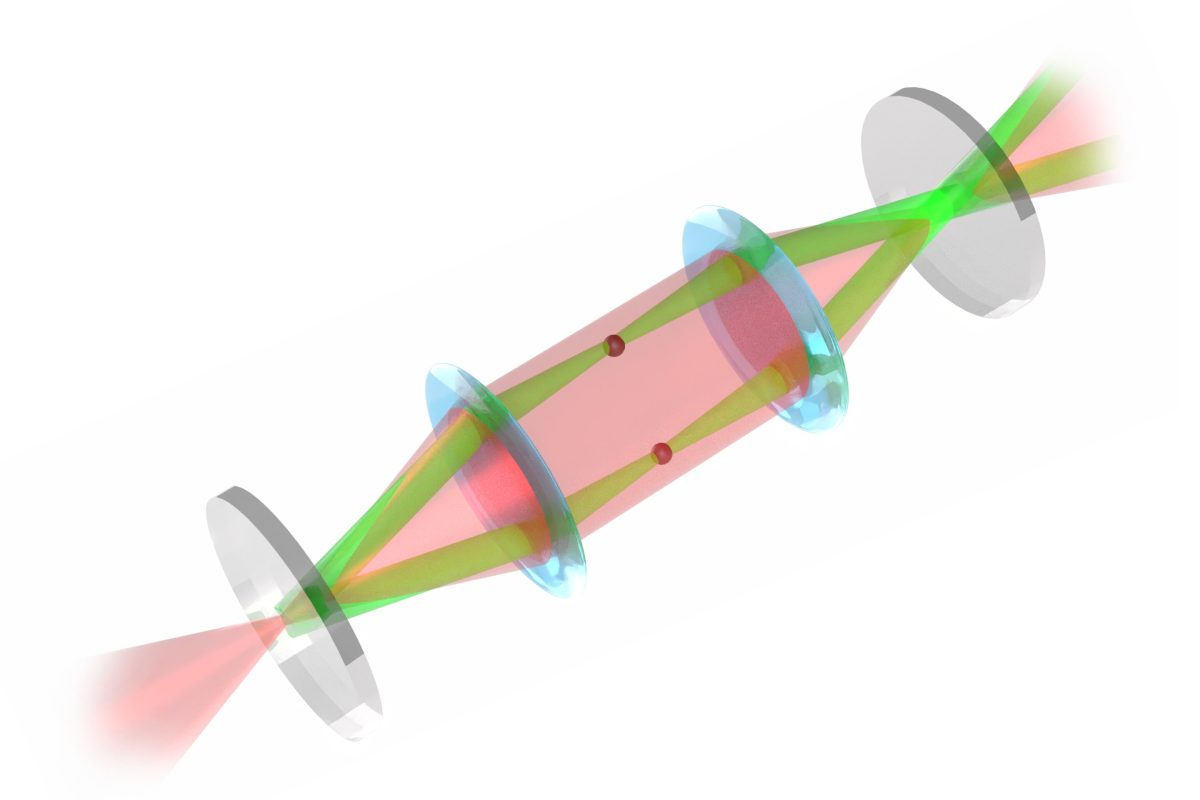
Simulating Black and White Holes with Vibrating Mirrors
Optical cavities are pairs of mirrors that trap light, and they underpin the operation of lasers, atomic clocks and many types of precision sensors. The website phys.org describes a remarkable experiment conducted with them by American scientists.
In an ordinary cavity, light bounces back and forth between two facing mirrors. Because they can retain only light whose wavelengths fit precisely within the distance between them, the cavity can isolate highly stable frequencies. However, if one mirror vibrates at a frequency matched to the light’s travel time between the mirrors, one theory predicts that the light will gradually flow in one direction, forming a short, concentrated pulse.
Mathematically, this one-way flow resembles light near the event horizon of a black hole or its purely hypothetical counterpart, a “white hole.” But testing this in practice would require a mirror that repeatedly accelerates to a substantial fraction of the speed of light within billionths of a second—far beyond the capabilities of current technology.
Replacing Light with Atoms
To get around this problem, Weld’s team replaced the light trapped in the cavity with atoms, which behave like waves at ultracold temperatures. The researchers began by cooling a gas of lithium atoms to almost absolute zero and then holding it in a lattice of laser light. The lattice made these “matter waves” travel at an almost constant speed, much like light, but at less than one metre per second.
The atoms were confined by two sheets of laser light that acted as mirrors without solid surfaces, one of which moved back and forth approximately 100 times per second. The team then captured images of how the atoms’ distribution changed over time and compared the results with theoretical predictions.
Atomic Packets Moving Along Stable and Unstable Paths
Within just a few cycles, the moving light sheet transformed the initially dispersed clouds into a compact packet of atoms that followed a repeating path. Packets starting from different positions all moved away from an unstable path and converged on a single stable one: the same one-way trajectory predicted to mimic the behaviour of black and white hole event horizons.
When they doubled the frequency of the motion, the researchers produced two concentrated packets, each following its own path. By abruptly changing the timing of the light sheet’s motion, they could swap the stable and unstable paths, changing the direction in which the packets travelled. They also observed subtle effects beyond the idealised light-like picture, which they attributed to the atoms’ speed not being quite as constant as that of light.
Weld’s team now hopes the effect could lead to new ways of compressing and expanding optical signals, perhaps in solid materials whose optical properties can be adjusted electrically, without any need for moving mirrors. The setup could also help physicists explore other fundamental predictions, such as how pairs of light particles can be created from empty space between rapidly moving mirrors.
