

The idea that a black hole could split into two has long been considered physically impossible. The laws of general relativity and thermodynamics make such a catastrophe seem like science fiction. However, a new theoretical study published in Physical Review D demonstrates that a loophole may exist under extreme conditions.
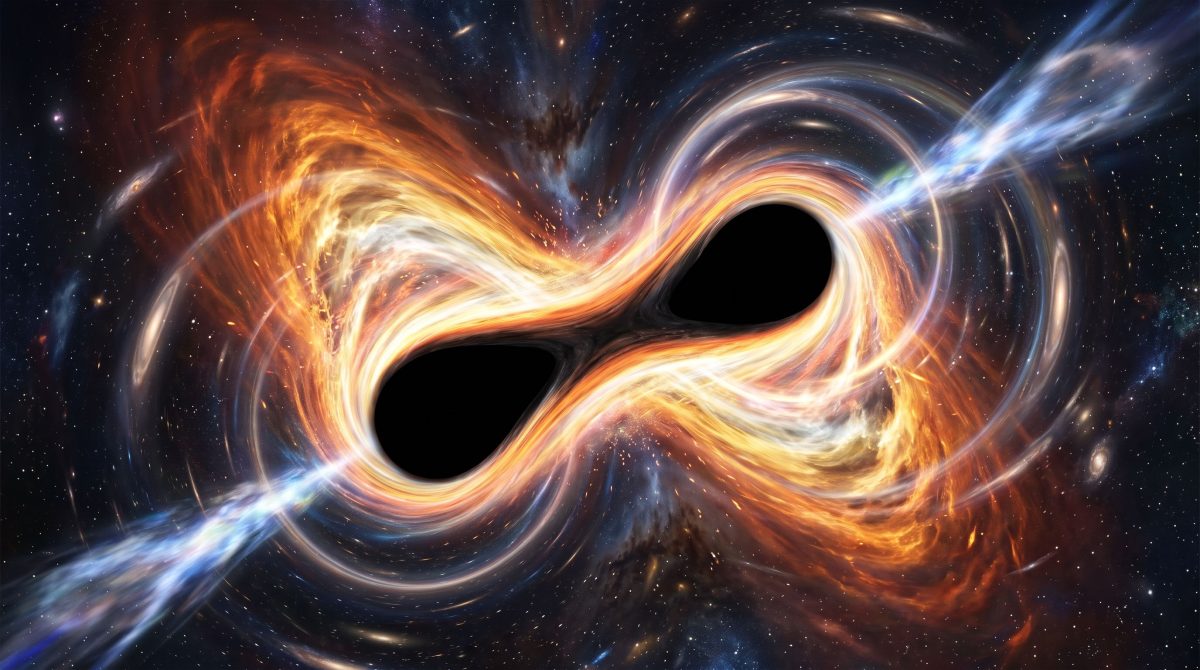
The study explores the limits of Einstein’s theory and raises the question of whether black holes can behave in ways that challenge our current understanding of the Universe.
The Entropy Barrier
The main reason black holes resist splitting lies in entropy. For a static object, entropy increases in proportion to the square of its mass. If one black hole splits into two smaller ones with the same combined mass, their total entropy decreases, contradicting fundamental thermodynamic principles.
However, the situation changes when an object has enormous angular momentum. A team led by Francesco Sannino, a professor of physics at the University of Naples Federico II, found that extremely rapid rotation changes the classical relationship between mass and entropy.
A favorable entropy balance alone is not enough for a successful split: the newly formed fragments must have enough energy and momentum to fly apart rather than merge again under their own gravity. Taking these parameters into account, the researchers found that the window of opportunity remains open only for objects rotating near the maximum physically possible limit.
Extra Dimensions
If such a split occurred, a single event horizon would divide into two separate cones. In spacetime, this geometry resembles a branching structure that scientists figuratively call a “pair of pants” topology.
The researchers also analyzed more exotic scenarios, including models with additional spatial dimensions and alternative theories of gravity. In higher-dimensional gravity, certain objects, such as black strings, become unstable. Under these conditions, splitting becomes thermodynamically favorable, especially if one of the resulting fragments is significantly smaller than the other.
Searching for Tiny Fragments
For now, the authors have not estimated the precise probability of splitting, since it depends on how gravity behaves beyond Einstein’s classical theory. Small primordial black holes, which formed at the dawn of the Universe, are considered far more likely to split than giant astrophysical objects.
If fragmentation does occur during events such as black hole mergers, its signatures could be detected indirectly. The researchers are looking to space-based gamma-ray instruments such as Fermi-LAT, which can search for distinctive radiation from the tiny resulting fragments. For now, the study describes a purely theoretical possibility, but it offers a new tool for testing the limits of modern physics.
Previously, we reported on how dark matter challenged Einstein’s theory of gravity.
Based on material from Interesting Engineering
