

The LUX-ZEPLIN dark matter detector has documented a solitary particle interaction that cannot be accounted for by established processes involving conventional matter. This could potentially represent the initial evidence of the fundamental substance constituting the majority of the universe’s mass. Presently, there is inadequate statistical confidence to substantiate this assertion. The research team has submitted the observation for review by the scientific community.
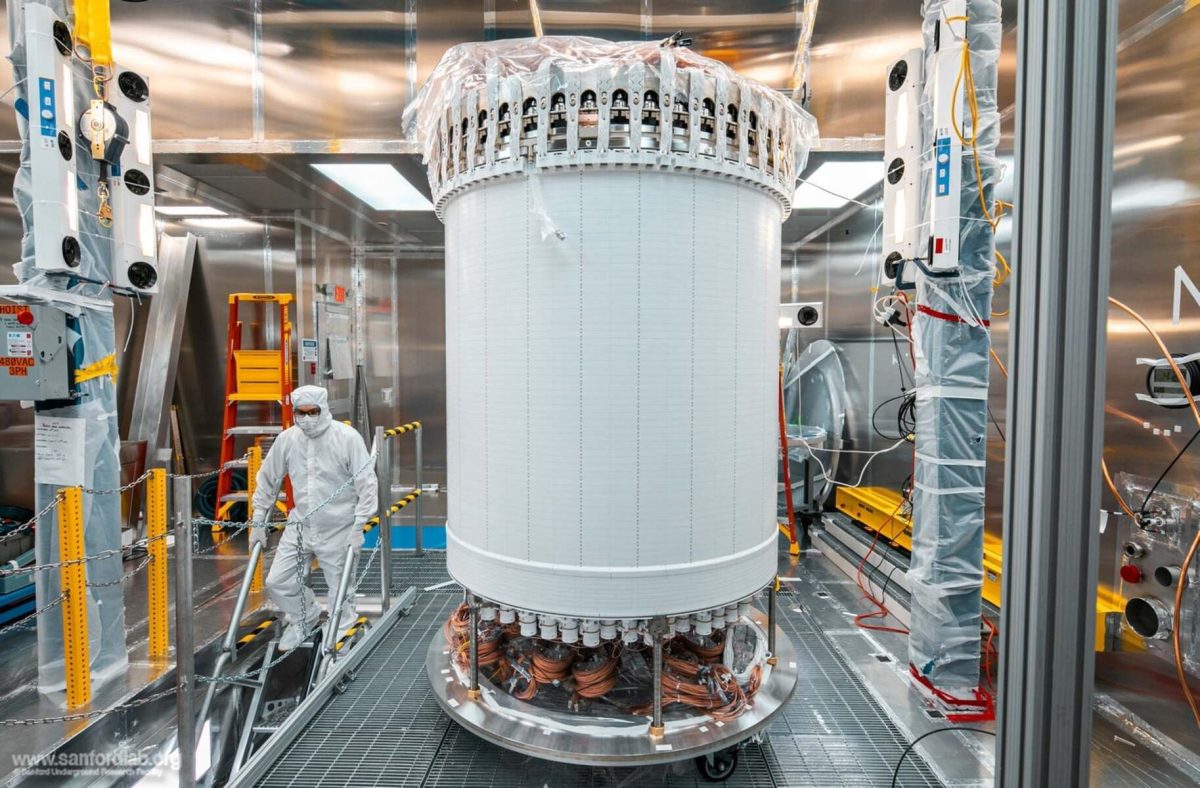
Photo credit: Matthew Kapust / Sanford Underground Research Facility.
A mechanism designed to capture infrequent collisions
The composition of dark matter remains unknown. Weakly interacting massive particles (WIMPs) are regarded as the leading candidates. It is believed that interactions between WIMPs and atomic nuclei occur with exceedingly low frequency; consequently, any extraneous background noise could potentially obscure the signal.
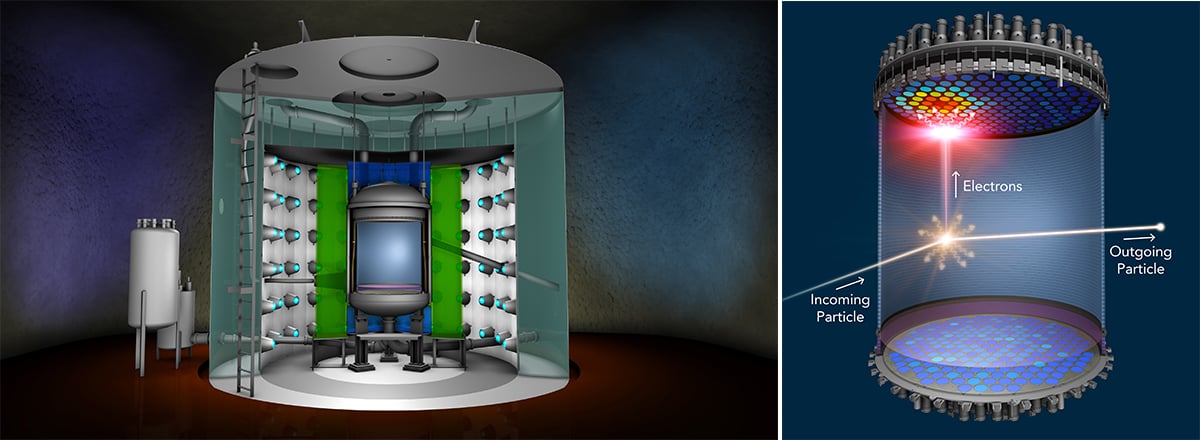
The LUX-ZEPLIN (LZ) facility is situated within a former gold mine in South Dakota, approximately one and a half kilometers beneath the surface. The geological rock layer provides a barrier against cosmic rays, and the tank containing ten metric tons of ultra-pure liquid xenon is encased by supplementary protective layers. When such a particle interacts with a xenon nucleus, it results in a double flash of light, which is subsequently detected by photodetectors.
A sign of increased energy levels
The analysis encompassed a total of 220 days of net data collection spanning the period from March 2023 to April 2024. Prior investigations primarily targeted weak, low-energy signals as forecasted by the most basic dark matter models. In this instance, the search parameters were broadened to incorporate more energetic collision events.
It was in this region that researchers detected a singular event characterized by a nuclear recoil spectrum that does not conform to known background processes. The outcome was unexpected, as it was anticipated to occur within a lower-intensity range. If the event were conclusively attributed to dark matter, its constituent particle would possess a mass exceeding that of a proton by more than 200 times.
The discovery was announced at the TeV Particle Astrophysics conference in Japan. The paper has been submitted to the journal Physical Review Letters, indicating that it has not yet undergone peer review, according to Imperial College London.
The five-sigma threshold
The statistical significance of the result is 2.6-sigma (2.6σ), which is substantially below the 5-sigma (5σ) threshold that physicists use to deem a discovery confirmed. According to Universe Today, the likelihood that the event was due to known background noise is approximately 0.5%.
Particle physicists established this criterion following a series of compelling signals that diminished as additional data were gathered. It was at this threshold that the discovery of the Higgs boson was announced in 2012. Results of lesser significance do not meet the criteria for this designation.
Next steps
The instrument gathered substantially more data than was utilized in this analysis. The data will be scrutinized to ascertain whether the signal is amplifying, diminishing, or attributable to a previously unidentified background process. The operations of LUX-ZEPLIN are scheduled to extend beyond 2028.
Henrique Araujo, a professor at Imperial College London, observed that the pursuit of extremely rare phenomena is inherently susceptible to unconventional background interference; consequently, the team requires additional statistical data. A significantly larger detector will be necessary to deliver a conclusive answer.
The XLZD project requires approximately tenfold the amount of liquid xenon and is projected to be initiated in the mid-2030s. The Boulby underground laboratory in the United Kingdom is under consideration as a potential site.
