

The X-ray trail near one of the Milky Way’s pulsars has turned out to be several times longer than anything seen before. It was detected with the help of an orbiting telescope. The structure extends in the same direction as ultra-high-energy gamma radiation whose source had not previously been identified. The coincidence means that, after being accelerated, the particles do not scatter in all directions but retain their direction of motion over dozens of light-years.
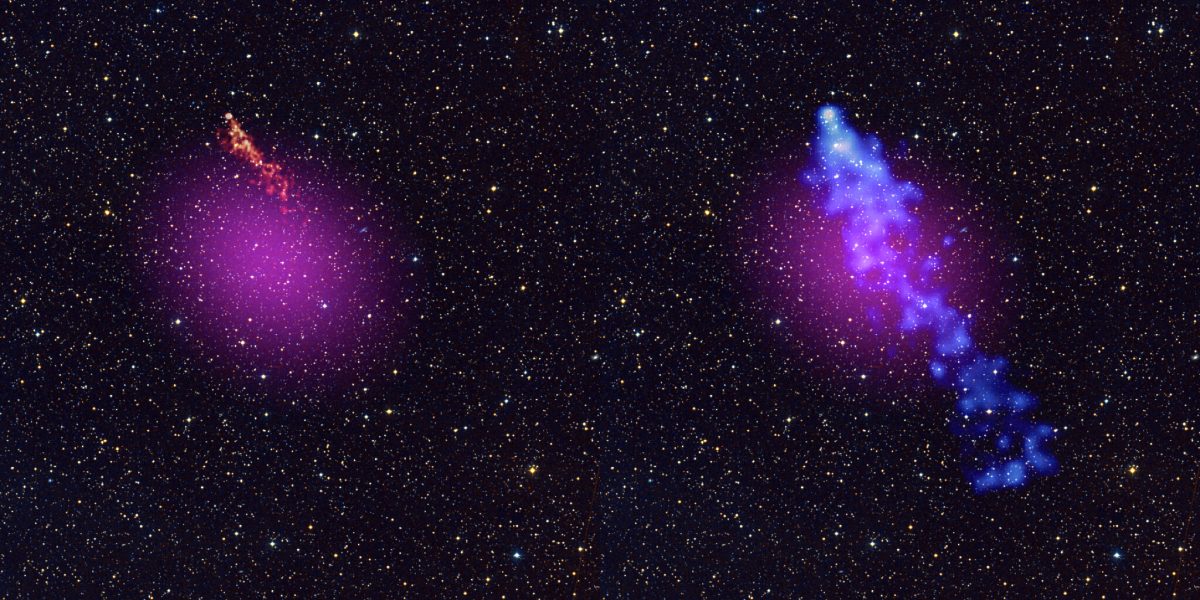
The Longest Known Tail
The middle-aged pulsar PSR J1740+1000 lies about 4,600 light-years from Earth. An X-ray tail several light-years long had previously been found next to it. New data show that it actually stretches southwest for as much as 32 arcminutes, corresponding to about 42 light-years.
No structure this extended has previously been recorded among pulsar wind nebulae. To understand the scale, the tail is roughly ten times longer than the distance from the Sun to the nearest star, Proxima Centauri, which is 4.2 light-years away. The results were published in the peer-reviewed journal Science China Physics, Mechanics & Astronomy.
Why It Had Not Been Seen in Full
This region of the sky had previously been studied with XMM-Newton, with a total exposure time of more than 400,000 seconds, more than six times longer than the new observations. Even so, only a small part of the extended structure was detected.
The Einstein Probe spacecraft carries a follow-up X-ray telescope with a wide field of view and a low background level. This combination makes it possible to detect faint, diffuse structures across large areas of the sky. About 70,000 seconds of accumulated signal — less than a day — was enough to reveal the full picture.
Gamma Rays Without a Visible Source
China’s Large High Altitude Air Shower Observatory (LHAASO) detects the most energetic gamma rays. Some of them are produced by particles with energies exceeding a petaelectronvolt. Near several such sources, there is no object capable of accelerating matter to such energies.
One explanation was that the accelerated particles had already traveled far from the place where they were energized. In that case, the gamma rays are produced in regions where no astronomical object is visible.
A Common Origin in Two Energy Bands
A simple coincidence in direction on the sky is not enough to draw a conclusion. The decisive point was that both types of radiation can be explained by the same population of high-energy electrons, while their spectra and positions on the sky are consistent with one another.
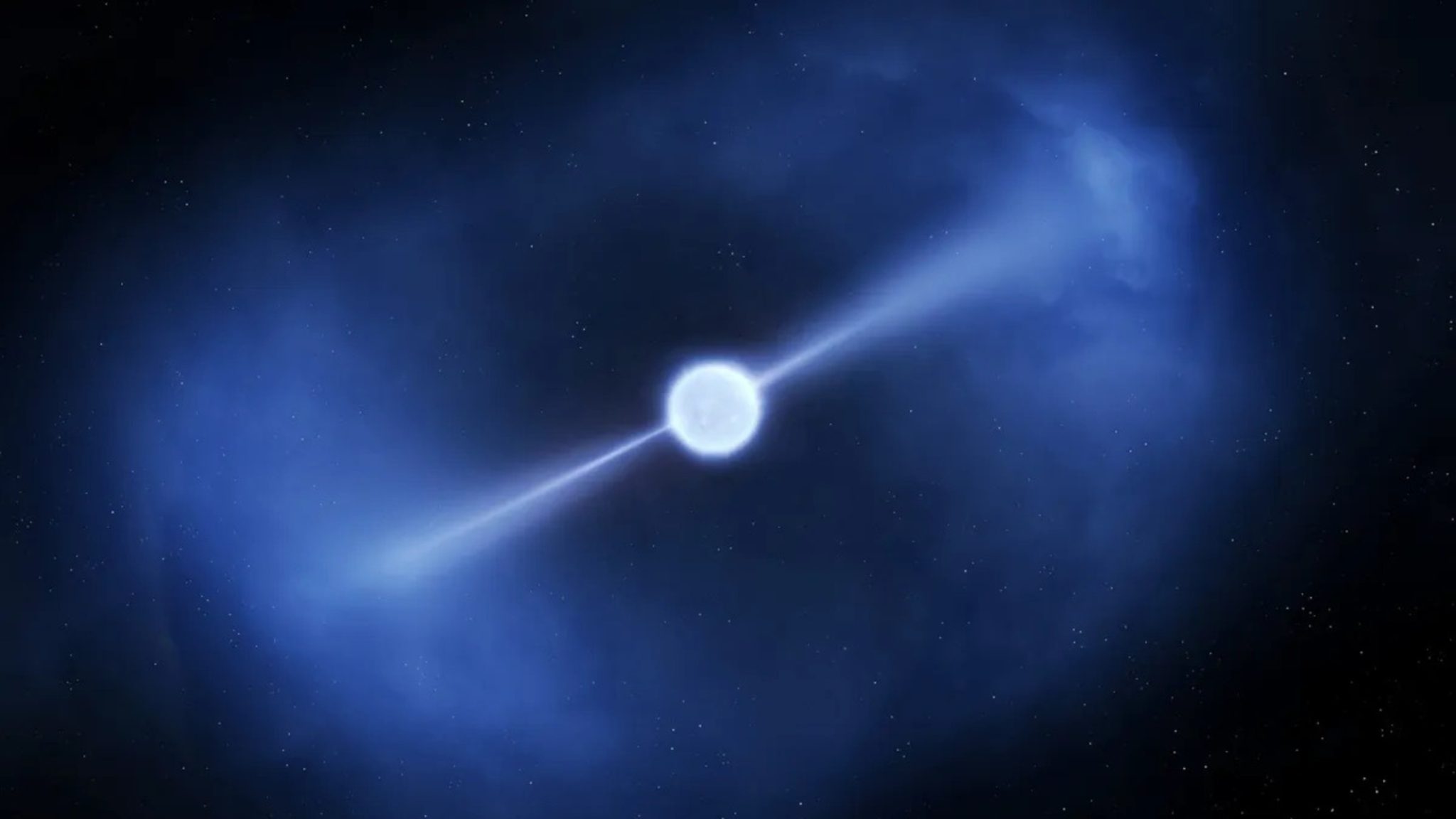
The particles are accelerated in the pulsar wind nebula. As they move along the tail through magnetic fields, they produce synchrotron radiation, which is detected in X-rays. The same electrons transfer energy to low-energy photons in interstellar space, boosting them to ultra-high energies.
Two Possible Explanations
In the interstellar medium, high-energy particles usually scatter on fluctuations in the magnetic field and gradually spread in all directions. Here, however, the preferred direction is preserved over 42 light-years, as phys.org reports.
The first explanation involves a highly ordered interstellar magnetic field, along whose field lines particle motion is relatively free while motion across them is suppressed. The second proposes a fast, collimated flow of matter that is continuously ejected in the same direction and carries particles away from the pulsar. It is not yet possible to determine which mechanism dominates.
Implications for Ultra-High-Energy Source Catalogs
The location where gamma rays are detected may not be the acceleration site itself, but only a section of the particles’ path. A spatial offset between an ultra-high-energy source and a candidate astronomical counterpart does not necessarily mean that the association is incorrect.
A commentary on the study was published in the same issue by Gabriele Ponti and colleagues from Italy’s National Institute for Astrophysics (INAF). For researchers compiling catalogs of gamma-ray sources, this means that displaced objects should be checked for possible connections with distant pulsars instead of dismissing such pairs as coincidental.
