

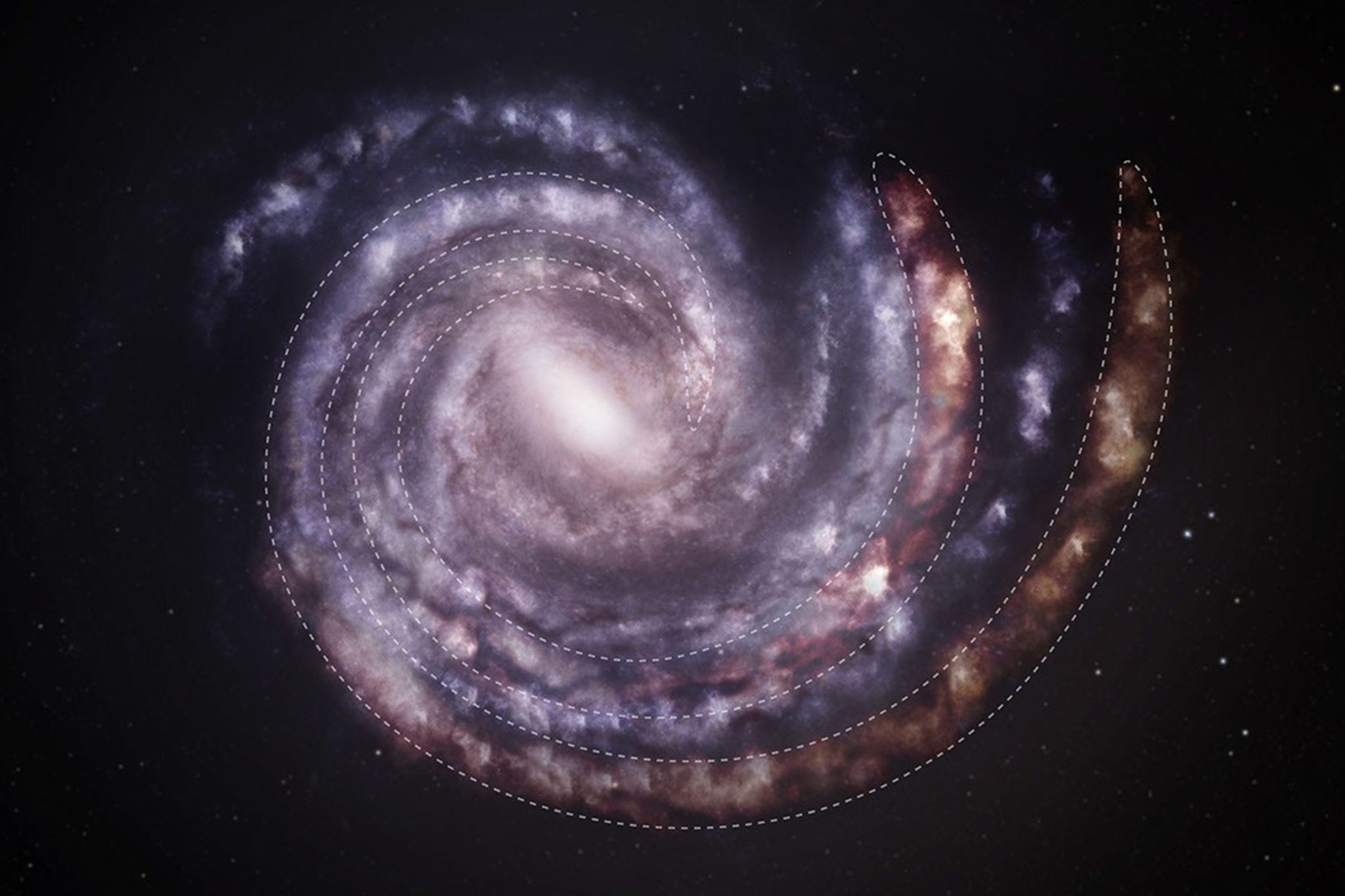
Two outer arms of the Milky Way have turned out to be farther from the center of the Galaxy than previously thought. A difference of about 10% may seem small, but it is enough to force astronomers to revise estimates of the mass of the entire stellar system. The distance was measured thanks to X-ray echoes from gamma-ray bursts.
Geometry Instead of Assumptions
Most methods for determining distances to spiral arms rely on models of the Galaxy’s rotation. In the outer regions, these models become increasingly unreliable.
A team led by Beatrice Vaia of the IUSS School for Advanced Studies Pavia and the University of Trento applied a different approach. The researchers used the phenomenon of X-ray echoes. When a gamma-ray burst outside our Galaxy emits a powerful pulse, its X-ray radiation is reflected by dust clouds in the spiral arms. Concentric rings form around the source, and their diameter directly indicates the distance to the cloud. Larger rings mean a closer cloud.
“This is a very direct method that relies entirely on geometry,” Beatrice Vaia explained. No assumptions are needed about exactly how the Milky Way rotates.
Three Arms and Three Bursts
The measurements used data from the Chandra X-ray Observatory, operated by NASA, and XMM-Newton, operated by ESA with NASA participation. The team processed observations of three different gamma-ray bursts whose radiation was reflected by dust in the Perseus Arm, the Outer Arm, and the Outer Scutum-Centaurus Arm.
X-ray rings around a gamma-ray burst. The diameter of each circle directly indicates the distance to the dust cloud that created it. X-ray: NASA/CXC/INAF/B. Vaia et al.; Optical: Pan-STARRS.
The results were published on July 1, 2026, in the peer-reviewed journal Astronomy & Astrophysics, NASA reports. The Outer Arm is located 15.2 kiloparsecs from the Galactic center, whereas previous estimates placed it at 13.8 kiloparsecs. The Outer Scutum-Centaurus Arm turned out to be even farther away, at 18.6 kiloparsecs instead of 16.9. The difference of over one and a 1500 parsecs for the most distant arm suggests that the outer regions of the Milky Way may extend further than previous estimates indicated.The data for the Perseus Arm, which lies closer to the center, matched previous estimates.
A Dust Cloud 3,500 Light-Years Wide
The method also made it possible to estimate the thickness of the dust cloud in the most distant arm. It is about 3,500 light-years wide. This means that the measurements refer to the entire cross-section of the spiral arm, rather than to a random isolated cloud that might not reflect its true position.
This means that the measurements refer to the entire cross-section of the spiral arm, rather than to a random isolated cloud that might not reflect its true position. Study co-author Ilaria Fornasiero, from the same joint program of the IUSS School for Advanced Studies Pavia and the University of Trento, emphasized that even small corrections to distances are fundamentally important. They directly affect estimates of the mass of the entire Galaxy, and the overall structure of the stellar system depends on how far its arms extend.
A Rare Tool
Despite its proven accuracy, the approach has a significant limitation. Bright gamma-ray bursts visible through the plane of the Galaxy are extremely rare.
“We rely on the Universe to provide us with these events, and in more than 25 years we have found only a few suitable for study,” said co-author Andrea Tiengo of the IUSS School for Advanced Studies Pavia. The team will continue searching for new bursts in order to refine the map of the Milky Way’s spiral structure.
