

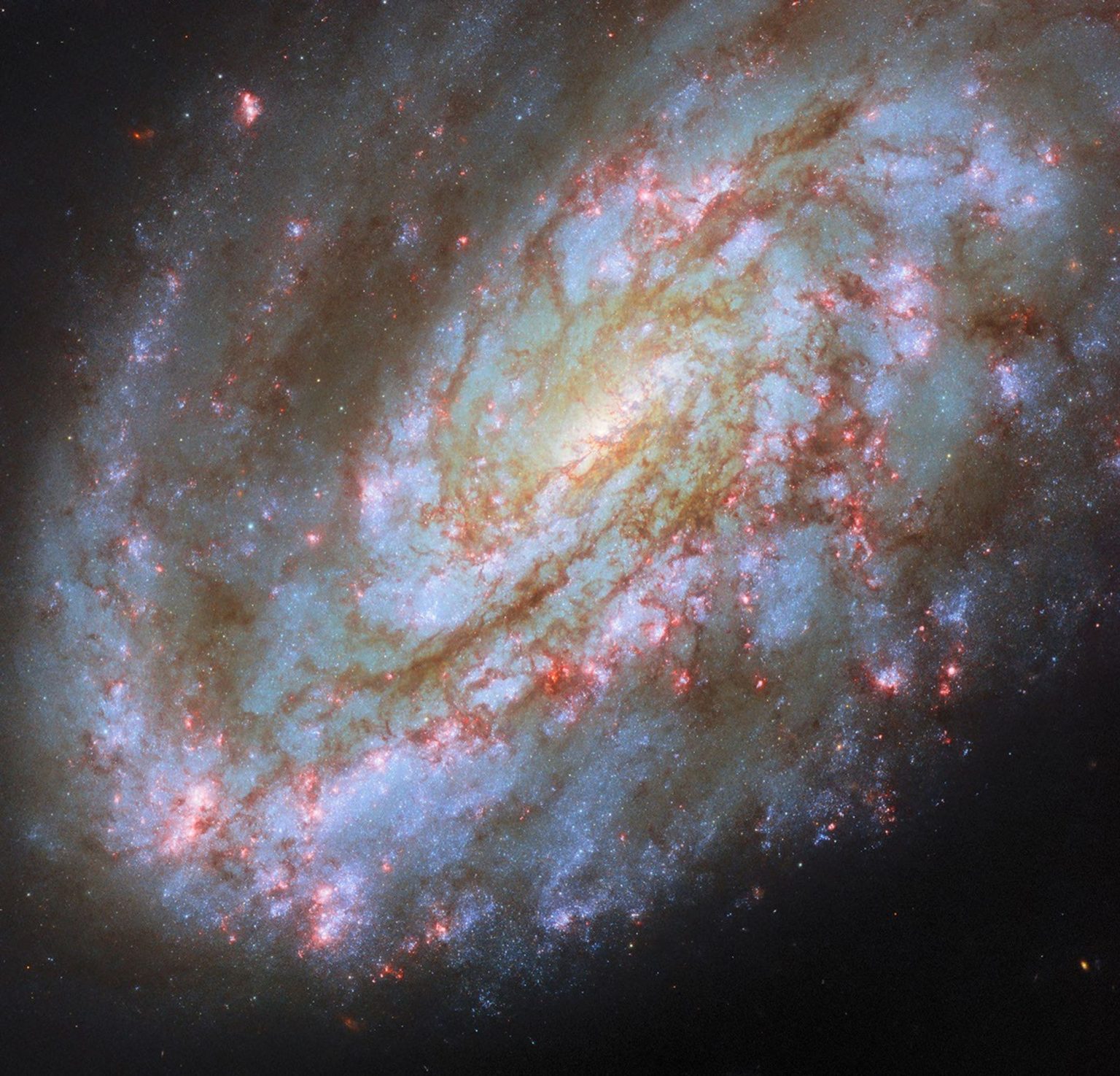
A distant spiral galaxy appears unusually asymmetric. One of its arms is densely populated with young stars, while the opposite arm is almost empty. Two different forces brought it to this state, and the earlier of the two acted hundreds of millions of years ago. The losses were substantial, yet new stars continue to form there.
A Shape without a Clear Category
NGC 4654 belongs to the intermediate spiral type. In terms of shape, such systems lie between galaxies with a prominent central bar and those without one. In this case, the structure is present but only weakly visible.
The object is located in the Virgo Cluster, one of the richest and most massive galaxy clusters. It lies 72 million light-years from Earth. The image obtained with the Hubble Space Telescope and published on NASA’s website shows only part of the full picture, because a long gas tail extends far beyond the frame.
The Effect of Ram Pressure
The space between the members of the cluster is filled with hot, diffuse gas known as the intracluster medium. The galaxy is moving through it at very high speed.
As a result, the leading edge of the disk is compressed and takes on a rounded, sharply defined shape. It is clearly visible in the new image.
On the opposite side, cold gas is pulled backward and forms an elongated tail. This process is known as ram-pressure stripping.
The Consequence of an Ancient Close Encounter
The distribution of stars is also asymmetric, which is unusual for spiral systems. The arm along the leading edge is rich in stars and gas, while the opposite arm contains noticeably less of both. Researchers believe that ram pressure alone is insufficient to produce such an effect.
The explanation was linked to another galaxy in the same cluster, NGC 4639. Approximately 500 million years ago, the two objects passed close to one another, and their gravitational interaction pulled part of the gas along one side of the disk. They are now far apart, but the shortage of stars in that arm remains.
Star Formation Has Not Stopped
Galaxies that lose cold gas usually experience a decline in the rate of new-star formation. In NGC 4654, however, this rate remains close to two solar masses per year, comparable to other systems of similar size. At this pace, it is not inferior to the Milky Way, where approximately the same amount of young stellar material forms each year.
The new Hubble data include a narrow band of red light emitted by clouds of excited gas. This emission is used to identify regions where young stars have recently formed.
In the image, these regions appear as bright pink bubbles. They are scattered from the leading arm to the outer edge of the disk, while some surround the weak central bar.
The Broader Research Goal
The data used to create this image were collected as part of two scientific projects. Both focus on the relationship between gas inside galaxies and the formation of young stars.
The observations cover a large sample of bright systems in the nearby Universe. Astronomers are studying how gas moves through galactic disks and under what conditions it compresses into stars and stellar clusters. Another area of research concerns the feedback from young stars and how they affect the surrounding material.
