

Using new computer simulations, astrophysicists reconstructed how the first galaxies formed in the early Universe. This made it possible to connect James Webb observations with the chemical composition of the oldest stars near the Milky Way. One of the results concerns the mystery of the similar iron content in the faintest dwarf systems. According to the calculations, most of them received this metal from a single explosion of an extremely massive star from that era.
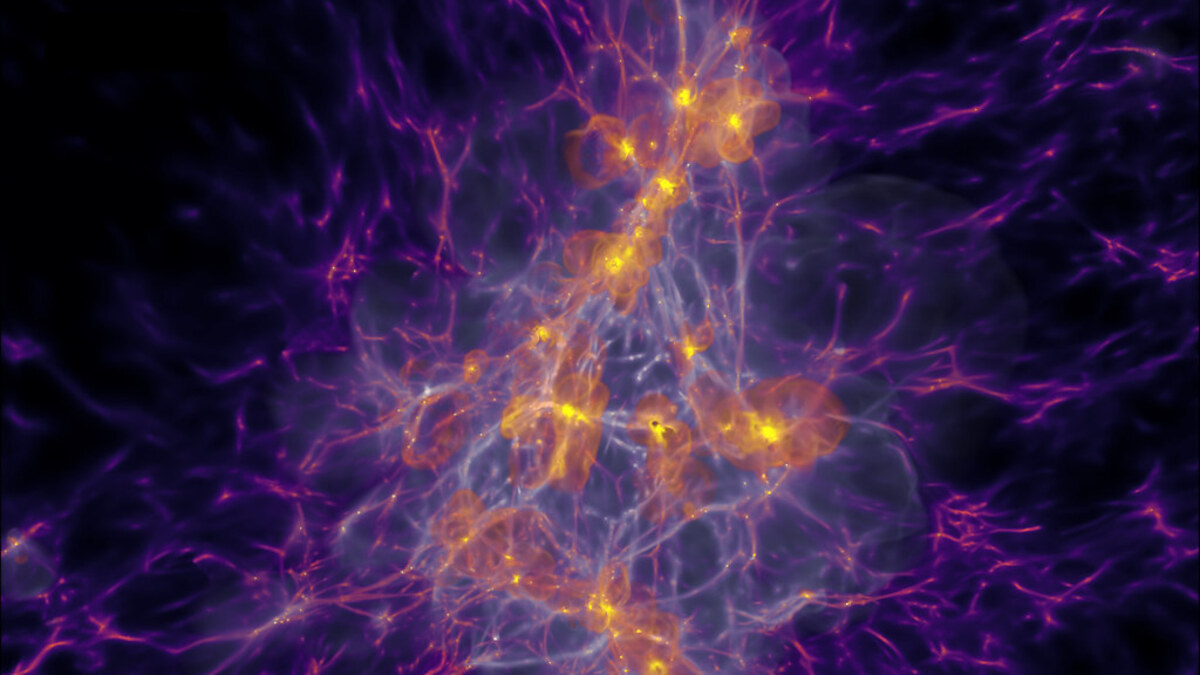
Two Views of the Early Universe
Early galaxies are seen by James Webb as they were more than 13 billion years ago. The oldest stars in the Milky Way are studied in their present-day state. In the spectra of distant objects, astronomers mainly determine oxygen, while in old stars they measure iron, so these data cannot be compared directly.
The MEGATRON project was created to combine these two sources of knowledge within a single physical model. It is led by scientists from the University of Bath together with colleagues in Chicago and Paris. As EurekAlert reports, four papers by the team were published on September 30 in the peer-reviewed Open Journal of Astrophysics.
How the Simulation Works
The simulation begins with primordial gas containing no heavy elements, as it was immediately after the Big Bang. It tracks the formation of the first stars, supernova explosions, and the incorporation of synthesized elements into subsequent generations of stars. The motion of matter, the propagation of light, and the chemistry of dozens of types of atoms and molecules are calculated together because they influence one another.
Simplified models may have underestimated the effect of stellar radiation on the gas surrounding galaxies. The new simulation reproduces fine details in the structure of this gas, helping improve predictions for observations.
The region of space was selected so that it would later grow into a galaxy with the mass of the Milky Way. The resolution reaches several parsecs, or about 10 light-years, so the model can resolve individual gas clouds where the first stars formed.
The Mystery of the Iron Plateau
The total stellar mass of the faintest dwarf galaxies around the Milky Way does not exceed 100,000 solar masses. Usually, the less massive a galaxy is, the less iron it contains. Here, however, this relationship does not hold. The smallest dwarf systems contain roughly as much of this metal as the largest ones, overall about 300 times less than the Sun.
Astronomers call this feature the iron plateau. Theorists have long been unable to explain where so much iron in such small galaxies came from.
One Explosion per Galaxy
More than 500 dwarf galaxies formed in the simulations, and in 78% of the least massive ones the iron content matched the observations. In a typical such system, exactly one first-generation star exploded, with a mass between 160 and 300 times that of the Sun. Such a star is completely disrupted, leaving no black hole behind.
The explosion releases about five solar masses of iron. For a star to form, gas must cool and contract under its own gravity. Ultraviolet radiation from a neighboring protogalaxy prevented this from happening in small concentrations of dark matter, so the first stars formed only in more massive ones, where gravity was strong enough to retain the ejected metal. According to the authors’ simplified calculation, iron distributed evenly through such an object produces just the abundance observed in dwarf galaxies.
A Prediction for New Telescopes
The model predicts that approximately one in five of the faintest galaxies should contain at least a thousand times less iron than the Sun. Among the 38 systems with measured iron content, none has yet been found, but the authors emphasize in their paper on arXiv that this list is still incomplete.
At the same time, the dwarf system Pictor II has a measured average iron abundance that nearly reaches this thousand-fold threshold, while in one of its stars the value is another ten times lower. According to the researchers, average values may be overestimated because only a few stars have been studied in each case.
New candidates for the faintest dwarf galaxies are expected from the Vera C. Rubin Observatory, while their composition will be measured using extremely large telescopes. The model itself is based on the assumption that the first stars were predominantly very massive, while the amount of nitrogen produced in the calculations is several orders of magnitude lower than in observations.
