

The Big Bang was probably not the point at which the Universe came into existence “from nothing.” According to a cosmological model developed by Neil Turok and Latham Boyle of the Perimeter Institute, this event served as a boundary separating our Universe from its mirror counterpart — an Anti-Universe in which time runs in the opposite direction.
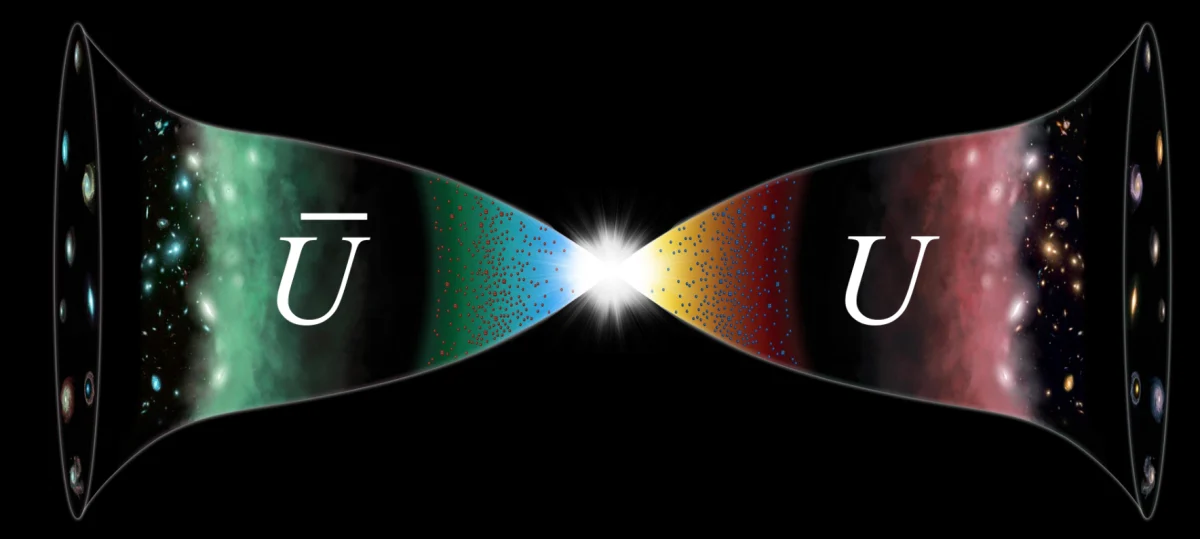
For decades, the perfectly flat geometry and uniformity of the early cosmos were explained by the hypothesis of inflation — a period of extremely rapid expansion before the hot phase. Turok and Boyle instead proposed a simpler approach: extend the laws of the Standard Model through the singularity and require CPT symmetry to be preserved. This principle of physics states that the laws of nature do not change if the signs of particle charges are reversed, spatial coordinates are inverted, and time is directed backward.
Life on the Other Side of the Singularity
In the CPT-symmetric concept, the cosmological scale factor approaches zero at the point of the Big Bang but continues smoothly beyond the boundary. On the other side, a mirror Universe unfolds in which the internal “arrow of time” points in the opposite direction to ours.
For hypothetical observers in that Universe, the passage of time would appear completely natural. From our point of view, however, their time moves into the past, space has the opposite orientation, and antimatter dominates instead of matter. Across the entire “Universe–Anti-Universe” pair, the total balance of charge and matter is preserved. The Big Bang therefore becomes not the beginning of time, but a point of symmetry within a larger cosmic structure.
Preserving Symmetry Instead of an Inflationary Phase
The mathematical framework of CPT symmetry near the singularity eliminates perturbations that grow without bound and leaves only finite modes. This makes it possible to explain acoustic oscillations in the cosmic microwave background without invoking hypothetical inflationary fields.
The model also suppresses primordial vorticity and tensor perturbations. Because massless gravitational waves are not produced by this mechanism, the model predicts the absence of a background of primordial long-wavelength gravitational waves. If future observations detect such waves from the earliest Universe, the CPT model would be disproved.
Superheavy Neutrinos and Dark Matter
In curved spacetime, the concept of an “empty vacuum” depends on the observer. Because CPT-symmetric geometry defines a specific initial vacuum state, modern observers perceive it as a medium containing a finite number of produced particles.
The theory points to a specific candidate — the sterile neutrino. According to the scientists’ calculations, a particle with a mass of about 4.8 × 10⁸ GeV, approximately 500 million times heavier than a proton, would provide the amount of matter required to explain dark matter. The mechanism does not require the introduction of new forces or additional particles and relies on a minimal extension of the Standard Model.
Testing the Theory in Practice
The model turns theoretical debate into specific experimental tasks. It makes three clear predictions:
- All three types of light neutrinos are Majorana particles, meaning they are identical to their own antiparticles.
- The lightest neutrino has zero mass.
- There is no background of primordial long-wavelength gravitational waves.
Future searches for neutrinoless double beta decay and measurements of the total neutrino mass may help test these claims. For now, the CPT-symmetric model represents an elegant alternative to traditional inflation, showing how a single fundamental symmetry could explain dark matter, the structure of the cosmos, and the imbalance between matter and antimatter.
Previously, we reported on how the heaviest antimatter particle was detected at the Large Hadron Collider.
According to The Brighter Side