

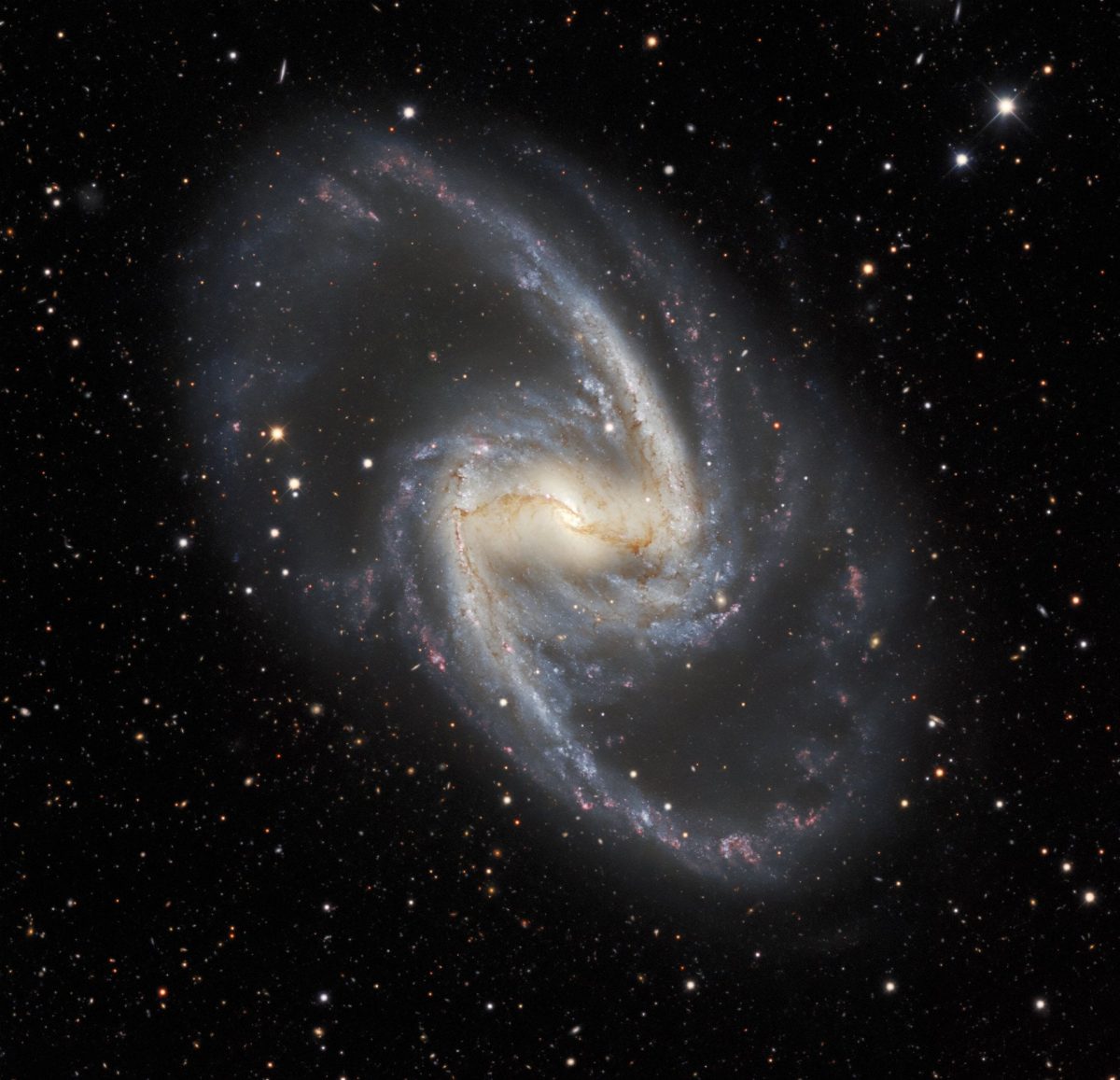
The star cluster at the center of a galaxy and the disk surrounding it do not form separately, but together. This was revealed by a computer model of a barred galaxy similar to our own. Gas flows toward the nucleus and feeds both structures from the same source. This explains why observations had not previously shown a connection between them.
The Mystery of Two Structures
At the centers of most galaxies, supermassive black holes are surrounded by dense nuclear star clusters, as well as disks made of the same material. Both structures began to be observed in the Milky Way and other galaxies only about ten years ago.
Sky surveys did not reveal a clear relationship between the masses and sizes of these structures. Computer calculations also failed to reproduce their formation realistically, so each was explained through its own separate scenario.
A Mechanism of Joint Growth
The simulation was carried out by a team led by the Leibniz Institute for Astrophysics Potsdam as part of the project studying stellar feedback in galaxies and its consequences (SMUGGLE-Ring). The findings, as Universe Today reports, were published in the peer-reviewed journal Astronomy & Astrophysics.
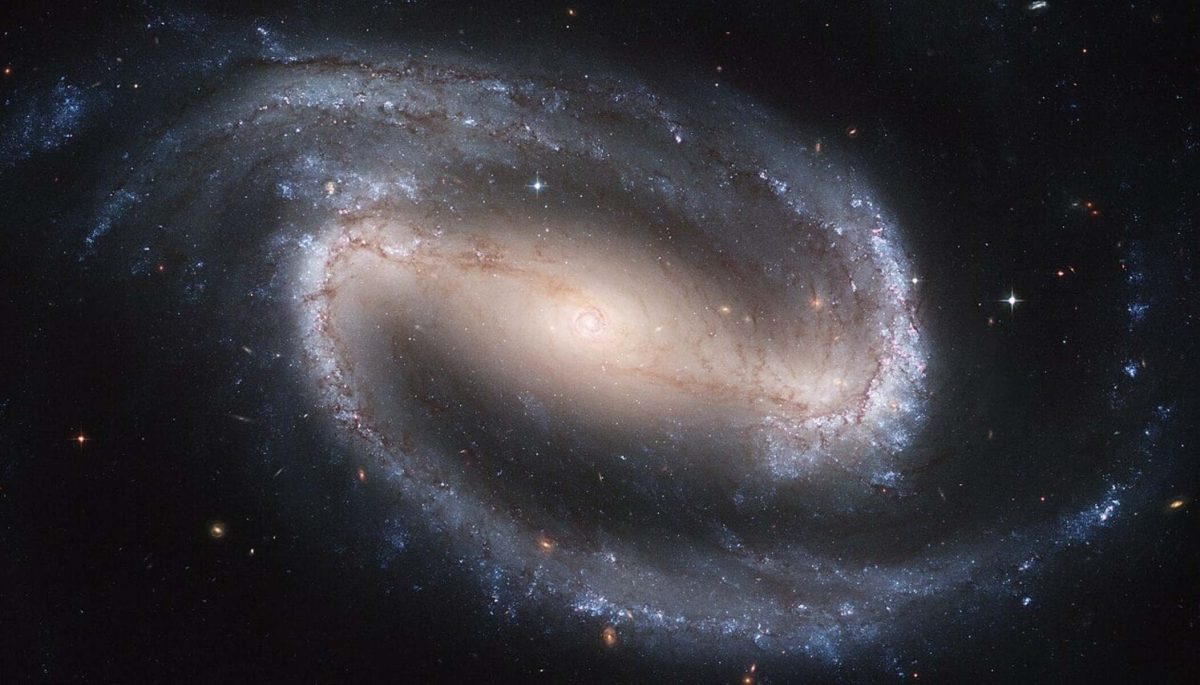
The key factor in the calculations turned out to be the stellar bar, which channels gas toward the center. There, matter accumulates, while shock waves from supernovae repeatedly trigger the formation of new stars. Over several billion years, stars with a combined mass of hundreds of millions of solar masses form in the nucleus.
Why the Connection Was Not Noticed
The apparent lack of connection between the two structures does not mean that their stars differ substantially in age, chemical composition, or motion. This is emphasized by Cristina Chiappini of the Leibniz Institute for Astrophysics Potsdam, a co-author of the study.
In the model, the ratio of the masses and sizes of the cluster and disk changes over time. At different stages of evolution, the same structures look completely different, even though they grow through a common mechanism. “Our simulation shows how a galactic bar acts like a cosmic conveyor belt, channeling gas inward and feeding both structures simultaneously from the same reservoir,” explains Seongwon Kwak.
A Merger at the Galactic Center
At one stage of the simulation, a dense group of stars with a mass of 30 million Suns spiraled toward the center of the galaxy. Its merger with the nuclear star cluster noticeably increased the cluster’s mass.
Approximately the same amount of matter is contained in the nuclear cluster of the Milky Way around Sagittarius A*. The addition of such a stellar group would nearly double its mass.
A similar picture was recently observed in NGC 1365. A massive stellar group was found within its bar and is expected to spiral toward the center over time. The result will be an increase in the mass of the nuclear star cluster, and later this may also affect the supermassive black hole inside it.
The Role of Dark Matter
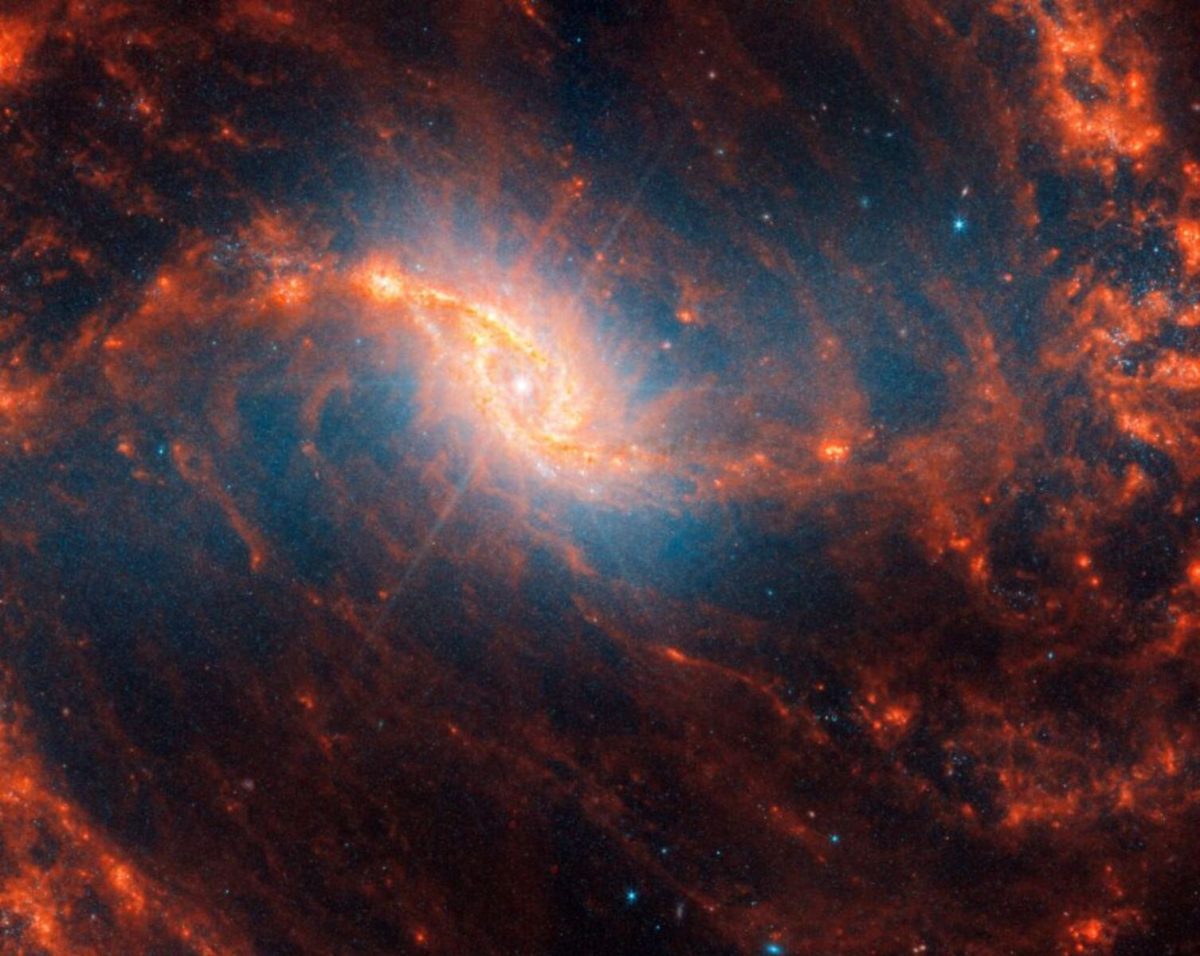
Another distinctive feature of this work concerns dark matter. Previous calculations treated the bar and halo as a fixed background, whereas in this model the particles moved freely and interacted with the stars.
Thanks to this approach, the bar formed on its own and changed over time, while the central structures developed together with it. The model also revealed a dark gap around the bar, which is observed in many galaxies and is considered a trace of the interaction between stellar matter and the invisible component.
