

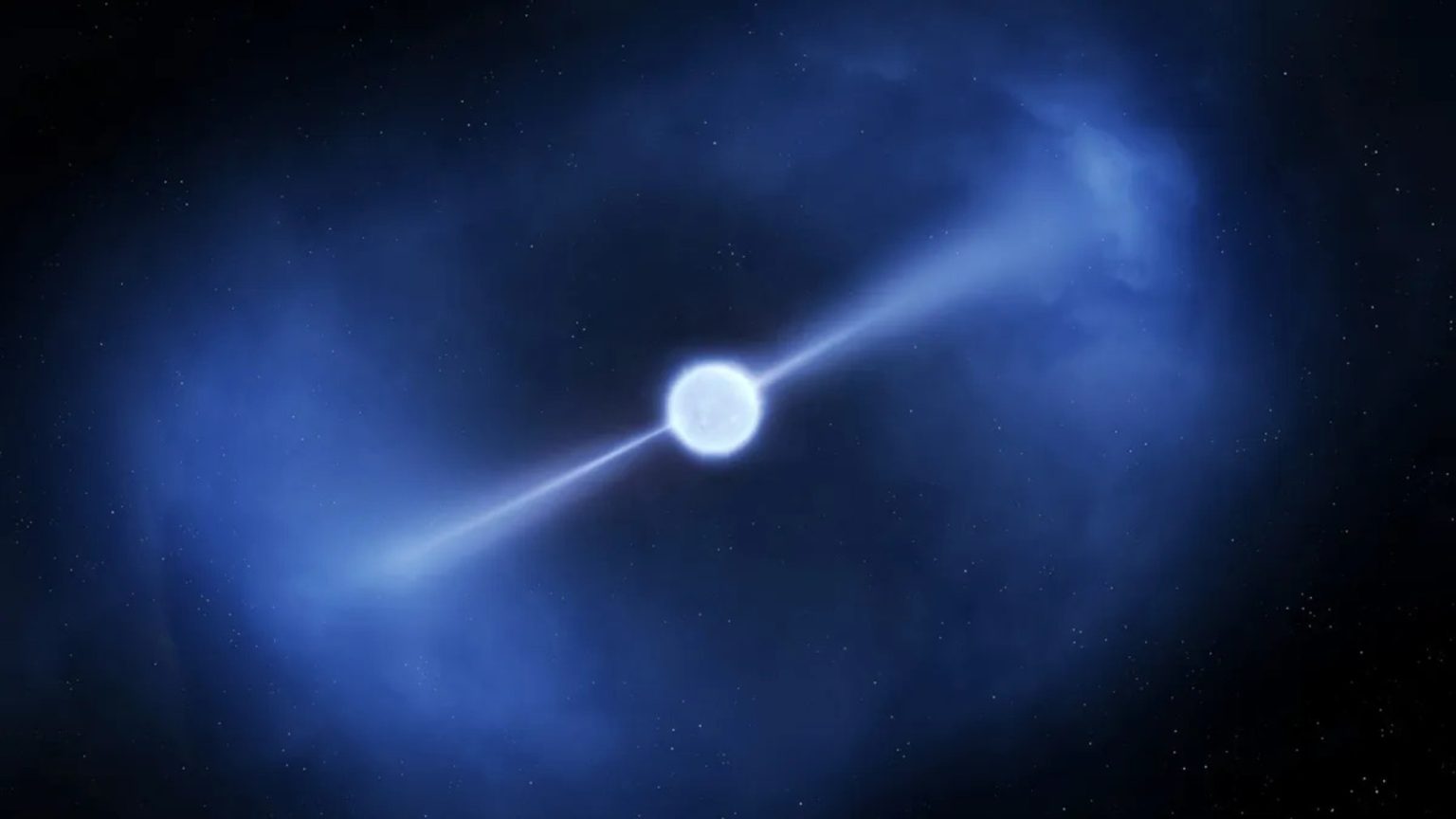
For decades, astronomers looked into the center of the supernova remnant G296.5+10.0 and found no radio signals there. A neutron star in this location was known, but it remained silent in the radio range. Now that silence has been broken. A team of Chinese researchers has, for the first time, detected weak radio pulses from the central compact object, which has received the unofficial name the Blue Eye Pulsar.
Consequences of a Spin Anomaly
The neutron star with the catalog designation 1E 1207.4-5209 belongs to the category of central compact objects, or CCOs. About a dozen of them are known, and all are located at the centers of supernova remnants. What distinguishes these objects from ordinary pulsars is precisely the absence of detectable radio emission.
Astronomers assumed that their magnetic field was too weak to generate radio jets. Decades of observations only confirmed this picture.
The mechanism that could have turned on the radio emission (the glitch) is likely related to a spin anomaly recorded in X-ray observations in 2015. A glitch is a sudden, slight acceleration of the neutron star’s rotation. Such events are thought to occur due to a rearrangement of its internal structure or the interaction of superfluid matter with a solid crust.
The team led by Zhang Lei of the National Astronomical Observatories of the Chinese Academy of Sciences suggests that this event strengthened or reoriented the object’s magnetic field. As a result, weak radio pulses became visible to the sensitive MeerKAT telescope in South Africa.
What the Blue Eye Pulsar Looks Like
The pulse frequency is one burst every 424 milliseconds, matching the previously known rotation period of this object. In X-ray images, it shines brightly.
When these data were combined with the new radio observations, the resulting image reminded one of the study’s authors, Tsinghua University professor Li Di, of a blue eye. This is how the unofficial name Blue Eye Pulsar was born. Its distance from Earth is about 10,000 light-years.
Quiet Neighbors in the Galaxy
If the glitch mechanism really does temporarily amplify radio emission, then as the rotation returns to its previous speed, the pulses should disappear. Further observations will show whether this happens. The authors already propose monitoring the object continuously.
The implications of the discovery, reported by Space.com with reference to the peer-reviewed journal Nature Astronomy, go far beyond a single object. If CCOs can switch on after glitches, then a significant portion of neutron stars in the Milky Way may be incorrectly classified as old and fading pulsars, when in fact they are young but simply quiet.
In that case, the true population of such objects in our galaxy may be much larger than current estimates suggest. This changes our understanding of the rate of neutron-star formation and the distribution of supernova remnants.
The hypothesis also offers a fresh perspective on the supernova remnant SN 1987A in the Large Magellanic Cloud. A pulsar has still not been detected there, although indirect evidence for a neutron star is convincing. Perhaps we simply have not heard it yet.