

One of the most prominent stars in the winter sky has turned out not to be alone. Another, much fainter star has been detected nearby. The search lasted for about a century, but astronomers had been unable to observe the neighboring object directly. This time, they obtained an image of it.
The End of a Long-Standing Debate
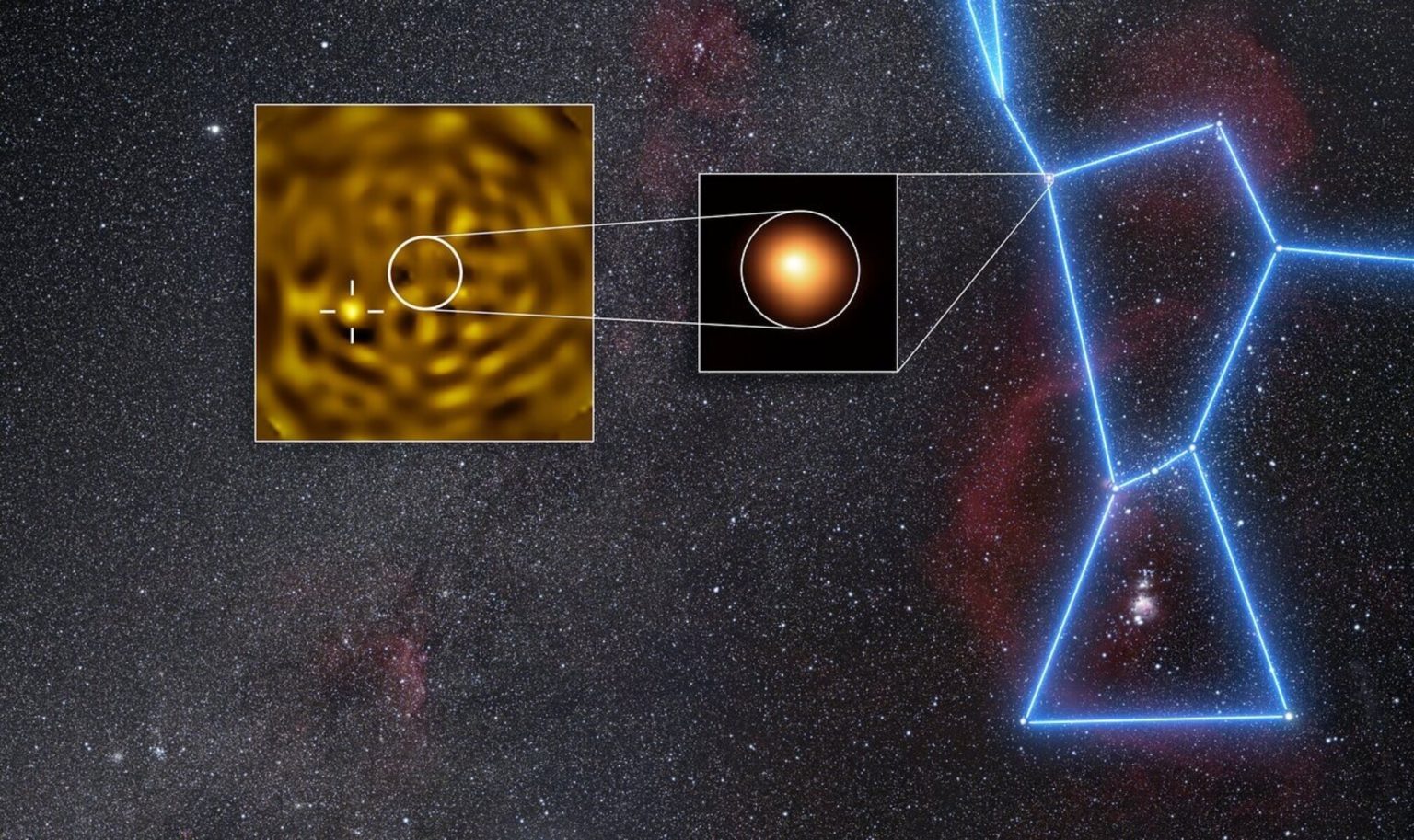
The clearest image of Betelgeuse’s probable companion was obtained by a team led by French astronomer Miguel Montargès of the Paris Observatory–PSL. The study was published in the peer-reviewed journal Astronomy & Astrophysics, and the researcher described the result as the conclusion of a century-long search, according to Рhys.org.
Variations in the brightness of the red supergiant were noticed long ago. One proposed explanation for the periodic fluctuations was the presence of another nearby star, but this hypothesis could not be verified. The faint light of such an object is lost in the glow of Betelgeuse itself.
A Prediction That Came True
A clue emerged from two studies published in 2024, whose authors calculated that the companion would reach its maximum apparent separation from the supergiant in December. The observations were conducted during that period, and processing the data took several more months.
The companion star was detected primarily because it turned out to be more massive than predicted. Earlier estimates placed its mass at approximately that of the Sun, whereas the new data indicate a range of two to three solar masses. According to Miguel Montargès, the equipment might not have been sensitive enough if the original estimates had proved correct.
An Image Instead of Indirect Evidence
The image was obtained using the Spectro-Polarimetric High-contrast Exoplanet Research instrument, SPHERE, installed on the European Southern Observatory’s Very Large Telescope in the Atacama Desert in Chile. This was a direct observation because the object’s own light was recorded, rather than its presence being inferred from variations in brightness.
Evidence of a second star had appeared before, including a possible direct detection using the Gemini North telescope in Hawaii. The latest result is being described as the most convincing evidence in favor of Betelgeuse B.
Image-processing methods originally developed for the search for exoplanets also proved effective for a massive star in a late stage of evolution, noted co-author Anthony Boccaletti of the Paris Observatory. Final confirmation is expected in a year, when the companion should appear on the opposite side, although, according to Miguel Montargès, little room for doubt remains.
The Question of the Future Supernova
Several years ago, Betelgeuse attracted widespread attention because of its sudden dimming, prompting speculation that a supernova explosion might be imminent. Miguel Montargès’s team studied the star using the VLT and showed that its light had been obscured by a cloud of dust.
A new element has now been added to the story because a close companion could influence how the future explosion occurs. The discovery of the second star also renews the long-standing mystery of Betelgeuse’s rapid rotation. Red supergiants of this age should rotate extremely slowly, whereas the measured surface speed is approximately an order of magnitude higher than expected. One previously proposed explanation was that Betelgeuse merged with another star in the past.
