Most massive black holes exist quietly at the very centers of their galaxies. However, an international team of astronomers from the University of North Carolina at Chapel Hill has made a discovery that goes beyond conventional expectations. The scientists detected an extremely rare wandering black hole located approximately 30,000 light-years from the galactic nucleus. Detailed results of the study were published in The Astrophysical Journal Letters.
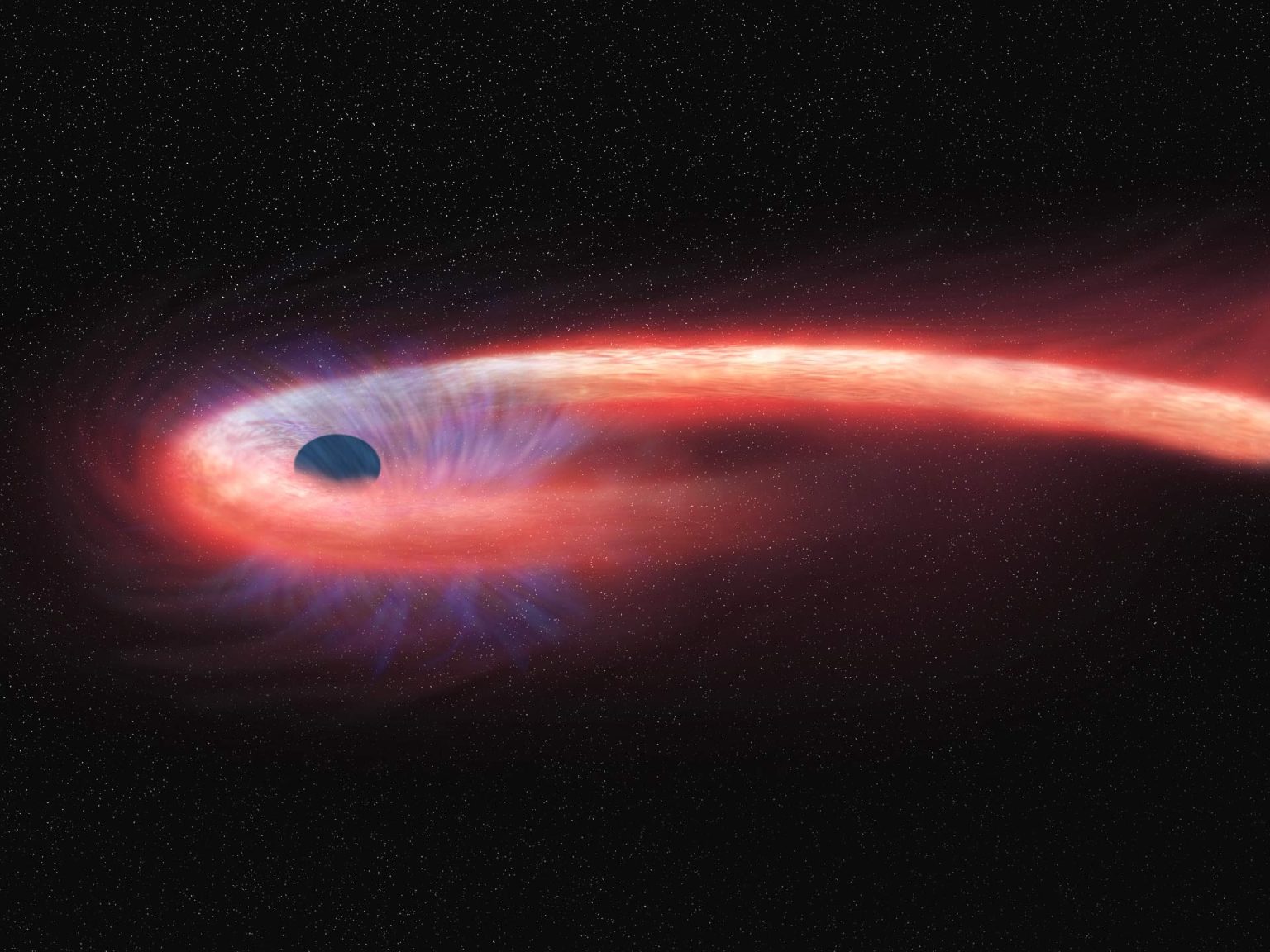
This cosmic giant owes its discovery to a dramatic event—a tidal disruption event, or TDE. This phenomenon occurs when a star comes too close to a black hole and is literally torn apart by its immense gravity. The catastrophic process is accompanied by a powerful release of light and energy. Such events are rare, occurring approximately once every 100,000 years in an individual galaxy. Although astronomers have documented more than one hundred such flares over the past decade, nearly all of them occurred strictly in central regions. The flare designated TDE 2025abcr was an exception and set a record for its distance from the center.
According to the researchers’ estimates, the mass of the detected object is approximately one million times that of the Sun. Astronomers suggest that the black hole may have ended up near the edge of the galaxy as a result of an ancient merger between two galaxies, or it may have been ejected from its original location through complex gravitational interactions near the center.
How to See an Invisible “Wanderer”
Black holes themselves are completely dark and emit no light, making them extremely difficult to find in the vastness of space. TDE flares serve as a kind of “cosmic beacon,” briefly illuminating these hidden objects and allowing scientists to study the process by which they consume matter.
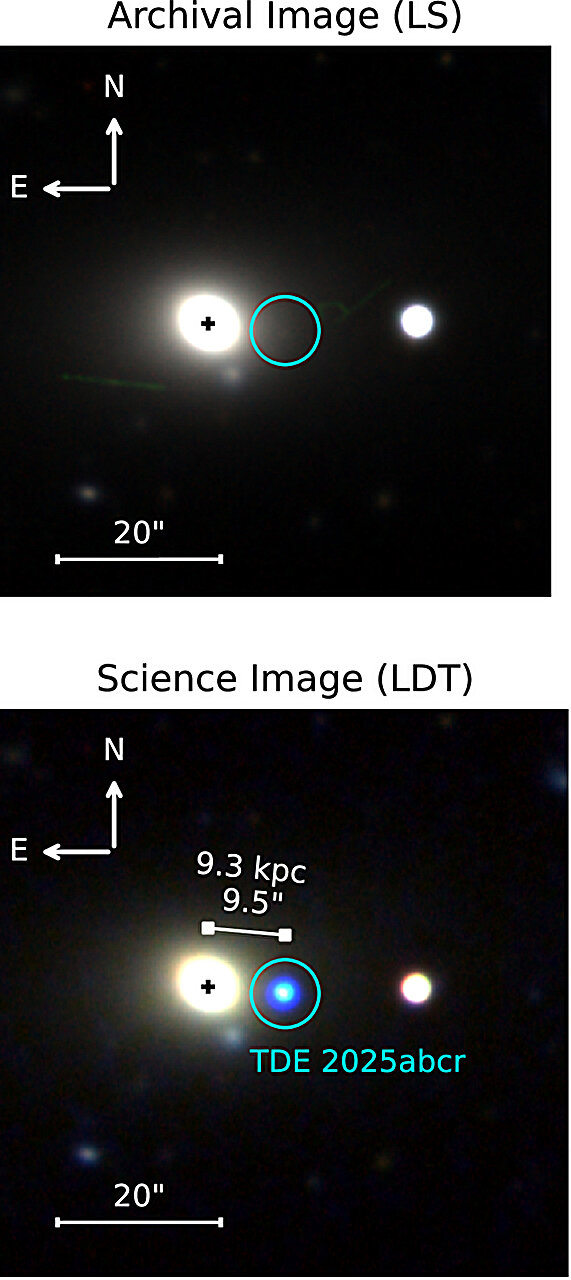
The key breakthrough in this story was the use of advanced technology. To identify TDE 2025abcr within enormous astronomical datasets, scientists used a specialized artificial-intelligence-based classification tool known as tdescore. Developed by researchers at the University of Maryland and NASA’s Goddard Space Flight Center, the algorithm was specifically configured to search for potential signals outside galactic centers.
By removing the traditional restriction and allowing the software to search for flares across the entire area of galaxies, the scientists were able to identify an object that previously would have been almost impossible to notice. In the modern era of rapid artificial intelligence development, such algorithms are becoming essential tools for astronomers searching for rare phenomena.
New Horizons for Ground-Based Observations
After artificial intelligence flagged the signal as a promising candidate, the researchers carried out follow-up observations using the 4.1-meter ground-based SOAR telescope in Chile.