

A new study published in the journal Astronomy & Astrophysics describes how astronomers are interpreting a new map of positron annihilation and whether the results reflect actual annihilation events or are merely imaging artifacts.
Gamma-Ray Signals from Positron Annihilation
Positrons—the antimatter counterparts of electrons—are produced in high-energy cosmic processes. When ordinary matter encounters its antimatter counterpart, they annihilate, or disappear, producing a characteristic gamma-ray signal with an energy of 511 keV. Scientists use this signal to determine where annihilation is taking place.
Over the past 20 years, so much data of this kind has accumulated that it has become apparent that positron annihilation may occur in unexpected places and far more frequently than previously believed. This was reported by phys.org
Tracking Positron-Annihilation Hotspots Beyond Our Galaxy
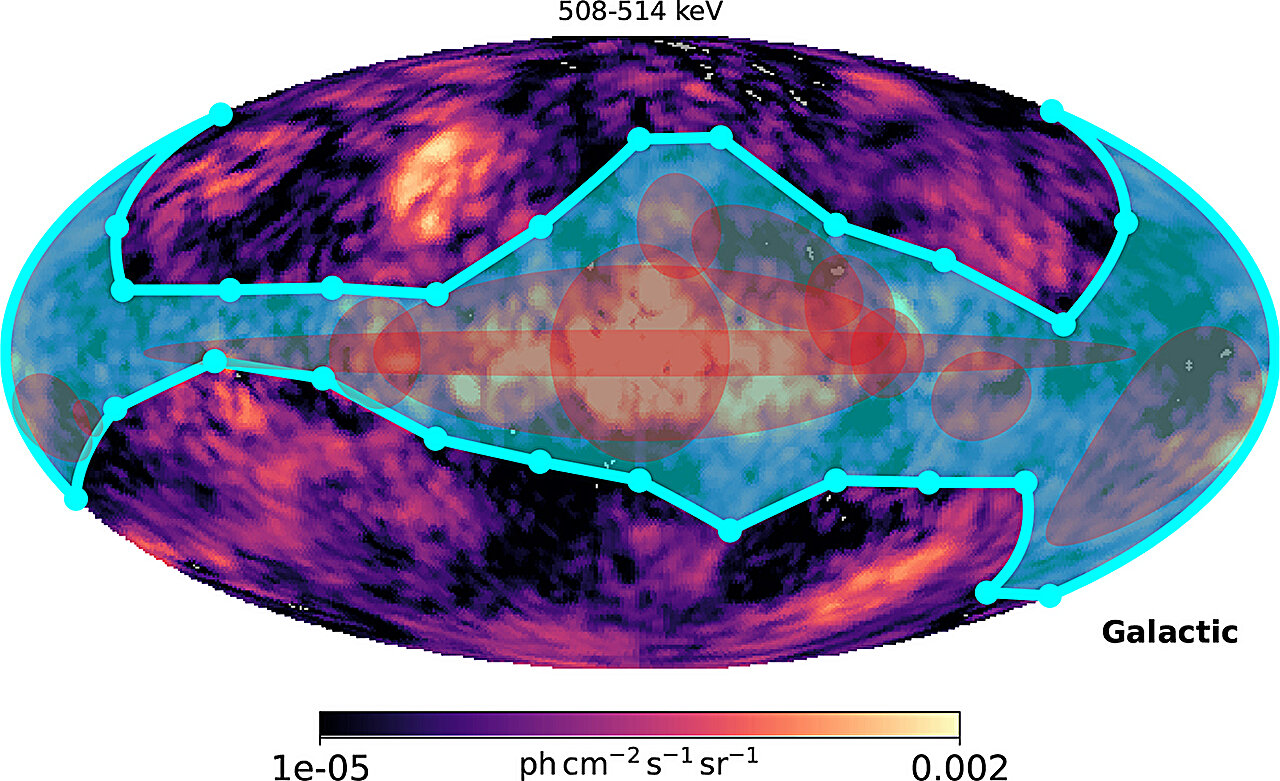
The team involved in the new study examined a sky map created from more than 20 years of data collected by the spectrometer aboard the International Gamma-Ray Astrophysics Laboratory, INTEGRAL/SPI. The map highlighted regions where the 511 keV gamma-ray signal was detected. The researchers masked the bright regions of the Milky Way and compared the remaining hotspots with maps of high-velocity gas clouds and a catalog of nearby galaxies.
Earlier INTEGRAL studies had already detected strong positron-annihilation signals in the emission from the Milky Way’s bulge and disk. In 2025, a reconstruction of INTEGRAL’s long-term dataset also revealed persistent hotspots outside the galactic plane, even after several checks.
“High-exposure regions outside the galactic plane were found in the areas of Andromeda, Ursa Major, Hydra, Sextans, and Virgo. In addition to these regions, two more hotspots were detected where there are almost no nearby galaxies. These areas appear to coincide with high-velocity clouds and, in particular, with the Magellanic Stream,” the authors of the study wrote.
Extragalactic Sources Point to a Higher Level of Positron Production in the Milky Way
The team evaluated the reconstructed 511 keV signals around high-velocity clouds, large clusters of nearby galaxies, and the Magellanic Stream—a vast ribbon of gas trailing behind the Large and Small Magellanic Clouds as they orbit the Milky Way.
They found that the two brightest hotspots aligned with the Magellanic Stream and another giant gas structure outside the Milky Way known as Complex C. The researchers say this alignment may indicate that positrons are escaping from the Milky Way and annihilating in the surrounding gas. This is unexpected because previous analyses suggested that positrons should move too slowly to reach the outer parts of the Galaxy before being annihilated. Four additional, weaker hotspots also pointed toward clusters of nearby galaxies, including Andromeda, Ursa Major, Hydra, and Virgo.
When the team estimated the expected contribution of positrons originating in the Milky Way based on their findings, the results were two to three times higher than previous estimates. The researchers say it is possible that positron-annihilation signals from extragalactic sources in nearby galaxy groups, such as Andromeda and Virgo, could explain the additional signal.
The Possibility of Background Fluctuations in the Images
Considerable uncertainty still surrounds the study’s results, as a large portion of the additional signal may be related to imaging artifacts. These signals are weak, and image reconstruction can create false structures. In addition, INTEGRAL’s sky coverage is uneven, which may make some regions more vulnerable to artifacts or more difficult to detect. However, the team says that, in their view, this is unlikely.
They wrote: “Although there is still a chance that some features of the high-latitude 511 keV emission are imaging artifacts, it would seem strange if all of the hotspots were merely background fluctuations.”
A more sensitive and more uniformly surveyed MeV gamma-ray sky could confirm or disprove the existence of these hotspots in the future. NASA’s upcoming COSI mission, expected to launch in 2027, could test for the presence of individual extragalactic 511 keV sources and provide additional confirmation.
