

For more than half a century, astronomers working within the Search for Extraterrestrial Intelligence project (SETI) have regarded the so-called “water hole” as the ideal place to “listen” to the Universe. It is a quiet interval in cosmic radio noise between frequencies of 1.42 and 1.66 GHz. It is within this range that hydrogen (H) and hydroxyl (OH) molecules emit and absorb energy; when combined, they form water.
For a long time, it was assumed that any intelligent carbon-based life form for which water is essential would choose this range for communication—both because of its poetic and chemical symbolism and because of the minimal level of static interference. However, these romantic ideas are gradually giving way to new, pragmatic technologies.
A New View of the Radio Spectrum
British researchers have proposed radically changing the focus of observations and moving beyond the “water hole.” Instead of traditional low frequencies, they concentrated on searching for concentrated narrowband signals in higher-frequency ranges that have so far remained virtually unexplored.
Astronomer Louise Mason of the University of Manchester notes that for decades SETI has examined only a tiny fraction of the radio spectrum. The new approach opens an entirely new parameter window for detecting technosignatures. Most interestingly, this method may be capable of detecting not only deliberate transmissions, but also accidental radio leakage or even relic signals left behind by civilizations that became extinct long ago.
Scanning the Past
The main advantage of the new approach is that it does not require the continuous construction of new and expensive radio telescopes. Scientists can review vast amounts of archival data collected for completely different purposes, which may already contain signatures of extraterrestrial intelligence.
Mason’s team began its analysis with Band 3 data obtained using the ALMA radio telescope array, the Atacama Large Millimeter/submillimeter Array, located in Chile. The researchers examined high-frequency narrowband regions around 90.642 and 93.151 GHz in the millimeter and submillimeter ranges.
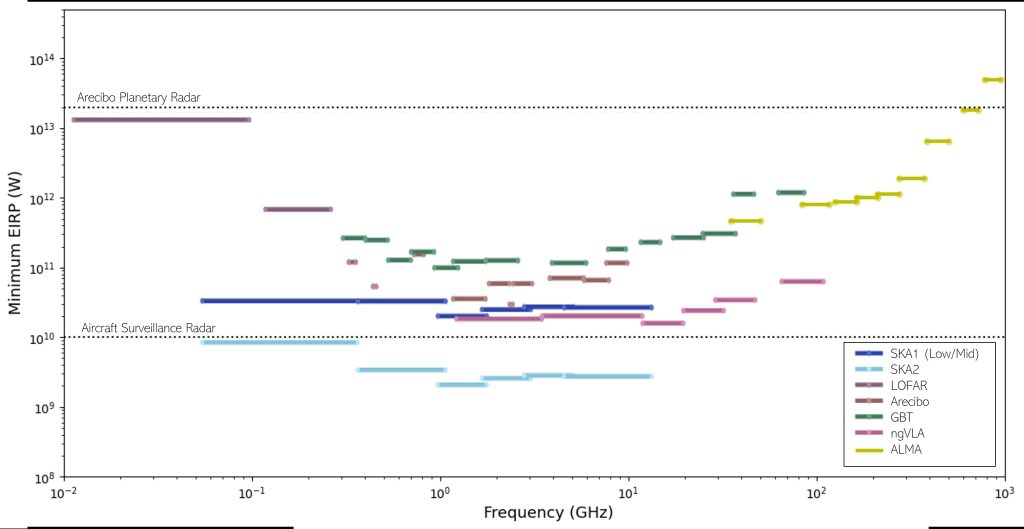
Thanks to ALMA’s high-resolution measurements and wide field of view, astronomers were able to capture signals from far more stars than the original observing programs had anticipated. As a result, thousands of unrelated stellar systems that had never previously been specifically examined are now included in this new search range.
Galactic Maps and Prospects
The study of ALMA data is only the first step. The team is now collaborating with the SETI Institute and incorporating astrometric data collected by the European Space Agency’s Gaia space telescope.
The researchers are comparing the information obtained with the so-called Besançon model—a detailed computer simulation of the Milky Way that reproduces the motion and orbits of hundreds of billions of stars in our Galaxy. This makes it possible to understand more precisely which regions have already been covered by the search and where the probability of detecting a signal is highest.
Although no confirmed contact or extraterrestrial signal has yet been found, scientists are convinced that the combination of high-frequency archival observations and galactic modeling has finally placed the search for extraterrestrial intelligence on the right track.
Earlier, we reported on how SETI received $200 million to search for extraterrestrials.
According to ras.ac.uk
