

Recently, strange luminous circles were discovered in photographs of our neighboring planet Venus taken back in 2010. Scientists suggest that these may be effects caused by small changes in the planet’s atmosphere.
Analysis of Archival Images in Polarized Light
In 2010, scientists waiting for an opportunity to use the William Herschel Telescope in the Canary Islands captured a brief, 36-minute series of images of Venus. They were waiting for the Sun to set so they could observe distant stars and dust disks around young stars. As a result, the data received little attention and were archived, but unexpected discoveries are now being found in these images.
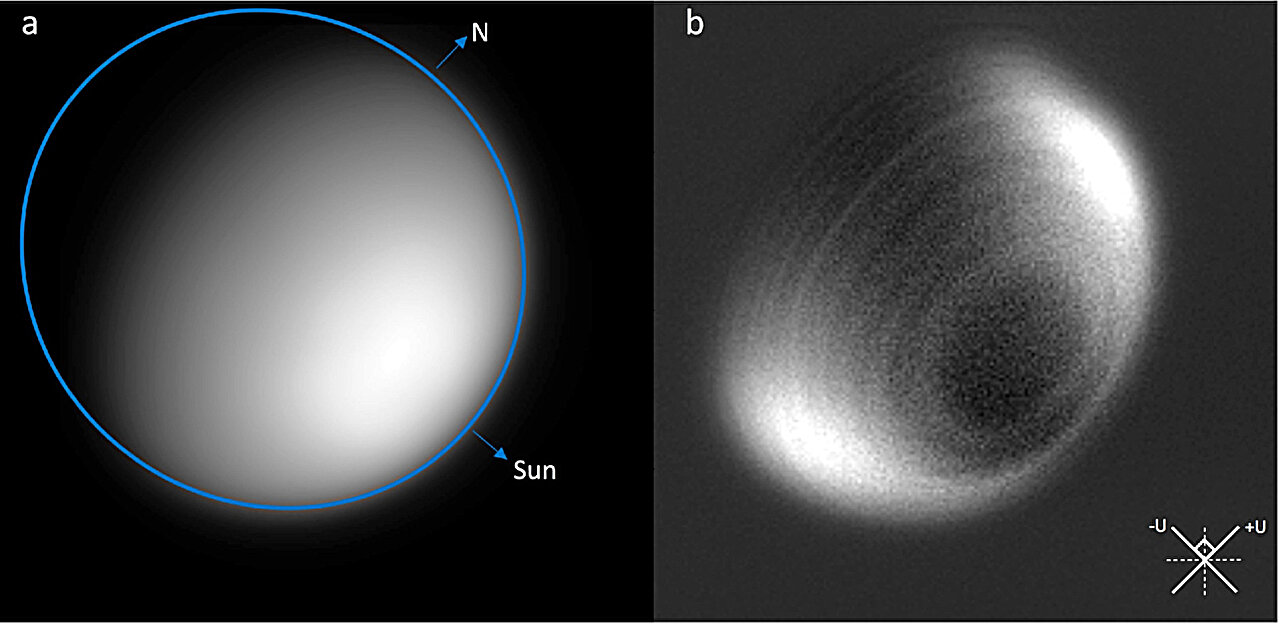
More than a decade later, researchers from the Netherlands decided to revisit the old observations. What they found hidden in the data revealed a series of faint, planet-scale concentric rings in the upper atmosphere. According to phys.org, their findings were published in an article in The Planetary Science Journal.
The team analyzed images obtained with ExPo, an ultrasensitive instrument designed to measure polarized light. They compared ordinary images with polarized photographs taken through several visible-light filters, searching for patterns that might reveal hidden atmospheric features.
They detected a faint ring-shaped pattern in three observations. The rings were completely invisible in ordinary images but appeared when the researchers isolated the polarized light.
Giant Atmospheric Waves
But what caused the rings, and why were they there? To find answers, the research team conducted several computer simulations modeling how sunlight scatters through the layer of gas above Venus’s clouds. These virtual models allowed scientists to test how different atmospheric conditions alter the light. The calculations showed that small changes in gas density of 5–10% produce ring-shaped patterns matching those seen in the data.
Unusual Observations
Based on these results, the authors suggest that these density fluctuations are enormous atmospheric waves. In particular, they may be giant planet-wide atmospheric gravity waves—a type of wave that creates undulating patterns in layers of gas, similar to waves on the surface of water.
Although the rings were observed directly, the atmospheric waves were inferred from the data. The team therefore emphasizes that its work represents the identification of a candidate phenomenon rather than confirmation of a new Venusian event. Since the ExPo instrument has been dismantled, the archival observations remain the only available dataset. As the researchers wrote: “We are therefore cautious in claiming the detection of a new atmospheric phenomenon on Venus.”
