

South Korea’s Danuri lunar orbiter has captured the first images of the site where the upper stage of a Falcon 9 rocket crashed into the Moon. A series of eight imaging sessions carried out immediately after the impact on August 5, 2026, at around 09:34 Kyiv time revealed a fresh crater and dark traces of ejected rock and dust around it. This is the first time the aftermath of an unplanne
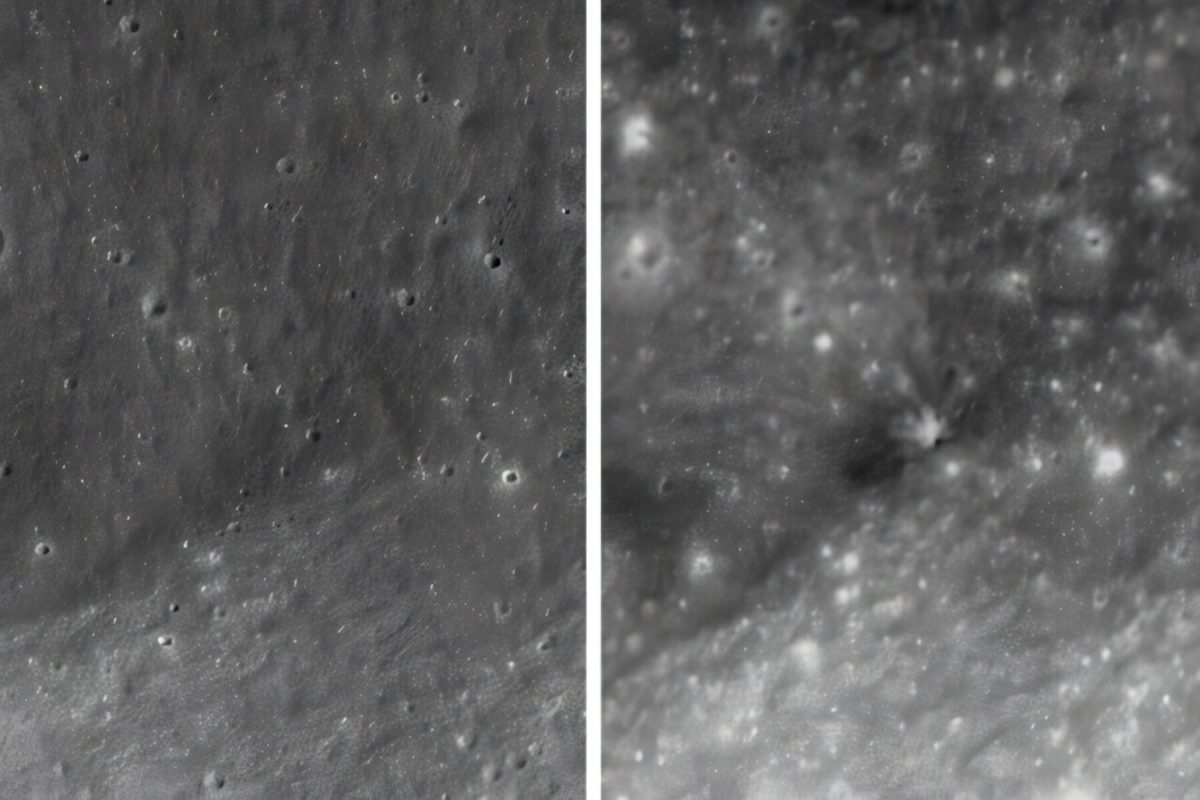
First Look at the Impact Site
The images were released by the Korea Aerospace Research Institute (KARI) on August 6. Danuri began observations about 30 minutes before the collision and, thanks to an orbital adjustment, passed over the predicted impact point several times. The result was eight imaging sessions.
The before-and-after images made it possible to identify terrain changes caused specifically by the collision. The images show darkening of the surface at the impact site and traces of scattered material. According to preliminary estimates, the crater itself is up to 27 meters across.
How the Uncontrolled Stage Ended Up on a Collision Course with the Moon
The Falcon 9 upper stage, weighing about 4,000 kilograms, was launched from Cape Canaveral on January 15, 2025. It carried two private lunar landers. Firefly Aerospace’s Blue Ghost successfully landed on the Moon on March 2 of that year, while ispace’s Resilience crashed during its landing attempt.
After completing the mission, the stage remained in an elongated Earth orbit because it did not have enough fuel for a controlled deorbit. Over nearly 19 months, solar activity and gravitational forces gradually altered its trajectory. Eventually, a collision with the Moon became unavoidable.
What the Danuri Images Offer Scientists
Scientists have obtained a rare dataset. Images of the same area before and immediately after the impact make it possible to distinguish changes caused solely by the collision from the natural terrain. This turns the uncontrolled crash into an improvised experiment with an ideal control point.
During planned impacts, such as the crashes of Saturn V stages during the Apollo program, such detailed comparative observations were not carried out. Next week, the Lunar Reconnaissance Orbiter will join the investigation and conduct its own imaging of the impact site. The resulting data will be combined for joint analysis, KARI said.
Rocket Debris on the Lunar Surface
This is not the first time human-made hardware has crashed onto the Moon. In March 2022, the third stage of a Chinese Long March 3C rocket left a double crater with a total length of about 29 meters near Hertzsprung Crater, Space.com reports. In that case, images were obtained only after a significant delay.
Danuri’s rapid response this time demonstrates that cislunar space is becoming increasingly populated with observational instruments. At the same time, concern about contamination of the Moon with debris is also growing.
Every new case of an uncontrolled object striking the lunar surface adds weight to calls for stricter disposal rules for spent rocket stages used in missions beyond low Earth orbit. Future lunar bases and scientific stations will require guarantees of safety from accidental impacts.
